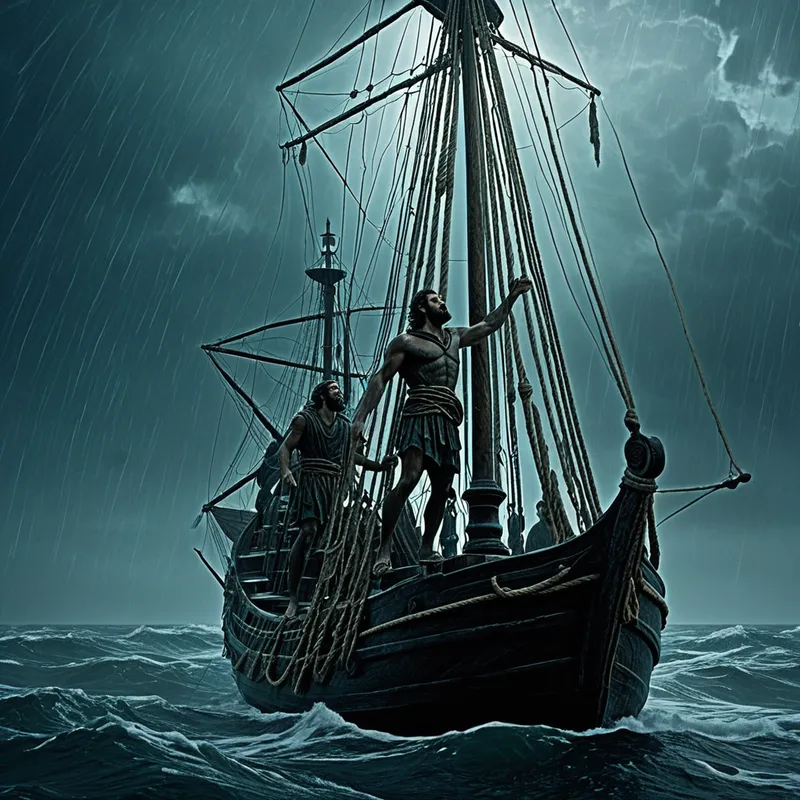
Odysseus' Voyage Myth Meaning & Symbolism
A warrior's decade-long, divinely-tormented voyage home becomes the ultimate metaphor for the perilous journey of the self back to its own center.
The Tale of Odysseus’ Voyage
Hear now the song of a man who was lost, not in wilderness, but in the wine-dark sea of his own destiny. His name was [Odysseus](/myths/odysseus “Myth from Greek culture.”/), sacker of cities, and his heart was a [lodestone](/myths/lodestone “Myth from Greek culture.”/) pulling only toward Ithaca. But the gods had woven a different thread. For offending the mighty [Poseidon](/myths/poseidon “Myth from Greek culture.”/), his return from the ashes of Troy became a decade of wandering, a canvas for divine wrath and human cunning.
His fleet, once proud, was dashed by Poseidon’s tempest upon strange shores. First, the gentle oblivion of the [Lotus-Eaters](/myths/lotus-eaters “Myth from Greek culture.”/), where his men dreamed of no home but the flower. He dragged them back to the ships, their mouths still sweet with loss. Then, to [the cave](/myths/the-cave “Myth from Platonic culture.”/) of the Cyclops [Polyphemus](/myths/polyphemus “Myth from Greek culture.”/), a mountain of hunger who devoured men whole. In the reek of that cavern, under the gaze of a single, pitiless eye, Odysseus devised his escape: a sharpened stake, a false name—“Nobody”—and a drunken giant blinded, bellowing to a father who would hear. This was the crime that salted [the sea](/myths/the-sea “Myth from Greek culture.”/) with Poseidon’s fury.
The winds themselves were given to him in a bag by Aeolus, a gift his suspicious crew untied, unleashing a gale that blew them back to despair. They sailed past the cannibal Laestrygonians, whose jagged harbor became a graveyard for all but one ship. On the isle of Circe, men were transformed into grunting beasts, their humanity dissolved by a witch’s brew. Only Odysseus, armed with the protective herb Moly, could confront her and win back their forms.
Guided by Circe, he then ventured to the very edge of [the world](/myths/the-world “Myth from Tarot culture.”/), to the dank [Underworld](/myths/underworld “Myth from Greek culture.”/). There, in the whispering gloom, he poured libations to shades and spoke with the prophet [Tiresias](/myths/tiresias “Myth from Greek culture.”/), who warned of the trials to come: the wrath of Poseidon, the sacred cattle of the sun, and the final challenge of reclaiming his home.
Past the singing [Sirens](/myths/sirens “Myth from Greek culture.”/), he had himself bound to the mast, his body taut with the ache of their forbidden knowledge. Between the monstrous [Scylla](/myths/scylla “Myth from Greek culture.”/) and the whirlpool Charybdis, he chose the lesser horror, losing six men to snapping jaws. Exhausted, they landed on Thrinacia. Hunger overcame fear; his men slaughtered the sacred cattle of [Helios](/myths/helios “Myth from Greek culture.”/). For this final sacrilege, Zeus himself shattered their ship with a thunderbolt. Odysseus alone survived, clinging to wreckage.
For seven years, he was captive-lover to the nymph Calypso, in a gilded prison of immortality and forgetfulness. Only by the command of the gods was he released to build a raft and face Poseidon’s final, crushing wave. Washed up, naked and salt-crusted, on the shores of Scheria, he was found by the princess Nausicaa. There, in the court of the Phaeacians, he told his tale—this tale—and wept. Moved, they gave him a ship that sailed as if on thought, delivering him at last, in deep sleep, to the hidden cove of Ithaca.
But the voyage was not over. Home was a fortress occupied by greedy suitors. The hero entered disguised as a beggar, his true form hidden in rags and scars. In his own hall, he endured insults, bided his time, and with his son [Telemachus](/myths/telemachus “Myth from Global/Universal culture.”/) and a few loyal servants, enacted a terrible, cleansing violence. The bow that only he could string sang once more, and arrows found their marks. Only when the last suitor fell, and he stood reunited with his ever-faithful [Penelope](/myths/penelope “Myth from Greek culture.”/), did the long voyage truly end. [The wanderer](/myths/the-wanderer “Myth from Taoist culture.”/) was home, and the king was restored.

Cultural Origins & Context
This epic, known as the Odyssey, is attributed to the blind poet [Homer](/myths/homer “Myth from Greek culture.”/), and was composed in the 8th century BCE, though its roots stretch back into an oral tradition of Mycenaean bards. It was not mere entertainment but a foundational narrative for the Greek world. Performed at festivals, in the courts of aristocrats, and around communal fires, it was a vehicle for cultural values: [xenia](/myths/xenia “Myth from Greek culture.”/) (the sacred duty of hospitality), cunning intelligence ([metis](/myths/metis “Myth from Greek culture.”/)), piety, and the paramount importance of home (nostos).
The society that cherished this tale was one of seafaring city-states, where journeying was fraught with real peril—pirates, storms, and unknown shores. Odysseus’ voyage externalized these collective anxieties while providing a model of resilience. The poem also served as a bridge between the heroic, martial age of the Iliad and the domestic, political realities of the emerging polis. It asked: What does a hero do when the war is over? How does he reintegrate? The Odyssey was the answer—a manual for navigating the sea of peace, which could be more treacherous than war.
Symbolic Architecture
At its core, the myth is not a travelogue but a profound map of the [psyche](/myths/psyche “Myth from Greek culture.”/)’s [journey](/symbols/journey “Symbol: A journey in dreams typically signifies adventure, growth, or a significant life transition.”/) toward [integration](/symbols/integration “Symbol: The process of unifying disparate parts of the self or experience into a cohesive whole, often representing psychological wholeness or resolution of internal conflict.”/). Ithaca is not just a physical [kingdom](/symbols/kingdom “Symbol: A kingdom symbolizes authority, belonging, and a sense of identity within a larger context or community.”/); it is [the Self](/myths/the-self “Myth from Jungian culture.”/), the center of one’s [identity](/symbols/identity “Symbol: Identity represents the sense of self, encompassing personal beliefs, cultural background, and social roles.”/) from which one can be exiled by [trauma](/symbols/trauma “Symbol: A deeply distressing or disturbing experience that overwhelms the psyche, often manifesting in dreams as unresolved emotional wounds or psychological injury.”/), ambition, or [fate](/symbols/fate “Symbol: Fate represents the belief in predetermined outcomes, suggesting that some aspects of life are beyond human control.”/).
The voyage is the necessary dissolution of the heroic ego forged in war. To return as a true king, Odysseus must be stripped of every trophy, every ship, every companion. He must become “Nobody” to become somebody whole.
Each [monster](/symbols/monster “Symbol: Monsters in dreams often symbolize fears, anxieties, or challenges that feel overwhelming.”/) and deity represents a psychic force. The [Lotus](/myths/lotus “Myth from Hindu culture.”/) is the allure of numbing escape, of abandoning one’s [purpose](/symbols/purpose “Symbol: Purpose signifies direction, meaning, and intention in life, often reflecting personal ambitions and core values.”/) for comfortable oblivion. The [Cyclops](/symbols/cyclops “Symbol: The cyclops represents the themes of isolation, raw power, and the struggle against monstrous aspects of oneself.”/) symbolizes brutish, unconscious instinct—the devouring, singular [perspective](/symbols/perspective “Symbol: Perspective in dreams reflects one’s viewpoints, attitudes, and how one interprets experiences.”/) that recognizes no law or [guest](/symbols/guest “Symbol: A guest in a dream can symbolize new experiences, unexpected situations, or aspects of oneself that are being revealed.”/)-[friendship](/symbols/friendship “Symbol: A bond characterized by mutual affection and support, representing an essential aspect of human social interaction.”/). To blind it is to render the unconscious knowable, but at the cost of making its rage a permanent part of your weather.
Circe represents the transformative power of the [anima](/symbols/anima “Symbol: The feminine archetype within the male unconscious, representing soul, creativity, and connection to the inner world.”/), the feminine within, which can bestialize a man driven by pure [appetite](/symbols/appetite “Symbol: Represents desire, need, and consumption in physical, emotional, or spiritual realms. Often signals unmet needs or excessive cravings.”/), or, if rightly encountered (with the Moly of divine [insight](/symbols/insight “Symbol: A sudden, deep understanding of a complex situation or truth, often arriving unexpectedly and illuminating hidden connections.”/)), initiate him into deeper mysteries. The [Underworld](/symbols/underworld “Symbol: A symbolic journey into the unconscious, representing exploration of hidden aspects of self, transformation, or confronting repressed material.”/) is the inevitable confrontation with the past—with dead mentors, comrades, and one’s own [mother](/symbols/mother “Symbol: The symbol of ‘Mother’ represents nurturing, protection, and the foundational aspect of one’s emotional being, often associated with comfort and unconditional love.”/). One must converse with these ghosts to gain the wisdom to proceed.

The Dreamer’s Resonance
When this myth stirs in modern dreams, it often signals a profound process of re-orientation. The dreamer may find themselves on an endless road, in a maze of airport terminals, or on a ship with no land in sight. This is the somatic feeling of nostos—the aching pull toward a center that feels lost.
Dreams of being trapped (in a cave, on an island) mirror Calypso’s Isle: a situation, relationship, or state of mind that is comfortable but stagnant, offering a seductive, soul-numbing peace. Dreams of hearing beautiful, irresistible music from a dangerous source echo the Sirens—the call of a knowledge or desire that promises fulfillment but threatens to wreck one’s current life structure. The psychological process is one of navigating the tension between necessary exploration and the imperative of return, of discerning which calls lead to growth and which to dissolution.

Alchemical Translation
The alchemical work modeled by Odysseus’ voyage is the opus contra naturam—the work against one’s own fallen or dispersed nature. It is the process of Individuation.
The initial state is the hero identified with his [persona](/myths/persona “Myth from Greek culture.”/): “Odysseus, sacker of cities.” The war ends, and this identity is shattered (the [nigredo](/myths/nigredo “Myth from Alchemical culture.”/), the first darkening). The long voyage is the albedo, the whitening or purification, where all attachments (ships, crew, trophies) are sequentially dissolved by the sea of the unconscious. He is reduced to his core, naked on Scheria.
The final and most sacred trial is not the killing of suitors, but the wearing of the beggar’s disguise. The integrated Self must willingly humble its own grandeur, move unseen in its own kingdom, and see the world truly before it can rightfully claim its throne.
The return and re-conquest of Ithaca is the [rubedo](/myths/rubedo “Myth from Alchemical culture.”/), the reddening or culmination. But this is not a return to the old self. The man who strings the bow is a synthesis: the cunning of the wanderer, the patience of the beggar, the authority of the king, and the loyalty of the husband. He has metabolized his trials. The psychic transmutation is complete. [The ego](/myths/the-ego “Myth from Jungian culture.”/), once a lone warrior, has become the wise ruler of a reclaimed inner landscape, its borders secured not by walls, but by hard-won self-knowledge. The voyage never leaves you, but you become the steady land to which it always sought to return.
Associated Symbols
Explore related symbols from the CaleaDream lexicon: