
Odysseus' Journey Myth Meaning & Symbolism
A warrior's ten-year voyage home becomes a labyrinth of the soul, testing identity against monsters, gods, and the longing for Ithaca.
The Tale of Odysseus’ Journey
Hear now the tale of a man who sailed into the mouth of the world and returned, not as he left, but as he truly was. The war at Troy was done, its towers ash, its glory a memory. Odysseus, sacker of cities, turned his face toward home, toward rocky Ithaca, and his patient queen, Penelope. But the sea-god Poseidon</ab title=“God of the sea, earthquakes, and horses”>idon held a grudge, and the winds became his wrath.
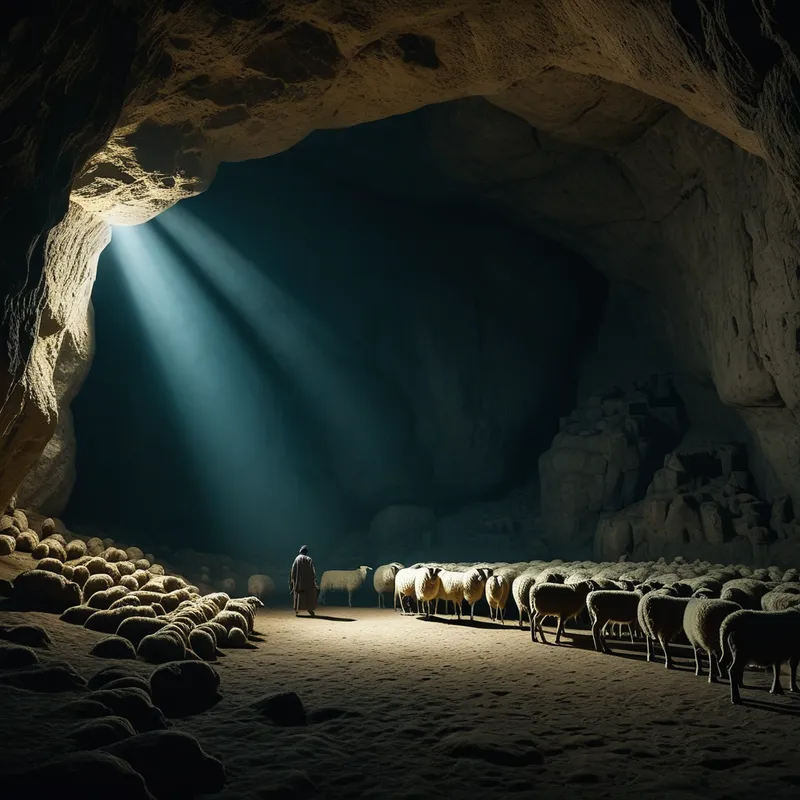
The first land was a sweet poison. The Lotus-Eaters offered fruit that dissolved memory, that made a man forget the pull of home, the taste of his own name. Odysseus dragged his weeping men back to the ships, their fingers stained with oblivion. Then came the island of the Cyclopes. In a cave smelling of wet stone and goats, they met Polyphemus, who devoured men whole. With a sharpened stake and a sharper lie—“My name is Nobody”—Odysseus blinded the beast. But as his ship fled, pride broke his silence. He shouted his true name to the waves, and Polyphemus’s curse to his father Poseidon echoed for ten long years.
They were blown to the edge of the world. Circe turned his crew to swine with a touch and a spell, their human minds trapped behind bristled hides. Only Odysseus, armed with the god Hermes’s herb, could withstand her. For a year, he lived as her lover in a perfumed hall, time itself unspooling. To go home, he had to descend. Into the dank, sunless land of the dead he went, to consult the shade of the blind prophet Tiresias. There, among the whispering dead, he learned the price of his journey: he would arrive home alone, a beggar in his own hall.
The path home was lined with impossible choices. Past the Sirens, whose song promised all knowledge, he had himself bound to the mast, his men’s ears stoppered with wax. He heard the blissful promise and the agony of being unable to reach it. Then the strait of Scylla and Charybdis: lose six men to the monster’s snapping jaws, or lose the entire ship to the sucking whirlpool. He chose the monster, his ears filled with the screams of his chosen companions.
Shipwrecked, soul-weary, he washed up on the island of the nymph Calypso, whose name means “she who hides.” For seven years, she offered him immortality and ageless love, a perfect, timeless paradise. But each night, he sat on the shore, staring at the empty horizon, his heart a compass needle fixed on Ithaca. His tears moved the gods. Released, he built a raft with his own hands and sailed into Poseidon’s final storm.
He crawled ashore, naked and unknown, in Scheria. There, in a king’s hall, he finally told his story. Moved by his trials, the Phaeacians gave him a ship and sent him home, asleep on a blanket of purple wool. He awoke on the familiar shore of Ithaca, but it was a stranger’s land. The goddess Athena disguised him as a beggar. In his own palace, suitors gorged on his wealth and plotted for his wife and throne. With the cold fire of a strategy forged in twenty years of suffering, he bided his time. The final test was not a monster, but a bow. In the great hall, the beggar alone could string the great bow of Odysseus. The twang of the string was the sound of a king returning. The battle was swift, terrible, and complete. Only then, in the quiet after the storm, did he reveal himself to Penelope, not with words, but with a secret known only to them: the immovable bedpost, carved from a living olive tree. The journey ended not with a shout, but with a recognition, in the quiet of their own chamber.
Cultural Origins & Context
This epic, the Odyssey, is attributed to the blind poet Homer, and was composed in the 8th century BCE, though its roots stretch back into an oral tradition centuries older. It was not a text to be read, but a performance to be heard. A rhapsode (a “song-stitcher”) would recite these verses, often at religious festivals or in the halls of the aristocracy, accompanied by a simple lyre. The rhythm of the dactylic hexameter was a mnemonic device, a river of sound carrying the story forward.
Its societal function was multifaceted. It was a foundational narrative for a culture defining itself post-Dark Ages, exploring themes of xenia (the sacred guest-host relationship), cunning intelligence (metis), and the tension between heroic glory (kleos) and domestic fidelity (nostos—the longing for home). It served as a map of the known and imagined Mediterranean, a repository of ethical dilemmas, and, crucially, a meditation on what it means to be a man, a king, and a husband after the world-shaking violence of war. It asked its audience: How do you come home when the war has changed you, and home itself may have moved on?
Symbolic Architecture
The journey of Odysseus is not a geographical trek but a descent into the architecture of the self. Each island is not a place, but a state of being, a psychic complex the ego must navigate.
The Lotus Island represents the temptation of psychic numbing, of forgetting one’s purpose and identity in the face of pain or ennui. Polyphemus’s cave is the brute, unconscious force of the untamed Self—the devouring aspect of nature (and our own nature) that must be outwitted, not confronted directly. His boast afterward symbolizes the inflation of the ego, the pride that calls down divine retribution and prolongs the struggle.
The journey to the Underworld is the non-negotiable descent into the unconscious. One cannot find the way forward without first consulting the ghosts of one’s past and the prophetic wisdom of the deep Self.
Circe embodies the transformative, often terrifying power of the anima—the feminine principle within the male psyche. She turns base instincts (the swine) into conscious problems that must be integrated through relationship (Odysseus’s year with her). The Sirens sing the siren call of inflation: the promise of omniscience, of transcending human limits, which leads only to psychic death on the rocks. Being bound to the mast is the ultimate act of conscious suffering—experiencing the pull of the complex without being destroyed by it. Calypso offers the final, most seductive temptation: eternal youth, a paradise without struggle or return. To refuse her is to choose mortal, imperfect, meaningful life over sterile perfection.
Ithaca itself is the symbol of the true center, the Self. But one cannot simply return to it; one must re-earn it, see it with new eyes, and cleanse it of the parasitic forces (the suitors) that have occupied it in one’s absence.

The Dreamer’s Resonance
When this myth stirs in the modern dreamer, it often signals a profound process of re-orientation. The psyche is navigating a protracted, confusing transition—a “long way home” after a life-altering event: the end of a career, a relationship, an identity.
Dreams of being lost at sea, of maps that keep changing, speak to the disorientation of this phase. A dream of being trapped in a cave or labyrinth points to the confrontation with a “cyclopean” complex—a monolithic, overwhelming problem that seems to have only one, terrifying perspective. Dream encounters with enchanting but dangerous figures (a captivating but toxic lover, a charismatic but draining leader) are visitations from Circe or the Sirens, revealing where one’s vital energy is being seduced and transformed against one’s will.
The somatic experience is one of profound fatigue mixed with restless urgency—the “Odysseus fatigue.” It is the body feeling the twenty-year weight of the journey, the deep cellular longing for rest and belonging, even as the mind knows there are more straits to sail, more disguises to wear. The dreamer is in the process of shedding old skins of identity, learning to move through the world with the strategic patience of the beggar-king, gathering the scattered parts of the self for a final, necessary reckoning.
Alchemical Translation
The alchemy of the Odyssey is the transmutation of the warrior into the integrated king. It is the opus of individuation, where the lead of a fragmented, war-torn identity is forged into the gold of a whole Self.
The initial state is nigredo—the blackening. This is the shipwreck, the loss of all companions, the naked arrival on Calypso’s or the Phaeacians’ shore. It is a total dissolution of the old persona (the “Great Hero of Troy”). The decade of trials is the albedo—the whitening, the purification through endless reflection and confrontation with shadow figures (monsters, gods, temptresses). Each victory is less about conquest and more about acquiring a piece of wisdom, a new facet of consciousness.
The final and most critical stage is the rubedo—the reddening. This is not the bloody battle with the suitors, but the quiet, fiery reunion with Penelope. It represents the sacred marriage (hieros gamos) of the conscious mind (Odysseus) with the anima, the soul-image that has remained faithful and discerning (Penelope). Their recognition scene is the fusion of the traveler’s hard-won wisdom with the soul’s enduring truth.
For the modern individual, this myth maps the path from being driven by the ego’s desires for glory, possession, and recognition, to being anchored in the Self. It teaches that the goal is not to avoid the journey, but to undertake it consciously. The monsters are not obstacles to be eradicated from the path, but guardians of the thresholds we must cross to become who we are. We are all called to leave our personal Troy, to be blown off course, to forget and remember our name, and to finally string the bow of our own authority in the hall of our own life. The true Ithaca is not a place we left, but a wholeness we must, through endless wandering, discover how to inhabit.
Associated Symbols
Explore related symbols from the CaleaDream lexicon: