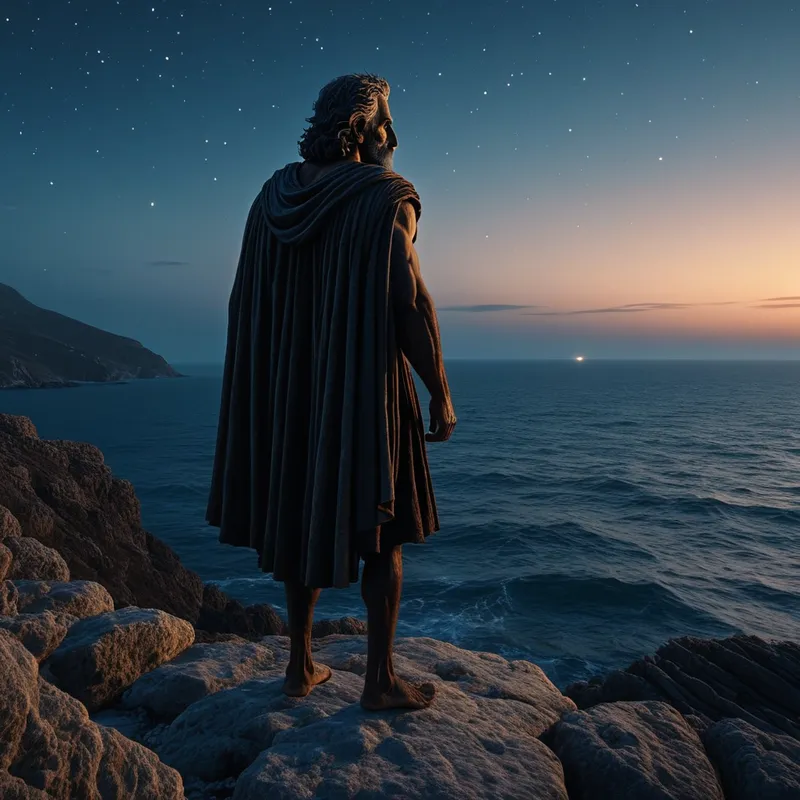
Odysseus gazing across the sea Myth Meaning & Symbolism
A hero, stranded on a distant shore, stares at the endless horizon, embodying the universal human ache for return and the self lost in the journey.
The Tale of Odysseus gazing across the sea
Hear now the tale of the man of twists and turns, not in the roar of battle, but in the terrible silence that comes after. The war-cry of Troy was a decade of memory, a ghost-echo in his ears. Now, he stood on the far shore of the world, a guest-prisoner of the nymph Calypso, whose name means “she who conceals.”
For seven years, Odysseus sat on the beach of Ogygia, a place of impossible, stifling beauty. Vines heavy with fruit offered themselves without labor. A cave, fragrant with cedar and thyme, provided perfect shelter. Calypso, deathless and fair, offered him the greatest seduction: immortality itself, an end to pain, toil, and the relentless pull of time. He would be her consort, forever young, forever at peace.
But each dawn, he walked the same path to the same rocky headland. He would turn his back on the lush interior, on the nymph’s persuasive song, and face the north and east. His eyes would scan the empty, heaving plane of the sea—the wine-dark sea that was both his prison and his only road. He did not see water. He saw the phantom outline of a rocky island, the smell of woodsmoke from his own hearth, the face of a woman growing older without him, the unsure smile of a son who left a boy.
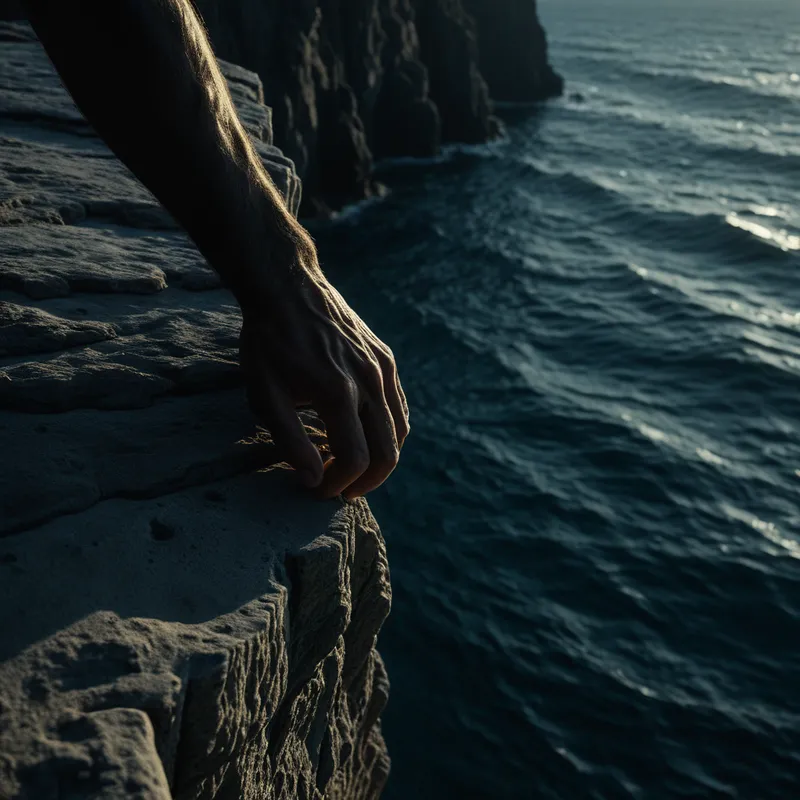
The conflict was not with monsters here, but with the landscape of his own soul. The rising action was the slow, daily ritual of his vigil. He felt the coarse grit of sandstone beneath his palms, the ceaseless wind carving lines beside his eyes that immortality would never smooth. He heard the crash and sigh of the waves—a sound like breathing, like the breath of home just beyond hearing. He tasted salt on his lips, indistinguishable from tears. The resolution was not an event, but a state of being: a profound, active ache, a longing so perfectly honed it became the core of his identity. He was not a man resting, but a man in perpetual, silent motion toward a point he could not see. He was the gaze across the sea.
Cultural Origins & Context
This crystalline moment of exile is drawn from the heart of the Odyssey, composed in the 8th century BCE but rooted in an older, oral tradition. It belongs to the “Global/Universal” category not by literal omnipresence, but because it articulates a human condition that transcends its specific Greek vessel. The bards, or rhapsodes, who sang this tale, were not merely entertainers; they were custodians of memory, identity, and psychological truth for a culture navigating its own expansion and dislocation.
Societally, the Odyssey functioned as a narrative anchor. For a maritime people whose sons and husbands were often lost to the sea—to trade, war, or misadventure—the story of Odysseus validated the agony of those left waiting and the relentless drive of those trying to return. It gave a heroic shape to the domestic yearning that underpinned the Greek world. The myth was passed down in communal feasts, a shared dream in hexameter verse that asked: What is a self, if not that which strives to return to its own context? What is home, if not the place where your story makes sense?
Symbolic Architecture
Odysseus on the shore is the archetypal image of the ego in exile. The sea is the collective unconscious—vast, unknown, and full of both peril and potential. Ithaca is the conscious self, the integrated personality, or in Jungian terms, the Self. Calypso’s offer of immortality represents the temptation of psychic stasis: to abandon the difficult journey of becoming in favor of a painless, eternal suspension in the unconscious (the island).
The gaze is not passive wishing; it is the active faculty of intentionality, the soul’s compass needle trembling toward its true north.
Odysseus’s refusal of divinity is the essential human choice. He chooses his mortal, aging, yearning self over a perfect, timeless non-self. The cliff’s edge is the liminal space between worlds, the ego’s precarious perch where it holds the tension between the known (the island prison) and the unknown-remembered (the distant home). His seven-year vigil symbolizes the necessary period of incubation, where the will to return is tempered and solidified in absence, much as metal is hardened.

The Dreamer’s Resonance
When this myth appears in modern dreams, the dreamer is often psychologically “stranded.” They may dream of standing on a shoreline, airport tarmac, or empty road, looking toward a horizon that promises home, reunion, or purpose, but feeling utterly unable to move. The somatic feeling is one of profound weight, of being magnetically pulled forward yet physically anchored.
This dream pattern signals a crucial phase in what Robert Johnson called “the incubation of the will.” The conscious ego has achieved something—survived a “war” (a career change, a divorce, an illness)—but has subsequently become stuck in a comforting yet soul-numbing situation (a sterile job, a safe but passionless relationship, a period of depression). The dream is not about inaction, but about the intense, focused gathering of intention. The dreamer is, like Odysseus, building the psychic charge necessary to reject the “immortality” of their current stagnation and petition the gods (the deeper Self) for the means to journey again. The tears in the dream are not of despair, but of liquefaction, the ego dissolving its rigid structures in the salt of longing to prepare for a new form.

Alchemical Translation
The alchemical process mirrored here is solutio—dissolution—but of a specific kind. It is not the chaotic drowning in the unconscious, but the deliberate washing of the ego in the waters of memory and desire until only the essential, irreducible core remains. Odysseus’s gaze performs this operation. By holding the image of Ithaca steadfastly in his mind’s eye while immersed in the sensory reality of exile, he separates the pure gold of his true aim from the alloy of comforting illusions.
The journey home is the individuation path, and the first, most critical step is not building a raft, but sustaining the gaze that makes the raft necessary.
For the modern individual, the “alchemical translation” is the transmutation of passive longing into active nostos (the Greek word for homecoming, the root of nostalgia). It begins by identifying our personal “Ogygia”—what comfortable prison have we accepted in exchange for ceasing our struggle? The next step is the daily, ritualistic “gazing across the sea”: the conscious, painful recollection of our authentic destination, whether that is a creative calling, a healed relationship, or a more integrated way of being. This sustained focus generates immense psychic tension. That tension, in time, will attract its own “Hermes”—the divine messenger (an insight, a synchronicity, an offer) that arrives to say the gods have decreed our release. The raft we build from our grief-stained timbers may be fragile, but it is oriented by a pole star forged in the fires of unwavering sight. We become, at last, the captain of our own return.
Associated Symbols
Explore related symbols from the CaleaDream lexicon: