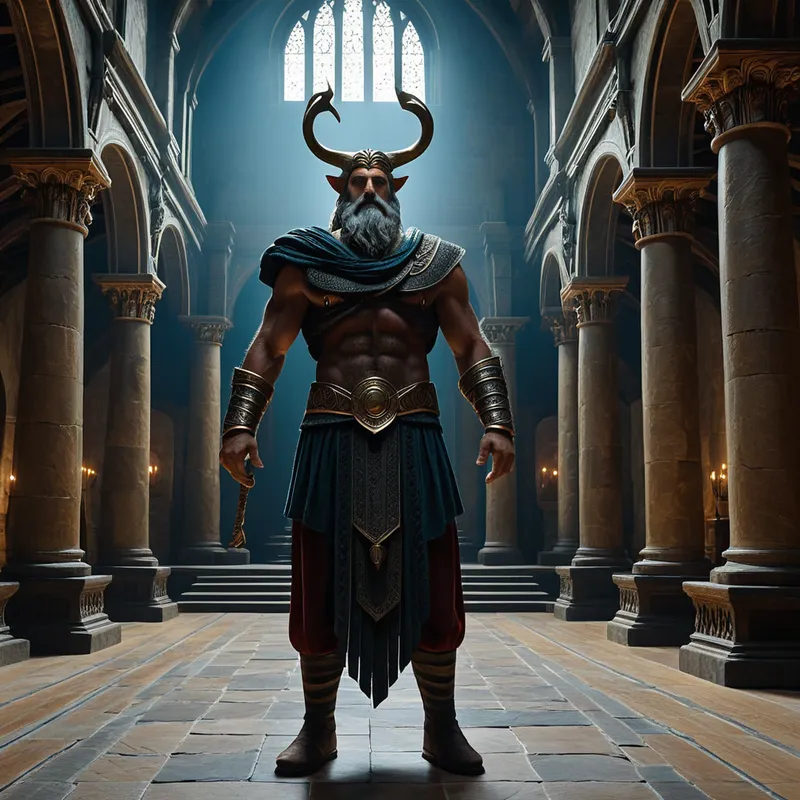
Odysseus' Bow Myth Meaning & Symbolism
The hero's unstrung bow, a symbol of latent power, becomes the ultimate test to reclaim his home, identity, and kingship from usurping chaos.
The Tale of Odysseus’ Bow
Hear now of the final trial, the test that parted shadow from substance in the hall of [Odysseus](/myths/odysseus “Myth from Greek culture.”/). For twenty years, his home, the rocky isle of Ithaca, had been a palace of ghosts and pretenders. His queen, [Penelope](/myths/penelope “Myth from Greek culture.”/), besieged by a hundred arrogant lords who feasted on his wealth and plotted for his throne, wove a shroud of cunning by day and unraveled it by night, a fragile thread holding chaos at bay.
The air in the great hall was thick with the smell of roasting meat, spilled wine, and arrogance. The suitors, sleek and loud, played at dice, their laughter a mockery of order. Into this den of wolves came a stranger—a beggar, broken by time and tide, his eyes holding the grey of distant seas. It was Odysseus, returned in disguise, a soul wearing the rags of its own suffering. He watched as the parasites devoured his legacy.
Then Athena, she who loves the cunning mind, stirred the queen’s heart. Penelope descended, holding the fate of the kingdom in her hands. She brought forth the great bow of Odysseus—a weapon of terrible beauty, a gift from the hero Iphitus. Crafted of polished horn and wood, it had lain unstrung for two decades, a sleeping dragon in the armory. “He who can string this bow,” she declared, her voice a calm blade in the tumult, “and shoot an arrow through the sockets of twelve axe-heads lined in a row… him shall I wed.”
One by one, the proud suitors tried. They warmed the bow by the fire, rubbed it with grease, their soft hands straining against the immutable curve. Muscles bulged, faces purpled with effort, but the bow remained a cold, unbending arc of refusal. It mocked them. It was not a test of brute strength, but of a covenant. The bow knew its master.
Then the beggar spoke. “Let me try, lords. Let me feel the weight of this great bow, if only to know my weakness.” Mockery rained down upon him. But with a patience forged in [the underworld](/myths/the-underworld “Myth from Greek culture.”/) and on Circe’s isle, he took it. His hands, scarred by oar and rope, knew the grain. He examined it like a shepherd checking his flock, turning it in the firelight, testing for wormholes in the horn—a gesture of intimate, rightful ownership. Then, with a motion as fluid as a remembered song, he planted one end on the ground, bent the other, and slipped the gut string into its notch. A deep thrum resonated through the hall, a note that silenced [the world](/myths/the-world “Myth from Tarot culture.”/).
He took an arrow from the quiver, nocked it, and drew the string to his cheek—a posture his body had never forgotten. In that moment, the rags fell away. The beggar was gone. There stood the king, the archer, the man who had sailed the wine-dark sea. He let the arrow fly. It hissed through the air, a shaft of pure intention, and passed clean through all twelve axe-rings, a thread of [justice](/myths/justice “Myth from Tarot culture.”/) through the eye of chaos. The trial was over. The true king had announced his return not with a shout, but with the singing of his own bow.
Cultural Origins & Context
This pivotal scene is the climax of the Odyssey, an epic composed in the 8th century BCE and attributed to [the bard](/myths/the-bard “Myth from Celtic culture.”/) [Homer](/myths/homer “Myth from Greek culture.”/). It was not mere literature but a foundational cultural text, performed orally at feasts and festivals. The story of the bow functioned as societal bedrock. In a world where guest-friendship ([xenia](/myths/xenia “Myth from Greek culture.”/)) was sacred law, the suitors’ violation was the ultimate social crime. Their defeat was not just a personal victory but the restoration of cosmic and social order.
The bow itself is a potent symbol from an older, perhaps Mycenaean, stratum of heroism. It is a weapon of [the hunter](/myths/the-hunter “Myth from African culture.”/) and the warrior-king, requiring skill and finesse over brute force, aligning with Odysseus’ defining trait: [metis](/myths/metis “Myth from Greek culture.”/), or cunning intelligence. The contest served as a public, ritualized demonstration of legitimate kingship. Only the true sovereign, whose identity is intertwined with his rightful tool, could perform the act. It was a tale told to reinforce the values of loyalty, intelligence, rightful rule, and the belief that identity, though tested and disguised, is an indestructible core.
Symbolic Architecture
The bow is the central [symbol](/symbols/symbol “Symbol: A symbol can represent an idea, concept, or belief, serving as a powerful tool for communication and understanding.”/), an object dense with meaning. It is not merely a [weapon](/symbols/weapon “Symbol: A weapon in dreams often symbolizes power, aggression, and the need for protection or defense.”/), but the arc of [the self](/myths/the-self “Myth from Jungian culture.”/).
The unstrung bow is the latent psyche, the potential for action and identity held in reserve, waiting for the conscious ego to reunite with its source of power.
Its unstrung state represents Odysseus’ twenty-[year](/symbols/year “Symbol: A unit of time measuring cycles, growth, and passage. Represents life stages, progress, and mortality.”/) liminality—his disguised [identity](/symbols/identity “Symbol: Identity represents the sense of self, encompassing personal beliefs, cultural background, and social roles.”/), his suppressed kingship, his [soul](/symbols/soul “Symbol: The soul represents the essence of a person, encompassing their spirit, identity, and connection to the universe.”/) in [exile](/symbols/exile “Symbol: Forced separation from one’s homeland or community, representing loss of belonging, punishment, or profound isolation.”/). The suitors, who represent chaotic, consumptive impulses (greed, lust, entitlement), cannot activate it. They are the parts of the [psyche](/myths/psyche “Myth from Greek culture.”/) that seek to possess the trappings of the Self (the [throne](/symbols/throne “Symbol: A seat of authority, power, and sovereignty, representing leadership, divine right, or social hierarchy.”/), the [queen](/symbols/queen “Symbol: A queen represents authority, power, nurturing, and femininity, often embodying leadership and responsibility.”/), the [wealth](/symbols/wealth “Symbol: Wealth in dreams often represents abundance, security, or inner resources, but can also symbolize burdens, anxieties, or moral/spiritual values.”/)) without having undergone the necessary trials to integrate it.
Stringing the bow is the ultimate act of psychic [integration](/symbols/integration “Symbol: The process of unifying disparate parts of the self or experience into a cohesive whole, often representing psychological wholeness or resolution of internal conflict.”/). It is the [moment](/symbols/moment “Symbol: The symbol of a ‘moment’ embodies the significance of transient experiences that encapsulate emotional depth or pivotal transformations in life.”/) where the endured suffering (the scars, the wisdom), the core identity (the [king](/symbols/king “Symbol: A symbol of ultimate authority, leadership, and societal order, often representing the dreamer’s inner power or external control figures.”/)), and the [instrument](/symbols/instrument “Symbol: An instrument symbolizes creativity, communication, and the means by which one expresses oneself or influences the world.”/) of [destiny](/symbols/destiny “Symbol: A predetermined course of events or ultimate purpose, often linked to spiritual forces or cosmic order, representing life’s inherent direction.”/) (the bow) are brought into perfect, effortless alignment. The [arrow](/symbols/arrow “Symbol: An arrow often symbolizes direction, purpose, and the pursuit of goals, representing both the journey and the destination.”/) shot through the axes is focused [consciousness](/symbols/consciousness “Symbol: Consciousness represents the state of awareness and perception, encompassing thoughts, feelings, and experiences.”/) piercing through a [series](/symbols/series “Symbol: A series in dreams can represent continuity, progression in life events, or the need for routine.”/) of obstacles or false choices, achieving a goal with unimpeachable [accuracy](/symbols/accuracy “Symbol: A measure of correctness, precision, or truthfulness in thought, action, or representation.”/). It is the decisive [action](/symbols/action “Symbol: Action in dreams represents the drive for agency, motivation, and the ability to take control of situations in waking life.”/) that ends inner debate and outer usurpation.
The Dreamer’s Resonance
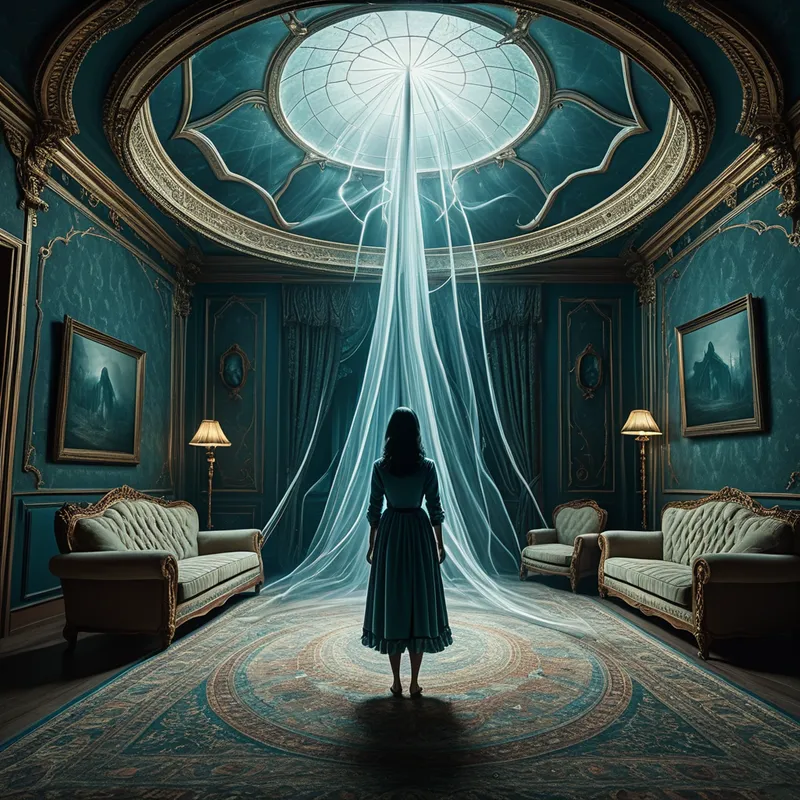
When this myth stirs in the modern dreamscape, it often manifests as a dream of a crucial, impossible test. You may dream of being in your own home, yet it is occupied by strangers or hostile figures. A task is set before you—often involving a familiar yet alien object, like a musical instrument you cannot play or a tool you cannot operate. The feeling is one of profound frustration and exposure.
Somatically, this mirrors a state of disempowerment and dis-identification. You feel “unstrung”—your energy scattered, your will diffuse, unable to marshal your resources to meet a life challenge. The mocking suitors are internal: voices of self-doubt, imposter syndrome, or the accumulated pressures of external expectations that have taken up residence in your psychic house. The dream is signaling a critical point of reckoning. The psyche is presenting the test of reclaiming your authentic authority. The anxiety arises because you, like Odysseus in his beggar’s disguise, have forgotten your own strength.
Alchemical Translation
The alchemical process modeled here is the reunification of the sovereign self. The long journey (the [nigredo](/myths/nigredo “Myth from Alchemical culture.”/) or blackening of suffering and dissolution) is over. The hero has returned, but in a base, unrecognizable form. [The great work](/myths/the-great-work “Myth from Alchemical culture.”/) now is the final transmutation.
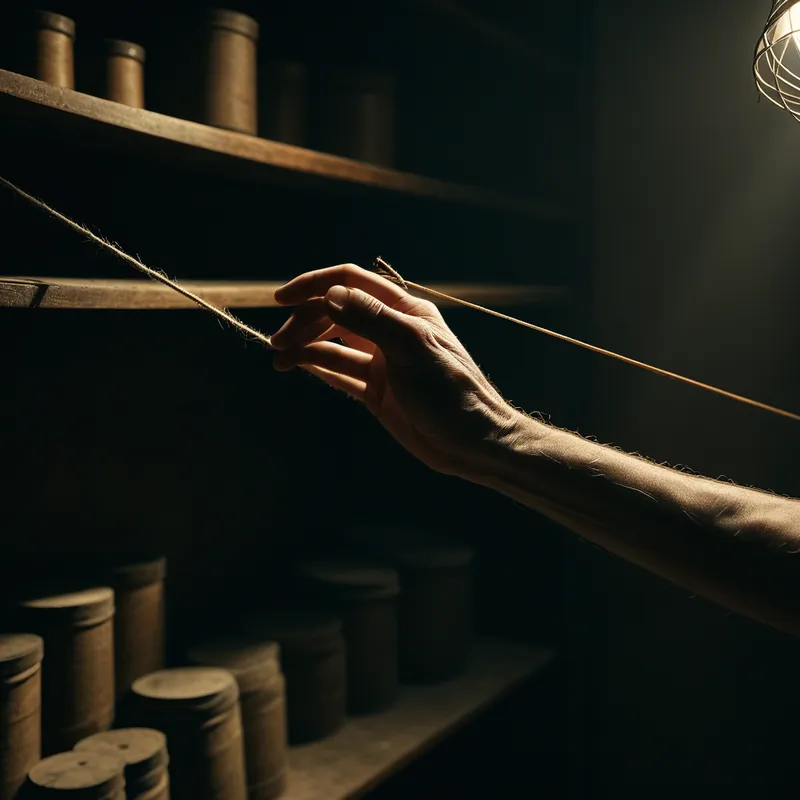
The storeroom where the bow is kept is the unconscious. To retrieve it, one must descend into the memory of who one truly was before the world broke upon them.
Stringing the bow is the [rubedo](/myths/rubedo “Myth from Alchemical culture.”/), the reddening, the moment of glorious, conscious integration. It requires three things: Recognition (touching and examining the bow, acknowledging your own latent power), Alignment (planting one end in the grounded reality of your experience), and Connection (joining the tension between who you are and who you must become).
For the modern individual, this is the process of individuation at a point of culmination. It is the executive act of the Self. It is quitting the soul-destroying job to start the true work. It is setting the final, non-negotiable boundary. It is speaking your truth after a long silence. It is the moment you stop trying to prove yourself to the internalized suitors and simply, effortlessly, perform the act that only you can do. The bow’s song is the sound of the psyche snapping back into its rightful shape, announcing that [the wanderer](/myths/the-wanderer “Myth from Taoist culture.”/) is home, the beggar is king, and chaos’s lease has expired.
Associated Symbols
Explore related symbols from the CaleaDream lexicon: