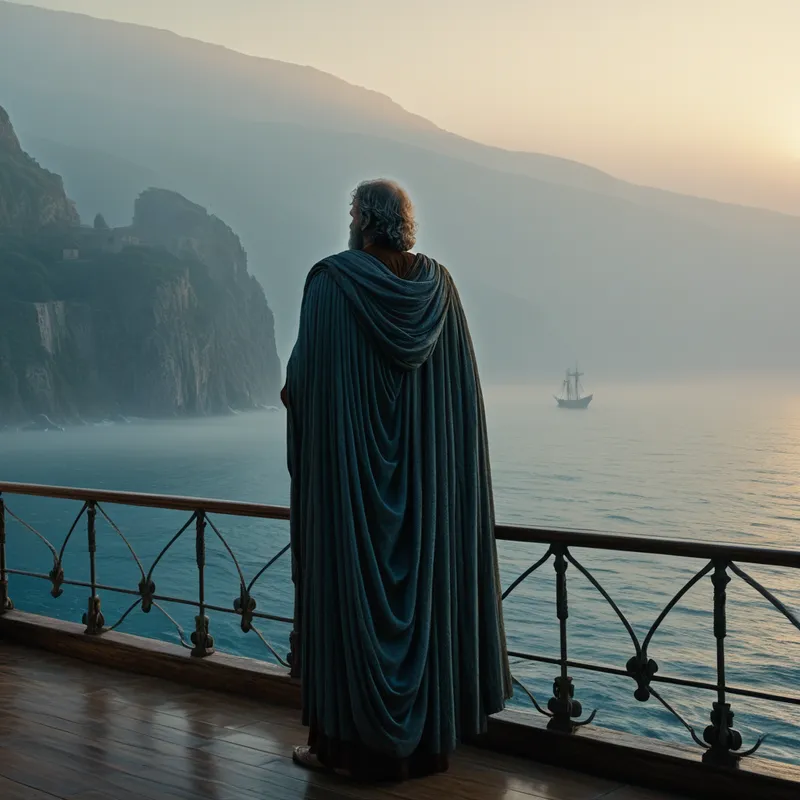
Odysseus and Penelope Myth Meaning & Symbolism
A king's twenty-year voyage home, a queen's cunning fidelity, and the final trial of a marriage that is both a kingdom and a soul.
The Tale of Odysseus and Penelope
Hear now the tale of the long road and the steadfast heart, a story woven on the loom of fate and unraveled by the cunning of mortals. The war at Troy was done, its ashes scattered to the wind that now filled the sails of homeward-bound kings. But for Odysseus, favored by the grey-eyed goddess Athena and cursed by the wrath of Poseidon, the journey was just beginning.
For ten years he wandered the wine-dark sea, a ghost in his own life. He stared into the cyclopean eye of a monster and told it his name was Nobody. He heard the haunting song of the Sirens, bound to his ship’s mast, his soul straining against the ropes. He descended to the sunless halls of Hades to drink the black blood of prophecy. He was held captive in silken luxury by the nymph Calypso, who offered him immortality if he would forget his mortal home. But in his sleep, he heard the sigh of the Ithacan pines and the whisper of a single, patient thread.
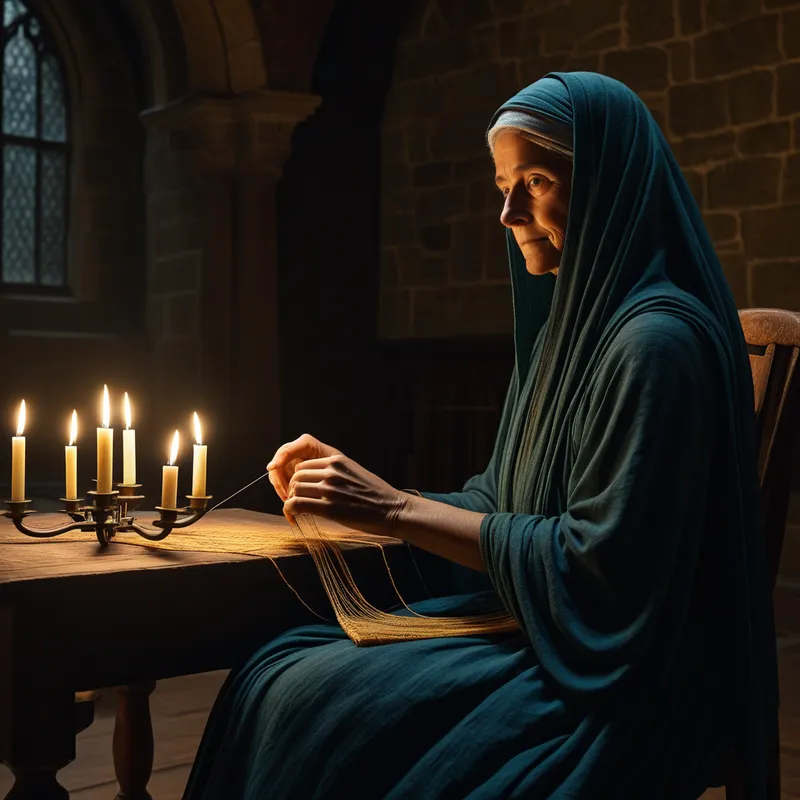
While he wandered, his kingdom festered. In the high halls of Ithaca, a plague of suitors descended—arrogant princes who gorged on his stores, drank his wine, and clamored for the hand of his queen, Penelope. They declared Odysseus dead, a feast for fish. But Penelope, her heart a citadel, devised a ruse as cunning as any of her husband’s. “I will choose a husband,” she said, “when I finish weaving a funeral shroud for my lord’s father, Laertes.” By day, she wove the great loom in the hall’s light. By night, in secret, by the guttering light of a single lamp, she unraveled the day’s work. For three years, she held time itself at bay with this shuttle of deceit, weaving and unweaving hope.
But the suitors grew impatient. The threads of her ruse frayed. The gods, in council, decreed the wanderer’s return. Cast upon the shores of his own land, disguised by Athena as a ragged beggar, Odysseus entered his own hall. He endured the blows and taunts of the usurpers. Only his old nurse, touching a scar as she washed his feet, and his now-grown son, Telemachus, knew the truth that lay beneath the grime and rags.
The final test came. Penelope, pressed to the limit, brought forth the great bow of Odysseus. “He who can string this bow and shoot an arrow through the sockets of twelve axe-heads,” she declared, “shall have my hand.” The suitors heaved and strained, their soft hands failing. The beggar stepped forward. With ease born of a lifetime of trials, he strung the bow. The song of the taut string was the sound of a kingdom snapping back into place. Then he turned, and the arrows began to fly, a terrible harvest in his own hall, with Telemachus and two loyal herdsmen beside him. The usurpers fell.
The hall fell silent, reeking of iron and justice. But one final trial remained. The queen, confronted with the blood-spattered stranger who claimed to be her husband, tested him. She ordered their marriage bed—a bed he had built himself around the living trunk of a great olive tree—to be moved. Odysseus roared with outrage, describing the immovable secret of its construction. At that, the walls around Penelope’s heart crumbled. The recognition was not of a face, but of a shared secret, the hidden root of their life together. After twenty years, the wanderer had truly returned, and the weaver could finally cease her unraveling.
Cultural Origins & Context
This epic of homecoming is the beating heart of Homer’s Odyssey, a foundational pillar of Western literature composed in the 8th or 7th century BCE. It emerged from an oral tradition, sung by bards (aoidoi) in the courts of the Greek Dark Ages and early Archaic period. The poem served as more than entertainment; it was a cultural database of values, geography, and social order.
In a society where the household (oikos) was the cornerstone of civilization, the myth dramatized its utmost peril and ultimate sanctity. Odysseus’s journey reaffirmed the Greek ideal of nostos (the difficult, glorious return home), while Penelope’s story presented a rarely celebrated female ideal: intelligence as a form of heroic endurance. Her fidelity was not passive waiting, but active, strategic governance in the face of chaos. The myth functioned as a societal anchor, reinforcing the virtues of cunning (metis), hospitality (xenia), and the unbreakable bond of the rightful royal family against the forces of disorder and greed.
Symbolic Architecture
At its core, the myth is a profound allegory of the psyche’s journey toward integration. Odysseus represents the conscious ego—the “I” that ventures into the world of experience, facing monsters, temptations, and the depths of the unconscious (his trip to the Underworld). His is the path of the explorer, whose trials are not just physical, but initiatory, stripping away his attachments to pride, haste, and even immortality itself.
The true destination of the hero’s journey is not a place on a map, but a state of recognition within the soul’s own hall.
Penelope embodies the anima—the inner feminine principle of connection, patience, and creative fidelity. Her loom is the world-making function of the psyche, weaving the patterns of meaning and relationship. Her nightly unraveling is not destruction, but the necessary deconstruction of false solutions and imposed timelines. She holds the center, preserving the psychic “kingdom” from being overrun by the chaotic, consumptive suitors—the shadow aspects of greed, entitlement, and disintegration.
Their reunion is the sacred marriage (hieros gamos) of the conscious and unconscious. The bed built around the living olive tree is the ultimate symbol: the rooted, indestructible center of the Self, known only to the two complementary parts of the whole psyche. The final test proves that the returning ego must know and honor this inner, living core, not just claim authority over it.

The Dreamer’s Resonance
When this myth stirs in modern dreams, it signals a profound process of psychic reintegration after a long period of struggle or alienation. To dream of endless, labyrinthine travel over strange seas is to feel the ego lost in the complexities of life, having survived many trials but not yet found its true bearing home.
To dream of weaving, or more potently, of unraveling a tapestry or project, mirrors Penelope’s vigil. It speaks to a somatic experience of holding space, of engaging in a creative act that is also a stalling tactic because the timing is not right. The dreamer may feel they are maintaining a fragile structure (a relationship, a career path, a sense of self) through deliberate, patient delay, buying time for a deeper truth to arrive. The suitors in dreams may appear as pressing obligations, draining people, or internal voices of doubt and impatience that demand a premature commitment or surrender.
The climactic dream of the “test of the bow”—attempting a task that requires one’s unique, almost forgotten strength—heralds a moment of readiness to reclaim one’s authority and identity, to act with decisive, focused will.

Alchemical Translation
The alchemical process mirrored here is the coniunctio oppositorum, the union of opposites, which is the goal of Jungian individuation. Odysseus undergoes the nigredo—the dissolution of his old heroic identity through suffering, loss, and descent. He is stripped to nothing, a beggar. Penelope, in her hall, endures the albedo—a long, lonely purification through steadfast focus and cunning, bleaching her intentions of all impurity.
The psyche’s journey is an odyssey toward the self, and its fidelity is a penelopean work of weaving meaning from the threads of time and trial.
The return and battle in the hall represent the rubedo, the fiery, often violent integration of the shadow (the suitors). One cannot simply return to the old home; the forces of chaos that have grown in one’s absence must be consciously and courageously confronted. The final, quiet recognition at the olive-wood bed is the citrinitas—the dawn of a new, conscious relationship with the Self. The wanderer is integrated with the weaver; the capacity for worldly experience is wedded to the capacity for inner, creative fidelity. The result is not just a restored kingdom, but a transformed, conscious individual, whose center is now known, rooted, and unshakable. The long war is over. The real marriage begins.
Associated Symbols
Explore related symbols from the CaleaDream lexicon: