
Odysseus Myth Meaning & Symbolism
The epic journey of a cunning hero navigating divine wrath, monstrous trials, and his own psyche to reclaim his home, throne, and true self.
The Tale of Odysseus
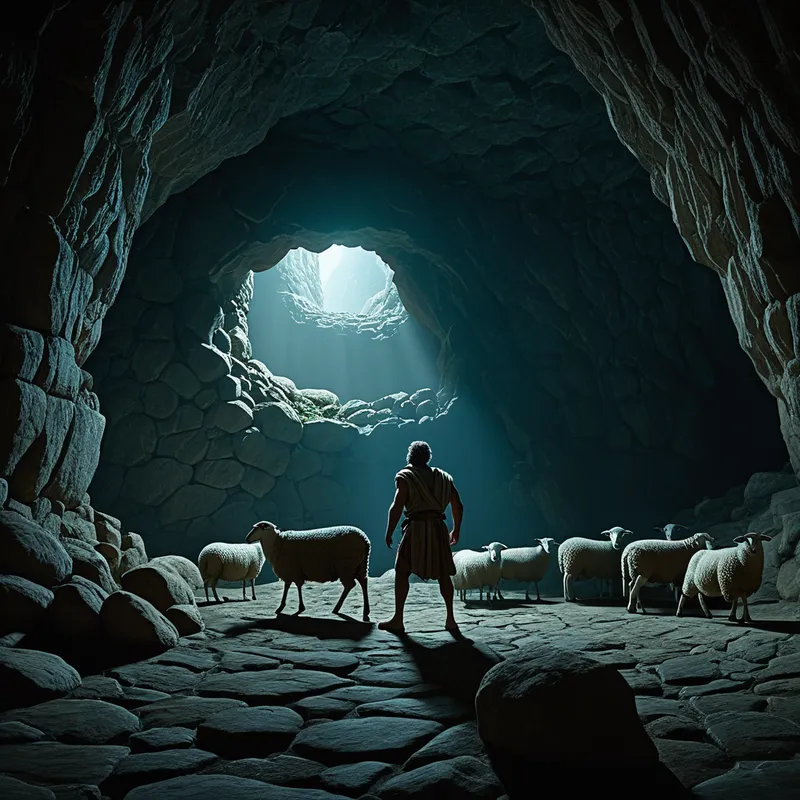
Hear now the song of the man of twists and turns, driven time and again off course, once he had plundered the hallowed heights of Troy. The wine-dark sea, beloved of [Poseidon](/myths/poseidon “Myth from Greek culture.”/), was not his friend. For the hero, Odysseus, had blinded the god’s son, the Cyclops [Polyphemus](/myths/polyphemus “Myth from Greek culture.”/), and for that, [the Earth](/myths/the-earth “Myth from Hindu culture.”/)-Shaker vowed he would wander, bereft of home and companions.
His fleet was shattered by wrathful winds. His men, their hearts undone by folly, were lost—some to the sweet, forgetful [lotus](/myths/lotus “Myth from Hindu culture.”/), others to the jagged rocks and ravenous maw of [the sea](/myths/the-sea “Myth from Greek culture.”/) monster Charybdis. He alone heard the haunting, flesh-craving song of the [Sirens](/myths/sirens “Myth from Greek culture.”/), bound fast to his ship’s mast, his desire a torment in his ears. He walked as a living man into [the mist](/myths/the-mist “Myth from Celtic culture.”/)-shrouded land of the dead, to hear the prophecy of the blind seer [Tiresias](/myths/tiresias “Myth from Greek culture.”/), his mother’s shade a silent reproach.
For ten years of war and ten more of wandering, his home, the rocky isle of Ithaca, lay under a shadow. Suitors, like vultures, feasted in his hall, courting his faithful wife [Penelope](/myths/penelope “Myth from Greek culture.”/), and plotting the murder of his son, [Telemachus](/myths/telemachus “Myth from Global/Universal culture.”/). The goddess Athena, his steadfast guide, wove a final plan. She transformed him into a ragged, aged beggar, so he might walk unseen in his own kingdom.
The climax came in the great hall. The bow of Odysseus, which no other man could string, became the instrument of his return. In a storm of arrows, the suitors fell. The final test awaited: the recognition by Penelope, who spoke of their marriage bed, built around a living olive tree, a secret known only to them. With that, the disguise fell away completely. [The wanderer](/myths/the-wanderer “Myth from Taoist culture.”/) was home. The king was restored. The long night of exile was over, and the dawn of reckoning had come.
Cultural Origins & Context
The story of Odysseus is [the cornerstone](/myths/the-cornerstone “Myth from Biblical culture.”/) of the Homeric Epic Cycle, crystallized in the Odyssey. It emerged from a rich oral tradition of aoidoi (bards) who performed at aristocratic feasts, weaving tales of the heroic past. Attributed to the blind poet [Homer](/myths/homer “Myth from Greek culture.”/), the epic served as a foundational narrative for Greek culture, defining ideals of cunning intelligence ([metis](/myths/metis “Myth from Greek culture.”/)), hospitality ([xenia](/myths/xenia “Myth from Greek culture.”/)), perseverance, and the complex relationship between mortals and gods.
It was not mere entertainment. The Odyssey functioned as a cultural map and a moral compass. It explored the boundaries of the known world, from the monstrous to the divine, while reinforcing the sacred duties of host and guest. It asked profound questions about what it means to be a man, a king, a husband, and a father after the traumas of war and displacement. In a society where identity was tied to one’s household (oikos) and city-state (polis), Odysseus’s struggle to reclaim his was the ultimate heroic quest.
Symbolic Architecture
At its core, the [Odyssey](/symbols/odyssey “Symbol: A long, adventurous journey filled with trials, transformations, and eventual homecoming, symbolizing life’s quest for meaning and self-discovery.”/) is not a travelogue but a profound map of the [psyche](/myths/psyche “Myth from Greek culture.”/). Odysseus’s [journey](/symbols/journey “Symbol: A journey in dreams typically signifies adventure, growth, or a significant life transition.”/) is the [soul](/symbols/soul “Symbol: The soul represents the essence of a person, encompassing their spirit, identity, and connection to the universe.”/)’s journey through the trials of the unconscious toward [integration](/symbols/integration “Symbol: The process of unifying disparate parts of the self or experience into a cohesive whole, often representing psychological wholeness or resolution of internal conflict.”/).
The true labyrinth is not made of stone, but of the self. The monster at its center is the unintegrated shadow, and the thread is the unwavering consciousness that must not be lost.
Odysseus himself embodies the metis—the adaptable, shapeshifting [aspect](/symbols/aspect “Symbol: A distinct feature, quality, or perspective of something, often representing a partial view of a larger whole.”/) of [consciousness](/symbols/consciousness “Symbol: Consciousness represents the state of awareness and perception, encompassing thoughts, feelings, and experiences.”/) necessary for survival. His antagonists are archetypal forces: Poseidon represents the raw, chaotic, and vengeful power of [nature](/symbols/nature “Symbol: Nature symbolizes growth, connectivity, and the primal forces of existence.”/) and the [unconscious depths](/symbols/unconscious-depths “Symbol: The hidden, primordial layers of the psyche containing repressed memories, instincts, archetypes, and collective wisdom beyond conscious awareness.”/). Athena is the [guiding light](/symbols/guiding-light “Symbol: This symbol represents hope, truth, and the illumination of one’s path, serving as a beacon in times of uncertainty.”/) of reasoned [strategy](/symbols/strategy “Symbol: A plan of action designed to achieve a long-term or overall aim, often involving competition, resource management, and foresight.”/) and awakened mind. The suitors symbolize the parasitic, consumptive forces that invade the psyche when the ruling principle (the [king](/symbols/king “Symbol: A symbol of ultimate authority, leadership, and societal order, often representing the dreamer’s inner power or external control figures.”/)) is absent.
Each [island](/symbols/island “Symbol: An island represents isolation, self-reflection, and the need for separation from the external world.”/) is a state of being. The [Lotus-Eaters](/myths/lotus-eaters “Myth from Greek culture.”/) offer blissful forgetfulness, the annihilation of [memory](/symbols/memory “Symbol: Memory symbolizes the past, lessons learned, and the narratives we construct about our identities.”/) and [purpose](/symbols/purpose “Symbol: Purpose signifies direction, meaning, and intention in life, often reflecting personal ambitions and core values.”/). Circe’s isle represents enchantment and animalistic transformation—the [danger](/symbols/danger “Symbol: The symbol of ‘Danger’ often indicates a sense of threat or instability, calling for caution and awareness.”/) of being seduced by lower instincts. The descent to the [Underworld](/symbols/underworld “Symbol: A symbolic journey into the unconscious, representing exploration of hidden aspects of self, transformation, or confronting repressed material.”/) is the necessary confrontation with the past, with [guilt](/symbols/guilt “Symbol: A painful emotional state arising from a perceived violation of moral or social standards, often tied to actions or inactions.”/) (the fallen comrades), and with ancestral wisdom (Tiresias). The final disguise as a [beggar](/symbols/beggar “Symbol: A symbol representing vulnerability, need, and social inequality, often reflecting the dreamer’s feelings of lack, dependence, or neglected aspects of self.”/) is the ultimate [alchemy](/symbols/alchemy “Symbol: A transformative process of purification and creation, often symbolizing personal or spiritual evolution through difficult stages.”/): the king must become nothing to become everything again, shedding his heroic ego to achieve a deeper, more authentic return.

The Dreamer’s Resonance
When the pattern of [the Odyssey](/myths/the-odyssey “Myth from Greek culture.”/) stirs in modern dreams, it signals a profound process of psychic navigation. The dreamer may find themselves lost in a vast, unfamiliar landscape (the sea), trapped in a confusing building (the labyrinthine journey), or confronted by a consuming, single-eyed presence (the Cyclops).
These dreams often surface during life transitions, after a personal “war” or great effort that has left [the ego](/myths/the-ego “Myth from Jungian culture.”/) feeling victorious but adrift. The somatic feeling is one of deep disorientation, a longing for a “home” that feels elusive or forgotten. Dreaming of being a beggar in one’s own house points to a crisis of identity and belonging. Dreaming of tying oneself to a mast to resist a beautiful, destructive song speaks to the conscious ego’s struggle against powerful, alluring complexes that threaten to dissolve its structure.
The process is one of re-orientation. The unconscious is presenting the dreamer with their own Polyphemus (a brutish, unseeing rage), their own Sirens (addictive escapes), and their own Charybdis (anxiety that swallows all). The dreamwork is the journey itself—the slow, often painful gathering of the scattered parts of [the self](/myths/the-self “Myth from Jungian culture.”/).

Alchemical Translation
The alchemy of the Odyssey is the transmutation of [the wandering hero](/myths/the-wandering-hero “Myth from Global culture.”/) into the integrated sovereign. It is the blueprint for individuation.
[The first stage](/myths/the-first-stage “Myth from Alchemical culture.”/), [nigredo](/myths/nigredo “Myth from Alchemical culture.”/), is the darkening: the shattering of the fleet, the loss of all companions, the confrontation with death and despair in [the Underworld](/myths/the-underworld “Myth from Greek culture.”/). This is the necessary dissolution of the old, war-forged identity. The albedo, or whitening, is seen in the guidance of Athena and the moments of clarity—the prophecy of Tiresias, the resistance to Circe’s charms. It is the emergence of a purer, more strategic consciousness.
The goal is not to avoid the whirlpool, but to sail so close to its edge that you are reshaped by its power, yet not consumed.
The final and most critical stage is the [rubedo](/myths/rubedo “Myth from Alchemical culture.”/), the reddening or culmination. This is not the battle with the suitors, but the scene with Penelope and the bed rooted in the living olive tree. This is the coniunctio, [the sacred marriage](/myths/the-sacred-marriage “Myth from Various culture.”/). The olive tree, sacred to Athena, symbolizes the deep, living, and rooted wisdom of the psyche. The marriage bed built around it represents the integration of the masculine, wandering consciousness (Odysseus) with the feminine, containing, and faithful wisdom of the soul (Penelope). He proves his identity not by force of arms, but by revealing his knowledge of this deepest, most rooted truth of the self.
Thus, the Odyssey teaches that homecoming is not a return to a geographical location, but the reclamation of one’s essential, rooted nature. The long journey is the circuitous path the soul must take to become capable of recognizing, and finally inhabiting, its own throne.
Associated Symbols
Explore related symbols from the CaleaDream lexicon:
- Mission
- Doesn
- Jeep
- Address
- Foreign
- Away
- Captain
- Swim
- Homeless
- Horizon
- Adventure
- Unfamiliar
- Campaign
- Search
- Excuse
- Boardwalk
- Spy
- Distant
- Quest
- Hike
- Return
- Lie
- Submarine
- Interest
- Unplugged Electronics
- Digital Detox
- Frayed Jeans
- Hiking Gear
- Canvas Backpack
- Tattered Poncho
- Worn Boots
- Torn Ear
- Twisted Elbow
- Hiking Trail
- Sailing Without a Map
- Rowing Alone
- Bustling Port
- Infinite Horizon
- Veiled Intentions
- Uncharted Mindscape
- Symbolic Journey
- Pirate
- Bumpy Ride
- Lone Cyclist
- Winding Mountain Pass
- Dusk-lit Travel Trailer
- Interstellar Journey
- Infinity Horizon
- Galactic Map
- Niobium Trail
- Storm Chaser
- Crafty Ant
- Shipwreck
- Deep-sea Diver
- Submarine Adventure
- Distant Horizon
- Adventurous Travel Guide
- Explorer’s Compass
- Traveler’s Suitcase
- Worn-Out Boots
- Oar
- Kayak
- Paddleboard
- Adventure Race Map
- Snowshoe
- Fantasy Quest
- Map and Compass
- Scenic Road Trip
- Outdoor Adventure
- Lincoln’s Log Cabin
- Pioneer Wagon
- Explorer’s Map
- Teddy Roosevelt’s Rough Rider Hat
- Marooned Ship
- Epic Adventure
- Cinematic Journey
- Mythical Legends
- Veiled Protagonist
- Bookworm’s Journey
- Narrative Arc
- Tales of the Unknown
- Heroic Odyssey
- Evolving Character
- Multitool Knife
- Nautical-themed Jewelry
- Wonderous RV
- Motorhome
- Retro RV
- Airstream Trailer
- Bumpy Gravel Road
- Rubber Band
- Pirate Ship
- Headphones of Harmony
- Home on Wheels
- Ship-Inspired House
- Treetop Walk
- Hazy Horizon
- Pilgrim’s Staff
- Ragged Cloak
- Endless Horizon
- Visionary Compass
- Path of Enlightenment
- Journeyman’s Quest
- Uneven Path
- Curved Horizon
- Migration Trail
- Worn Sandals
- Cedar Bark Float
- Driftwood
- Woven Reed Raft
- Hand-carved Paddle
- Stone Sling
- Seasonal Migration Path
- sling
- Fish Hook
- Trapping Snare
- Cane Fishing Rod
- Decoys of Clay Birds
- Weathered Driftwood
- Tattooed Symbols
- Survival Instinct
- Ocean Driftwood
- Vision Quest
- Silk Road
- Hero’s Journey
- Destiny’s Call
- Hero’s Quest
- Search Engine
- Exoplanet
- Exile
- Pragmatics
- Accent
- Oblique
- Bend
- Progression
- Protagonist
- Odyssey
- Bending
- Drift
- Deafness
- Scar
- Drifting
- Navigating
- Pivoting
- Lateral
- Denim
- Seeker
- Transit
- Inclination
- Aphelion
- Crawl
- Sway
- Loading
- Helm