Odin's Well of Mímir Myth Meaning & Symbolism
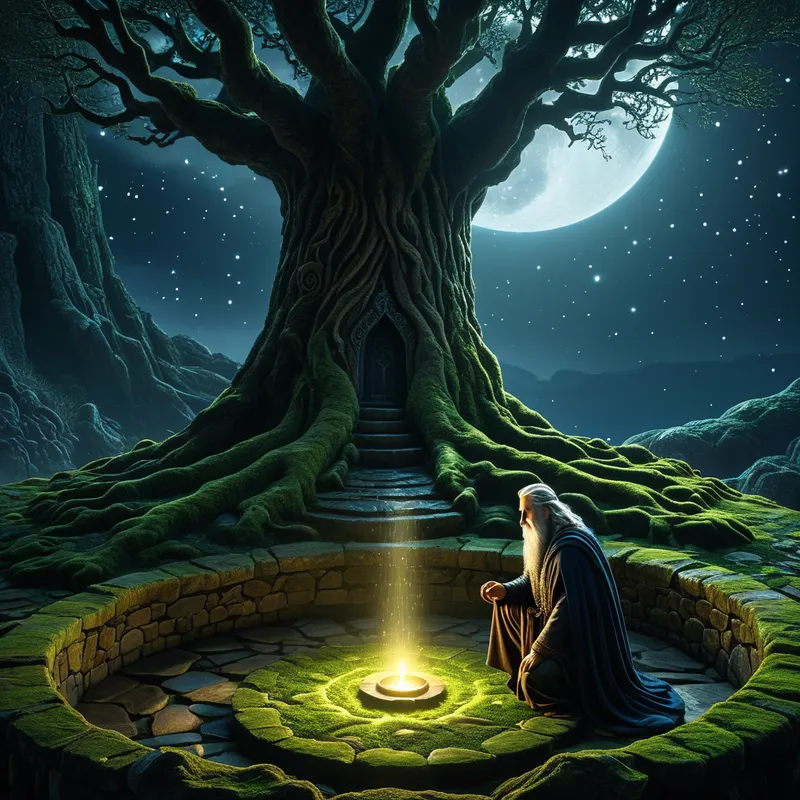
The Allfather Odin journeys to the roots of the world tree, sacrificing his eye to the guardian Mímir for a drink from the well of cosmic wisdom.
The Tale of Odin’s Well of Mímir
Listen, and hear the price of seeing. In the time before time, when the Yggdrasil was young and its roots drank from the springs of creation, there existed a well of such profound depth that it held not water, but the memory of the cosmos itself. This was Mímisbrunnr, hidden beneath a root that plunged into the land of the frost giants. Its guardian was Mímir, whose knowing was older than the mountains.
And he who sought it was Odin, the Allfather, the Raven-God, he who hung on the windswept tree for nine nights to grasp the runes. Yet even that terrible ordeal left him restless. A shadow was gathering at the edge of all things—the shadow of Ragnarök. To steer the fate of gods and men, he needed not just power, but foresight. He needed to see the pattern in the weave, to drink from the source of memory itself.
So Odin journeyed, alone, down the gnarled root of the world tree, into a twilight realm of dripping stone and ancient cold. The air grew thick with the silence of forgotten ages. There, in a cavern where the roots of Yggdrasil drank deep, he found the well. Its waters were dark, still, and fathomless, reflecting not his face, but the slow dance of stars and the ghostly shapes of things long past. And beside it, watching with eyes that held the depth of the well, was Mímir.
No greeting passed between them. The need was plain. “I have come for a drink from your well, Mímir,” Odin said, his voice the rumble of distant thunder. “I seek the wisdom to see what is, what was, and what may yet be.”
Mímir’s gaze was unblinking. “All who come here seek wisdom, Lord of the Slain. But the waters of Mímisbrunnr are not given freely. They are paid for. What will you give? What treasure of Asgard will you lay in my palm?”
Odin knew then. The well demanded not a thing he possessed, but a part of his very being. It demanded a sacrifice of perception itself. Without hesitation, he drew forth his spear, Gungnir. The point gleamed in the subterranean gloom. There was no cry, only the terrible, wet sound of severing, a sound that echoed in the hollow of the cavern. Into his own palm fell his eye, a sphere of brilliant blue, still seeing.
He extended his hand, the offering resting on his bloodied skin. “There is my payment.”
Mímir accepted the eye. He took it gently and lowered it into the dark waters of the well. As it sank, the well began to glow from within, a soft, terrible light. Then Mímir handed Odin a drinking horn, carved from a giant’s tusk. “Drink now, One-Eye. And see.”
Odin knelt. He brought the horn to his lips and drank. The water was cold as the void between worlds, and it burned like fire. In that draught, the universe unfolded before his inner sight—the birth of giants, the singing of dwarves, the first breath of man, and the last, dying gasp of the sun at Ragnarök. He saw the hidden threads of cause and effect, the sorrow woven into joy, the destruction seeded in creation. He gained the wisdom he sought, but it was a wisdom stained with eternal grief. He rose, no longer just the god of victory, but the god who had seen the price of all things. He was now Hár, the High One, who sees from a single, all-encompassing vantage.

Cultural Origins & Context
This myth comes to us from the rich tapestry of Old Norse literature, primarily preserved in the 13th-century Poetic Edda and referenced in Snorri Sturluson’s later Prose Edda. It was not a story for children, but a profound cosmological and psychological narrative shared among skalds (poets), warriors, and chieftains. In a culture that valued cunning (seidr) and foresight as highly as brute strength, Odin’s sacrifice modeled the ultimate pursuit: knowledge of fate itself.
The myth functioned on multiple levels. It explained Odin’s iconic one-eyed visage, a key identifier in art and poetry. More deeply, it established a core cultural value: that true wisdom, the kind that can steer a clan or a kingdom through hardship, is never free. It is always purchased with a piece of the self. This resonated in a world perceived as fundamentally hostile, where survival depended on making hard choices and paying necessary costs. The tale was a reminder that to lead, to know, and to truly see into the nature of reality requires a willingness to relinquish a part of one’s own limited perspective.
Symbolic Architecture
At its heart, the myth is an allegory for the birth of consciousness. The Yggdrasil represents the structured cosmos and the axis of the self. The well at its root is the unconscious, the vast, dark reservoir of ancestral memory, instinct, and latent knowledge—the collective and personal psyche. Mímir, the guardian, is the archetype of the inner sage or the Self, the part of the psyche that holds this deep knowledge but demands a transformative toll for access.
To gain the vision of the whole, one must surrender the vision of the half.
Odin’s eye is the sacrifice of ordinary, dualistic perception—the ego’s way of seeing the world in terms of self/other, win/lose, safety/danger. Placing it in the well symbolizes offering the ego’s limited viewpoint back to the source, to the unconscious, so that it may be transformed. The resulting wisdom is not merely intellectual; it is a gnostic, embodied knowing that sees time as a whole, that understands paradox, and that carries the weight of that understanding. Odin does not become blind; he gains a different kind of sight—introspective, holistic, and tragically foresighted.
The Dreamer’s Resonance
When this myth stirs in the modern dreamscape, it often manifests as dreams of profound, voluntary loss for a greater gain. A dreamer might dream of willingly removing a tooth, cutting their hair, or—most directly—losing or covering an eye. They may find themselves at the edge of a deep pool, well, or dark mirror, compelled to offer something precious into it.
Somatically, this can correlate with a feeling of pressure or ache around the brow or the “third eye” region, a sign of intense psychic restructuring. Psychologically, the dreamer is at a crossroads where their current mode of perception—their worldview, a cherished belief, a long-held self-image—has become inadequate. The unconscious is presenting the archetypal pattern of Mímir’s Well: to move forward into a new, more integrated state of consciousness, something familiar and seemingly essential must be willingly surrendered. The dream is not a prophecy of literal loss, but an illustration of the psychic process required for deep growth. The anxiety in the dream is the ego protesting its necessary diminishment.

Alchemical Translation
In the alchemy of individuation—the process of becoming psychologically whole—Odin’s ordeal is the quintessential model for the nigredo, the blackening, and the subsequent illumination. The journey to the roots is a descent into the shadow, into the parts of ourselves we have repressed or ignored. The confrontation with Mímir is the encounter with the Self, the central archetype of wholeness that governs the process.
The sacrifice of the eye is the critical operation: the mortificatio or death of the ego’s dominant attitude. In modern terms, this could be sacrificing the need to be right, the illusion of control, a toxic identity, or an addiction to superficial certainties. One offers this limited “sight” into the waters of the unconscious.
The well does not destroy the offering; it transmutes it. The eye becomes part of the well’s memory, meaning the ego-perspective is integrated, not annihilated.
The drink from the horn is the resulting illuminatio. The conscious mind, now humbled and opened by its sacrifice, is infused with the symbolic wisdom of the unconscious. The individual gains insight (in-sight). They begin to perceive the patterns of their own life, their complexes, and their destiny with a newfound, often bittersweet clarity. They see how their past wounds shape their present, and they accept the inevitable cycles of loss and creation. Like Odin, they become capable of holding paradox—joy and grief, power and limitation, life and its destined end—within a single, unified field of awareness. They become, in a psychological sense, the one-eyed sovereign of their own inner kingdom.
Associated Symbols
Explore related symbols from the CaleaDream lexicon: