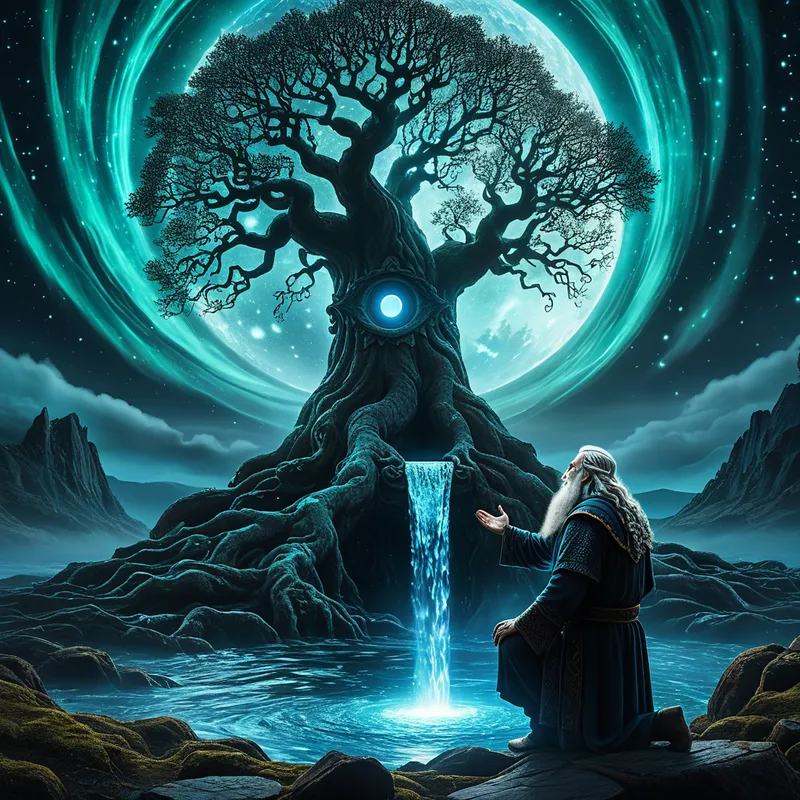
Odin's Well of Mimir Myth Meaning & Symbolism
The All-Father Odin sacrifices his eye to drink from the Well of Wisdom, gaining cosmic sight but forever bearing the wound of knowing.
The Tale of Odin’s Well of Mimir
Listen. In the time before time, when the worlds were young and the Yggdrasil groaned with the weight of its own becoming, there was a well. Not of water, but of memory. Not of life, but of knowing. It lay in the deepest, coldest roots, in the shadowed realm of Jotunheim, where the earth itself remembers the first frost.
Its keeper was Mimir. No god, no giant wholly, but a being so ancient his beard was woven with the moss of forgotten ages, his skin the texture of root-bark. His well held the waters of Mimir, and to drink was to see—to see the woven threads of fate spun by the Norns, to see the secret names of things, to see the end that waits for all, even gods.
And Odin, the All-Father, the Raven-God, he who hung on the windswept tree for nine nights to grasp the runes, felt a hunger. A thirst no mead could quench. He had sought knowledge in pain, but the well’s wisdom was of a different kind. It was the deep, silent knowing of the soil, the cold memory of stone. It was the pattern behind the pattern.
So Odin journeyed down, down the great trunk of Yggdrasil, past the eagle’s perch, past the dragon’s gnawing, into the clammy dark where the roots drink from the primeval void. He found Mimir, silent as a standing stone beside the well, whose waters were black and still, yet hummed with a sound like distant stars grinding.
“Keeper,” Odin said, his voice the rustle of raven wings. “I have come for a drink.”
Mimir’s eyes, like chips of glacial ice, opened. “The price is known, Wanderer. All who come know the price. The well does not give its sight for free. It demands a sight in return.”
Odin knew. He had always known. The bargain was etched in the bones of the world. To gain the sight that sees all patterns, one must surrender the sight that sees only one world. To gain the inner vision, one must sacrifice the outer.
There was no hesitation, yet the moment stretched into an aeon. The air grew thick with the scent of damp earth and ozone. Odin’s hand did not tremble as he reached for his own face. This was not the frenzy of battle, but the terrible, lucid clarity of choice. A gasp, not of pain but of profound offering, was torn from him. And then—the price was paid. The well’s waters did not splash; they sighed, accepting the offering, turning a darker shade of night for a heartbeat.
Mimir, without a word, took a drinking horn fashioned from a great beast’s curl, dipped it into the whispering blackness, and handed it to the one-eyed god. Odin drank. The water was cold enough to freeze time, bitter with the taste of ash and origin. And then—the vision. Not a flash, but an unfolding. He saw the tapestry of the Nine Worlds in its dreadful, beautiful entirety. He saw the threads of his own doom, and the doom of all he loved, woven inescapably into the grand design. He gained the wisdom he sought, and with it, the eternal burden of that foresight. He rose, forever altered, the empty socket a well of shadow, the remaining eye now holding the reflected depth of the cosmos itself.

Cultural Origins & Context
This myth survives primarily in the Poetic Edda, specifically in the poem Völuspá (The Prophecy of the Seeress) and referenced in the later Prose Edda of Snorri Sturluson. It was not a children’s fable but a core narrative of the skalds and seers, told in mead-halls shadowed by the northern winter. Its function was multifaceted: it explained the iconic one-eyed depiction of the chief god, it established the supreme value of wisdom (wod) in a culture often stereotyped for its martial prowess, and it framed the acquisition of ultimate knowledge as a terrifying, transformative ordeal, not a gentle study.
The myth reflects a worldview where knowledge is not free or innocent. It is a hard currency, traded in a cosmic economy of sacrifice. In a universe destined for Ragnarok, foreknowledge is both power and curse. Odin’s endless quest for wisdom—from the runes, from the severed head of Mimir (which he later consults), from seeresses—is the desperate struggle of a ruler trying to avert fate, embodying the Norse heroic ideal: to strive with full awareness of inevitable defeat.
Symbolic Architecture
At its heart, this is a myth of consciousness and its cost. The well is the collective unconscious, the vast, impersonal reservoir of all experience, memory, and archetypal patterns. Mimir (Memory) is its guardian, the threshold figure between the personal ego and the transpersonal depths.
The eye sacrificed is the vision of the literal world, the ego’s singular perspective. The wisdom gained is the vision of the symbolic world, the psyche’s multidimensional reality.
Odin’s sacrifice represents the necessary de-integration of the ego. To see with the “eye of the psyche,” one must relinquish the naive, one-sided perception that takes the surface of reality as the whole truth. The physical eye sees objects; the inner eye sees relationships, histories, and potentials. The wound—the empty socket—becomes a permanent opening to the numinous, a reminder that true wisdom is born of acknowledged lack, not accumulated possession. It is the price of moving from a life lived in the world to a life conscious of the world.

The Dreamer’s Resonance
When this myth stirs in the modern dreamer, it often manifests as dreams of profound and costly choices. To dream of willingly removing an eye, or of being offered a drink from a dark, significant source in exchange for something precious, signals a psyche at the brink of a major expansion of consciousness.
Somatically, this can feel like pressure in the forehead (the “third eye” region) or a sense of profound inner rearrangement. Psychologically, it is the process of sacrificing an old way of seeing—a cherished belief, a self-image, a narrow worldview—that has become a limitation. The dreamer is in negotiation with their own inner Mimir, the deep self that holds ancestral wisdom but demands a price: the comfort of ignorance, the simplicity of blame, the safety of a smaller life. The agony in the dream is the ego’s resistance to its own necessary diminishment for the greater whole of the Self to emerge.

Alchemical Translation
In the alchemy of individuation, Odin’s ordeal is the nigredo—the blackening, the dissolution of the old form. The ego, identified with its outward-looking “eye,” must be broken down. The sacrifice is the ultimate act of surrender, not to an external god, but to the imperative of the Self. One trades a literal, materialistic orientation for a symbolic, psychological one.
The well’s waters are the aqua permanens, the transformative substance that dissolves the lead of literal perception to reveal the gold of symbolic understanding.
The modern individual undergoing this process does not pluck out a physical eye. They might sacrifice a career for a calling, a relationship that limits growth, or a rigid identity. They drink from the well when they commit to therapy, engage in deep meditation, or immerse themselves in art—any practice that plunges them into the depths of their own being. The “wisdom” gained is not intellectual facts, but a felt, often sorrowful, understanding of one’s own patterns, wounds, and place in the larger human story. One emerges, like Odin, forever marked. The wound of the sacrificed naivete remains, but it becomes the vessel for a deeper, more compassionate sight—the sight that can hold paradox, endure uncertainty, and perceive the hidden connections weaving life together. One becomes, in a humble, human-scale way, a keeper of one’s own well.
Associated Symbols
Explore related symbols from the CaleaDream lexicon: