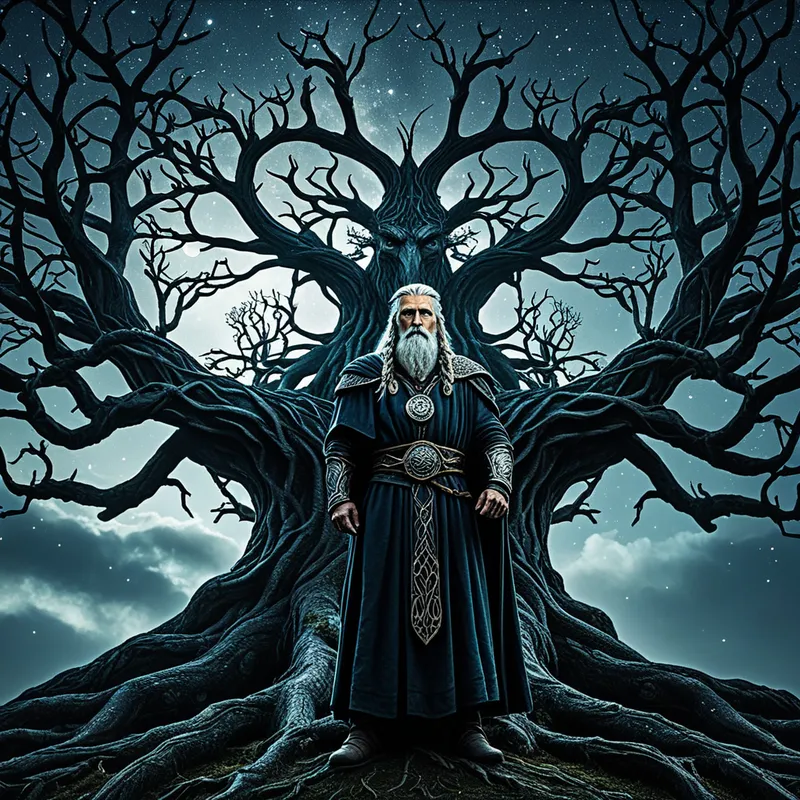
Odin's Memory Mead Myth Meaning & Symbolism
The All-Father sacrifices his eye and hangs himself on the World Tree to gain the mead of poetry, memory, and divine inspiration.
The Tale of Odin's Memory Mead
Hear now of the draught that holds the song of the worlds, the mead that remembers all things. It began not with a god, but with a truce. In the dawn of time, the Aesir and the Vanir, weary of war, spat into a vast vat to seal their peace. From that mingled spittle of deities, a being was formed: Kvasir, the wisest of all. He wandered the Nine Worlds, answering every question, a living vessel of all knowledge.
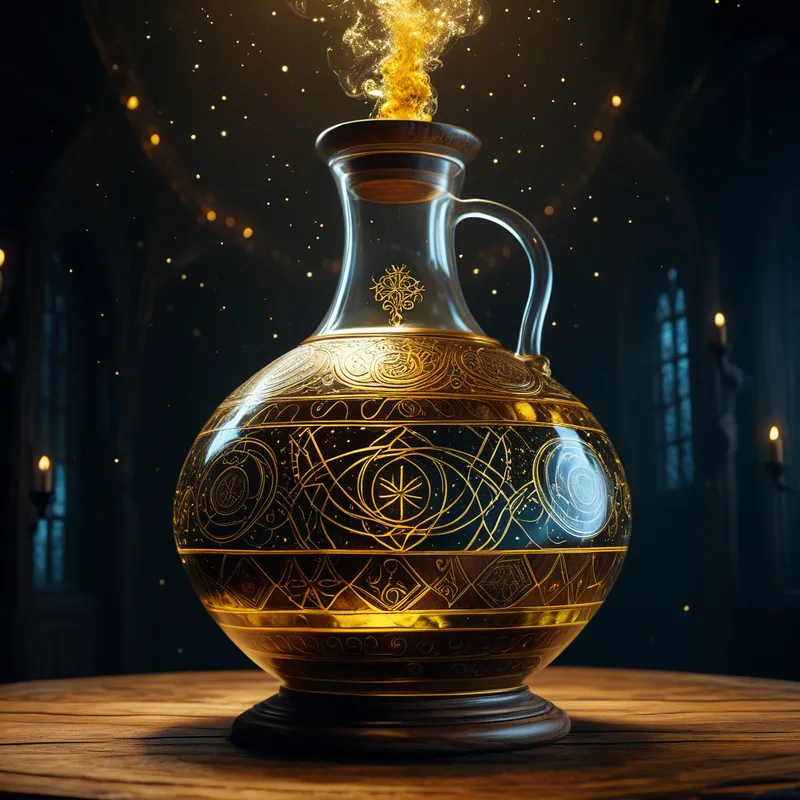
But knowledge attracts shadows. Two dark dwarven brothers, Fjalar and Gjalar, invited Kvasir into their stone-hewn hall. They asked for a private word, a secret counsel. When he leaned close, they struck him down. His blood, thick with wisdom, they drained into three great vats. They mixed it with honey, and in the deep dark, a fermentation of spirit began. This was the Mead of Poetry, the Odrerir. He who drank it would become a skald or a sage, his words weaving fate itself.
The mead passed through treachery to the giant Suttung, who hid it in the heart of a mountain called Hnitbjorg. He set his daughter, Gunnlod, as its sole guardian, to sit upon the three vats in the eternal stone dark.
And in Asgard, the All-Father watched. Odin, whose one eye saw much, knew of the mead. His hunger was not for power, but for the memory of things—the song of creation, the whisper of the roots of Yggdrasil, the fate of gods and men. He would have it. He journeyed to the world of men, disguised, and with cunning set a feud aflame between the servants of Suttung’s brother. In the chaos, Odin, now called Bolverkr, the "Worker of Evil," offered his service to Suttung’s brother to repair the damage. His price? A single drink of the mead. The brother, bound by oath, agreed but knew he could not fulfill it.
So Odin went to the mountain. He took a rat-auger and bored through the living stone, becoming a serpent slithering through the dark, damp passage. He emerged into Gunnlod’s cavern. For three nights, he spoke to the lonely giantess. He did not conquer her with force, but with words—words of the vast sky she had never seen, of the winds in the high branches of Yggdrasil. He wooed her loneliness. Moved, she granted him one drink from each of the three vats. In one draught, he drained them all. The mead, the memory of all that was and would be, flooded into him. He transformed into an eagle, bursting from the mountain, the stolen wisdom a raging fire in his gut.
Suttung, seeing the eagle soar, took his own eagle-form and gave chase. The race shook the skies. As Odin neared Asgard, the Aesir saw the pursuit. They rushed out vats to catch what he would disgorge. Odin, the great eagle, reached the walls of Asgard and spewed the mead into the waiting vessels. But in his desperate speed, some dripped backwards, falling to the world below. That which was caught became the mead of true poets and seers. That which was spilled became the mead of bad poets and braggarts. And Odin, his theft complete, had swallowed the world’s memory.
Cultural Origins & Context
This myth, preserved primarily in the Prose Edda of Snorri Sturluson, is not a simple folktale. It is a core narrative of the skaldic tradition—the poets themselves. In a culture where oral history, complex praise-poetry, and legal recitation were paramount, the source of eloquent speech and memory was a divine mystery. The myth functioned as an etiological story, explaining the origin of poetic inspiration (ódhr), linking it directly to divine sacrifice and cunning. It was told in halls by skalds who saw themselves as vessels of this very mead, their craft a sacred, dangerous inheritance from the All-Father himself. It legitimized the poet’s role as more than entertainer; he was a memory-keeper, a wisdom-bringer, operating in the liminal space between order (Asgard) and chaos (Jotunheim), much like Odin.
Symbolic Architecture
The myth is a profound map of the psyche’s quest for wholeness. Odin is not a pristine hero; he is the Trickster-Sage, willing to orchestrate betrayal, exploit emotion, and steal to achieve his ends. The mead represents integrated consciousness—the fermented product of conflict (the Aesir-Vanir war), death (Kvasir), and transformation.
The price of true memory is the sacrifice of a partial view.
Odin’s hanging on Yggdrasil, a separate yet deeply connected ordeal, is the key. To gain the runes (the structure of reality), he must offer himself to himself, pierced by his own spear. To gain the mead (the content of reality), he must offer his singular perspective—his eye. Both are transactions with the unknown. The eye is a symbol of directed, conscious perception. Its loss is the surrender of egoic certainty, creating a void that can be filled by a more holistic, intuitive knowing—the mead that "sees" everything. Gunnlod, the guardian, represents the fertile, contained unconscious that holds the treasure. She is not defeated but courted; the wisdom must be related to, not raped.
The Dreamer's Resonance
When this myth stirs in modern dreams, it speaks to a crisis of meaning and a hunger for authentic voice. Dreaming of a precious, guarded fluid may indicate a nascent creative or spiritual potential felt as a tangible, yet inaccessible, energy within. Dreaming of a wound in the side, or the loss of an eye, often coincides with a painful but necessary sacrifice—the end of a relationship, a career, a long-held identity—that feels like a mutilation but is the prelude to a deeper acquisition.
The somatic sensation is often one of pressure in the head or chest, a "fullness" with no outlet, or conversely, a piercing emptiness. The psychological process is the ego’s confrontation with a content too vast for its current container. The dreamer is being called to make space, to undergo a symbolic self-sacrifice, to bore through the mountain of their own defenses (the hardened persona) to reach the guarded, perhaps lonely, creative spirit within (Gunnlod).
Alchemical Translation
The journey of Odin is the archetypal process of individuation. The prima materia is the raw, conflicted substance of the self (the warring Aesir and Vanir). Kvasir is the nascent, unified Self, born from reconciling opposites, but he is fragile in a world of shadow (the dwarven brothers, representing unconscious, acquisitive complexes).
The treasure is always in the dragon's keep. One must become the dragon, the thief, and the hero to claim it.
Odin’s actions model the alchemical stages: Calcinatio (the burning feud he ignites), Solutio (boring through the mountain, becoming the serpent in the watery dark), Coagulatio (wooing Gunnlod, forming a relationship with the anima), and Sublimatio (transforming into the eagle, carrying the spirit to a higher plane). The final act—spewing the mead into the vessels of Asgard and Midgard—is the crucial stage of giving the integrated wisdom back to the community of the psyche and the world. Not all of it is perfectly retained; some is wasted. This acknowledges that the process is messy, partial, and human. The individuated Self does not become a perfect god on a throne, but a conduit, forever marked by the sacrifice (the one eye) and forever filled with the flowing, intoxicating memory of the whole.
Associated Symbols
Explore related symbols from the CaleaDream lexicon: