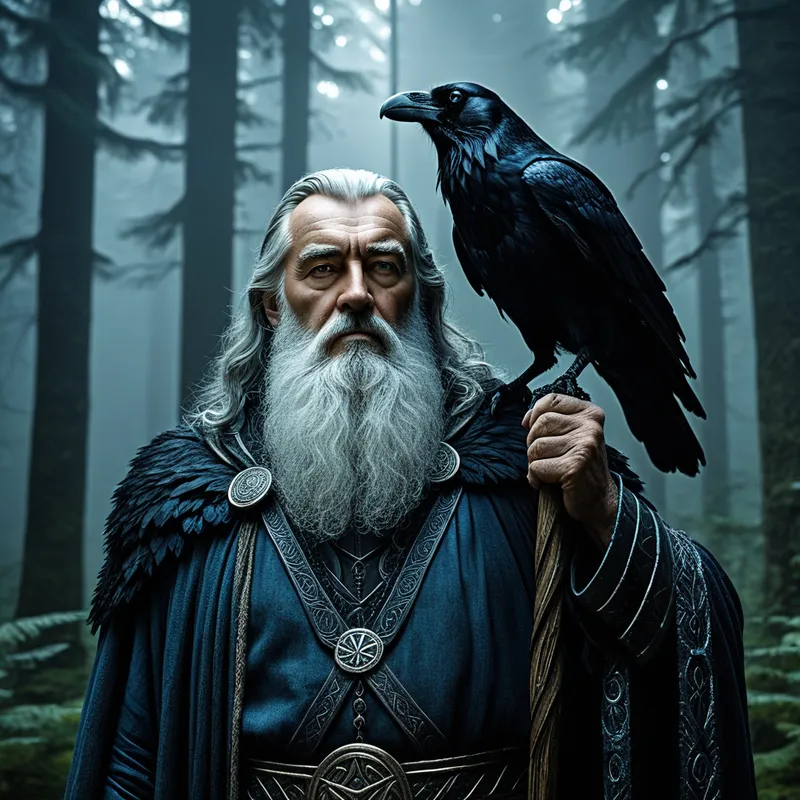
Odin's Eye Myth Meaning & Symbolism
The All-Father Odin sacrifices his physical eye to drink from Mimir's Well, gaining cosmic wisdom and the terrible price of true sight.
The Tale of Odin’s Eye
Listen. In the time before time, when the roots of the Yggdrasil drank from the deepest wells and its branches scraped the void, there was a hunger. It was not a hunger of the belly, but of the soul. It gnawed at the one they called the All-Father, Odin. He who had shaped worlds and fathered gods still walked in a twilight of unknowing. He knew the names of things, but not their hearts. He knew the paths of the sun, but not the secrets woven between the stars.
His throne, Hliðskjálf, showed him the nine worlds in their splendor and sorrow. He saw the laughter in Ásgarðr, the toil in Miðgarðr, the chill gathering in Jötunheimr. Yet it was a sight of surfaces. The hidden currents of fate, the whispered reasons why, these were locked away. They were held in the silent, dark water of a well that lay at a root of the World Tree, in the land of the frost giants. This was Mímisbrunnr.
Its guardian was Mímir, a being of ancient memory, whose head was a repository of all that had been and all that might be. The water of his well was not water, but liquid wisdom, the ørlög itself made drinkable. To know the price of a drink from that well was to know the first secret.
Odin, cloaked in grey, journeyed alone. He passed from the golden brightness of his hall into the misty, primordial gloom of Jötunheimr. The air grew cold enough to still thought. Before him, the well lay, a circle of perfect blackness ringed with hoar-frosted stone. And there sat Mimir, his eyes like deep pools reflecting no light, only depth.
“All-Father,” Mimir’s voice was the sound of stone settling, of roots growing. “You seek the water that grants sight beyond sight.” Odin did not bow, but his gaze was earnest. “I seek an end to seeking. I must see the threads, not just the tapestry.” A silence stretched, filled only with the drip of wisdom into the well. “The water is not denied,” Mimir said. “But all things have a price, and the price of this sight is sight itself. What you have, you must give. An eye for an eye. The outer vision for the inner.”
The forest held its breath. The choice was not between wisdom and ignorance, but between one kind of seeing and another. To remain whole and blind to the depths, or to become wounded and see truly. Odin did not hesitate. His hand went to his face. There was no cry, only a sharp, sacred silence, a tearing not just of flesh but of a way of being. In his palm, his eye glimmered, a wet jewel catching the faint light.
He offered it. Mimir took the offering, and it sank into the dark waters of the well, a final sacrifice. Then, Odin knelt. He cupped his hands, broke the obsidian surface of the well, and brought the water to his lips.
The world exploded inward. Not with light, but with knowing. He saw the past not as story, but as living memory. He saw the future not as prophecy, but as a web of branching possibilities, each thrumming with consequence. He saw the sorrow woven into joy, the death hidden in birth, the glorious, terrible doom of Ragnarök and the green shoot that would rise after. The price was felt immediately—a permanent void in his perception, a literal half-darkness. But flooding into that void was a vision so vast it made the missing eye a tiny, necessary scar. He rose, no longer just a king of gods, but a knower of fates. He paid the price, and he bore the wound, forever after.

Cultural Origins & Context
This myth comes to us from the rich, fragmentary tapestry of Old Norse literature, primarily preserved in 13th-century Icelandic texts like the Poetic Edda and Snorri Sturluson’s Prose Edda. These works, compiled centuries after the Christianization of Scandinavia, are our best windows into a pre-Christian worldview that was oral, poetic, and deeply embedded in a culture facing a harsh, majestic, and unforgiving natural world.
The myth of Odin’s sacrifice would have been told by skalds (poets) and storytellers, not as a simple fable but as a foundational narrative explaining the nature of divine power and the structure of reality. In a society that valued practical wisdom, cunning (seidr), and the ability to face inevitable fate with courage, Odin was a complex model. He was not a benevolent father-figure but a god of ecstasy, war, poetry, and death, constantly seeking advantage and knowledge through perilous journeys and painful bargains. This story functioned to explain Odin’s authority—it was earned, not inherited—and to underscore a core cultural truth: that true wisdom, the kind that governs and guides, is never free. It requires a sacrifice that permanently alters the seeker. It legitimized the idea that leaders and seers must pay a personal price for their insight, a concept that resonated deeply in a warrior culture familiar with the costs of power.
Symbolic Architecture
At its heart, this is not a story about acquiring information. It is an allegory for the fundamental shift in consciousness required for profound understanding. The physical eye represents our ordinary, dualistic perception—seeing the world as separate objects, divided into self and other, subject and object. It is the vision of the ego, concerned with surface, possession, and literal sight.
The sacrifice of the eye is the willing surrender of the ego’s complete perspective to make room for a consciousness that can hold paradox.
Mimir’s Well is the unconscious itself, the vast, dark reservoir of ancestral memory, archetypal patterns, and non-personal knowledge. Its waters are the substance of the Self. The act of drinking is the terrifying, enlightening process of integrating this unconscious content into conscious awareness. The gained wisdom—the knowledge of runes, fates, and hidden things—symbolizes the emergent property of this integration: a participatory knowing that sees connections, patterns, and meanings invisible to the literal gaze.
Odin’s resulting state—one-eyed in the physical world, all-seeing in the metaphysical—embodies the quintessential condition of the sage. He carries a wound that is also a source of power. He sees through the world, not just at it. The empty socket is a permanent reminder of the cost, a check against the inflation that absolute knowledge can bring. He is whole in a new, asymmetrical way, integrated through his lack.

The Dreamer’s Resonance
When this myth stirs in the modern dreamer, it often manifests as dreams of losing or injuring an eye, of finding hidden wells or springs, or of making a terrible but necessary bargain with a shadowy, ancient figure. Somatic sensations might include a pressure or emptiness in the forehead or eye socket, a feeling of being “blinded by insight,” or a chilling clarity.
Psychologically, this signals a critical juncture in the process of individuation. The dreamer is confronting the price of their own development. To gain a deeper understanding of their own nature, their patterns, or their life’s direction, they must willingly sacrifice a long-held, ego-identified way of seeing themselves and the world. This could be a cherished self-image, a rigid belief, or a comfortable narrative about one’s past or future. The dream is an expression of the psyche’s recognition that growth now requires a fundamental, irreversible change in perspective—a death of an old mode of consciousness. The anxiety in the dream mirrors Odin’s moment of choice: the terror of self-mutilation balanced against the imperative for deeper truth.

Alchemical Translation
The alchemical process mirrored here is the nigredo, the necessary blackening, dissolution, and sacrifice that precedes enlightenment. In the vessel of the psyche, the prima materia—the raw, unconscious content of the self—must be broken down. Odin’s act is the ultimate solve (to dissolve): he dissolves the integrity of his own face, his own wholeness as defined by his physical form.
The myth presents individuation not as a gentle unfolding, but as a voluntary trauma that creates the space for the transpersonal to enter.
For the modern individual, this translates to the painful but deliberate deconstruction of a persona or a complex that has outlived its usefulness. It is the businessman sacrificing his sole identity in profit to find meaning; the intellectual sacrificing her purely rational framework to embrace intuition; the caregiver sacrificing his need to be needed to find his own core. The “eye” given up is always something precious, a faculty or identity we believed was essential to our being.
The “water” drunk is the reintegration of what was lost in a new form. The sacrificed eye does not vanish; it sinks into the well (the unconscious) and transforms it. The wisdom gained is the newly configured Self, which now operates from a center that includes both the wound and the vision. The individual, like Odin, becomes a ruler of their inner world not through force, but through the hard-won authority of having paid the price. They see with a cyclopean vision—single-pointed, focused on the essence, capable of perceiving the symbolic and the literal simultaneously. They walk through life with a sacred scar, a reminder that their deepest sight was bought with a piece of their former self, and that this is the only way true wisdom is ever earned.
Associated Symbols
Explore related symbols from the CaleaDream lexicon: