
Odin and Mimir's Well Myth Meaning & Symbolism
The Allfather Odin sacrifices his eye to drink from the Well of Wisdom, gaining cosmic insight at a terrible, transformative price.
The Tale of Odin and Mimir’s Well
Listen, and hear the price of knowing.
In the deep, cold roots of [the world](/myths/the-world “Myth from Tarot culture.”/), where the [Yggdrasil](/myths/yggdrasil “Myth from Global/Universal culture.”/) drinks from the primeval dark, there lies a well. Its waters are not for the thirsty, nor its secrets for the timid. This is [Mímisbrunnr](/myths/mmisbrunnr “Myth from Norse culture.”/), and its guardian is [Mímir](/myths/mmir “Myth from Norse culture.”/), whose name means “the rememberer.” He is ancient, his beard the grey of mountain mist, his eyes holding the patient stillness of stone that has witnessed the turning of ages. In the [water](/myths/water “Myth from Chinese culture.”/) he tends swim all that was, all that is, and the ghostly threads of all that may yet be.
To this place came Óðinn, the Allfather, the [Raven](/myths/raven “Myth from Haida culture.”/)-God. He did not come in thunder or with the host of the Einherjar. He came alone, a wanderer in a dark cloak, his spear [Gungnir](/myths/gungnir “Myth from Norse culture.”/) a silent staff. The air here was thick, smelling of wet earth, ancient bark, and the cold scent of deep water. The only light came from the well itself, a liquid, shifting luminescence that cast wavering shadows on the gnarled roots overhead.
He stood before [Mimir](/myths/mimir “Myth from Norse culture.”/), and the guardian did not speak. He merely watched, knowing why the lord of Asgard had descended from the high branches to this [underworld](/myths/underworld “Myth from Greek culture.”/). Odin’s voice, when it came, was a low rumble that held no command, only a desperate hunger. “A drink,” he said. “From your well.”
Mimir stirred, the water lapping softly at the stone rim. “All drink from their own wells, Alföðr,” he replied, his voice like stones grinding slowly in a stream. “The well of your own experience, your own sight. My well… its water is memory itself. It is the past that shapes the present, the root of all consequence. To drink it is to see the weave, not just the thread. The price is commensurate.”
Odin knew. The knowledge had been a cold weight in his chest long before this descent. He saw the futures branching like frost on a window—[Ragnarök](/myths/ragnark “Myth from Norse culture.”/), the wolf, the serpent, the death of his sons, the burning of the world. To steer fate, even for a moment, he needed not just foresight, but understanding. He needed the wisdom that comes from seeing the cause within the effect, the seed within the fruit.
“I will pay,” Odin stated, his single eye fixed on the shimmering depths.
Mimir nodded, once. “Then you must give to the well. An offering of equal value. You seek the sight that sees all paths? Then you must surrender the sight that sees but one.”
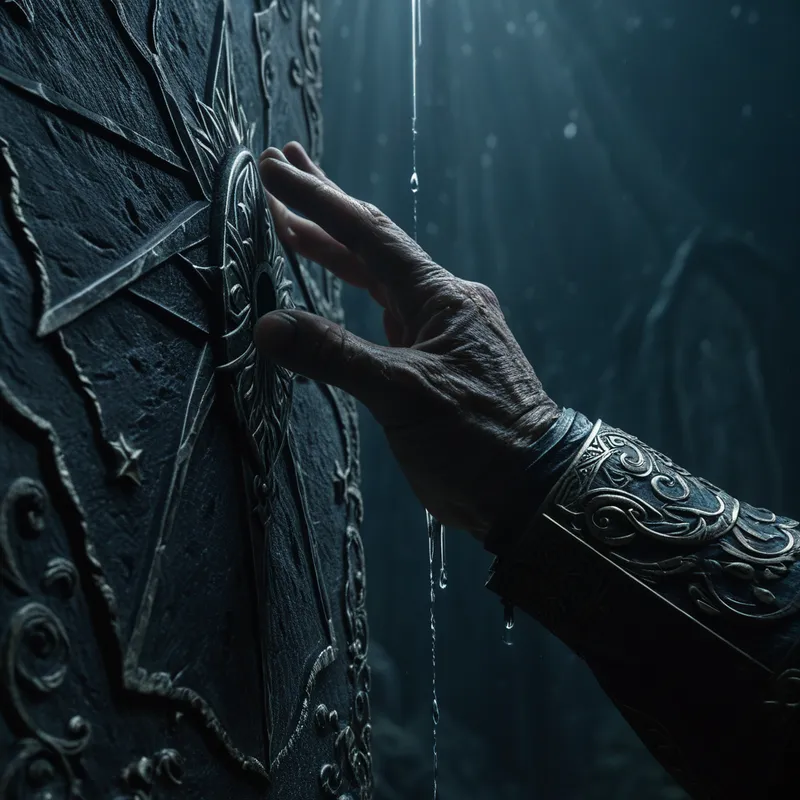
There was no ceremony. No grand speech. In the profound silence of that root-chamber, Odin, father of gods, reached to his own face. His breath hissed, a sharp, pained sound swallowed by the dense air. His hand came away holding the orb of his right eye, its light already fading. He did not cry out. He held it forth, a terrible, glistening offering, and let it fall into the waiting waters of Mímisbrunnr.
It sank without a ripple, a jewel of flesh and vision given to the deep. Where it vanished, the water seemed to brighten, to hum with a deeper, more resonant knowledge.
Then, and only then, did Mimir dip a horn into the well. He offered it to the god who was now, forever, the One-Eyed. Odin took it. He drank deeply of the waters of memory, of root-wisdom, of cause and consequence. The knowledge flooded him—a torrent of pasts and futures, of hidden truths and the sorrowful, beautiful mechanics of the cosmos. He gained the wisdom he sought, a dreadful, all-encompassing understanding.
He left his eye in the dark. He carried the well’s reflection in his mind, and a pain that would never leave his empty socket. He ascended back to the worlds of light and action, now seeing not less, but infinitely more, through the lens of a sacrifice that defined his very being.
Cultural Origins & Context
This myth comes to us from the rich tapestry of Old Norse literature, primarily preserved in the 13th-century works of Snorri Sturluson, the Icelandic scholar, in his Prose Edda. Snorri compiled and systematized stories from a much older oral tradition, the lifeblood of pre-Christian Scandinavian culture. These tales were not mere entertainment; they were the sacred narrative technology of a people, recited by skalds (poets) and storytellers who functioned as the memory-keepers of their society.
The story of Odin and Mimir would have been told in halls smoky with firelight, its themes resonating with a worldview that saw existence as a precarious balance won through struggle and sacrifice. In a culture that valued cunning (seidr) and foresight as highly as physical courage, Odin’s quest positioned him as the ultimate model of the seeker. He was the god who risked everything—even his own wholeness—for the advantage of knowledge, reflecting a pragmatic, if grim, understanding that true gain requires true loss. The myth served to explain Odin’s distinctive one-eyed visage, to underscore the source of his proverbial wisdom, and to illustrate a core existential principle: wisdom is not free. It is purchased with a piece of [the self](/myths/the-self “Myth from Jungian culture.”/).
Symbolic Architecture
At its [heart](/symbols/heart “Symbol: The heart symbolizes love, emotion, and the core of one’s existence, representing deep connections with others and self.”/), this myth is an archetypal map of the awakening of [consciousness](/symbols/consciousness “Symbol: Consciousness represents the state of awareness and perception, encompassing thoughts, feelings, and experiences.”/). The Mímisbrunnr is not a literal pool but the [collective unconscious](/symbols/collective-unconscious “Symbol: The Collective Unconscious refers to the part of the unconscious mind shared among beings of the same species, embodying universal experiences and archetypes.”/) itself—the vast, subterranean [reservoir](/symbols/reservoir “Symbol: A contained body of water representing stored resources, emotions, or potential, often signifying controlled or suppressed aspects of the self.”/) of ancestral [memory](/symbols/memory “Symbol: Memory symbolizes the past, lessons learned, and the narratives we construct about our identities.”/), instinct, and latent [knowledge](/symbols/knowledge “Symbol: Knowledge symbolizes learning, understanding, and wisdom, embodying the acquisition of information and enlightenment.”/) that underlies individual [awareness](/symbols/awareness “Symbol: Conscious perception of self, surroundings, or internal states. Often signifies awakening, insight, or heightened sensitivity.”/). Mimir, the rememberer, is its [guardian](/symbols/guardian “Symbol: A protector figure representing safety, authority, and guidance, often embodying parental, societal, or spiritual oversight.”/), representing the objective, timeless [psyche](/myths/psyche “Myth from Greek culture.”/) that exists before and beyond [the ego](/myths/the-ego “Myth from Jungian culture.”/).
To drink from the well is to seek conscious integration with the unconscious. It is the ego’s daring quest to know the unknown depths of its own being.
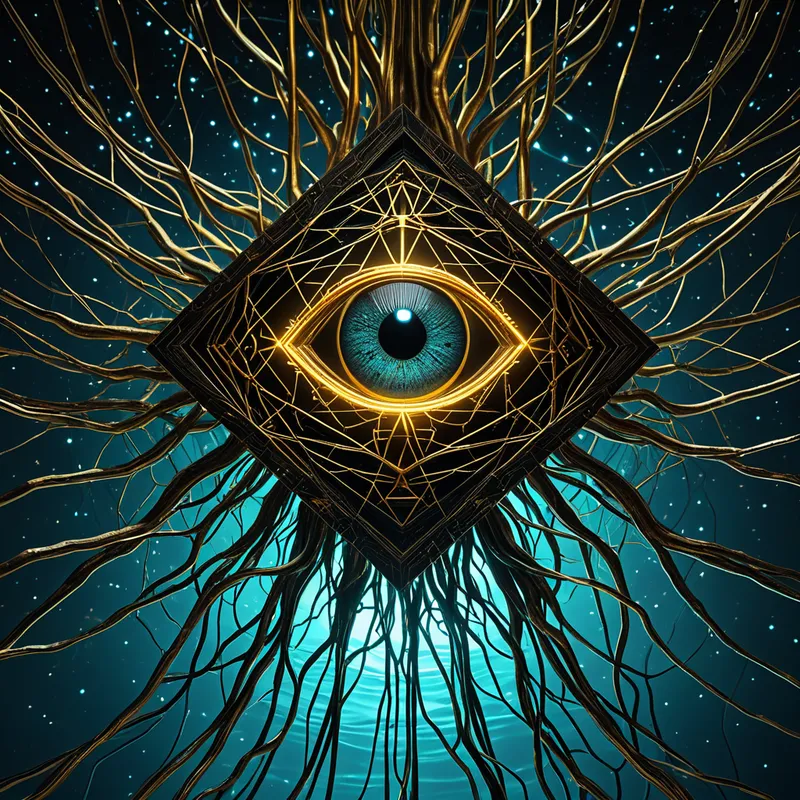
Odin’s eye represents directed, focused consciousness—the light of the ego that illuminates a single, [linear](/symbols/linear “Symbol: Represents order, predictability, and a direct, step-by-step progression. It symbolizes a clear path from cause to effect.”/) [reality](/symbols/reality “Symbol: Reality signifies the state of existence and perception, often reflecting one’s understanding of truth and life experiences.”/). It is the tool of [differentiation](/symbols/differentiation “Symbol: The process of distinguishing or separating parts of the self, emotions, or identity from a whole, often marking a developmental or psychological milestone.”/), separating “I” from “thou,” “here” from “there.” To gain the nonlinear, panoramic wisdom of the well (the unconscious), he must sacrifice this one-pointed [perspective](/symbols/perspective “Symbol: Perspective in dreams reflects one’s viewpoints, attitudes, and how one interprets experiences.”/). The exchange is alchemical: limited, personal [sight](/symbols/sight “Symbol: Sight symbolizes perception, awareness, and insight, representing both physical and inner vision.”/) for unlimited, impersonal [insight](/symbols/insight “Symbol: A sudden, deep understanding of a complex situation or truth, often arriving unexpectedly and illuminating hidden connections.”/). The empty socket becomes a permanent wound, a reminder of the cost of consciousness, but also a [vessel](/symbols/vessel “Symbol: A container or structure that holds, transports, or protects something essential, representing the self, emotions, or life journey.”/) now open to a different kind of [perception](/symbols/perception “Symbol: The process of becoming aware of something through the senses. In dreams, it often represents how one interprets reality or internal states.”/)—the inner [sight](/symbols/sight “Symbol: Sight symbolizes perception, awareness, and insight, representing both physical and inner vision.”/) of [intuition](/symbols/intuition “Symbol: The immediate, non-rational understanding of truth or insight, often described as a ‘gut feeling’ or inner knowing that bypasses conscious reasoning.”/), [prophecy](/symbols/prophecy “Symbol: A foretelling of future events, often through divine or supernatural means, representing destiny, fate, and hidden knowledge.”/), and holistic understanding.
The Dreamer’s Resonance
When this myth stirs in the modern psyche, it often manifests in dreams of profound exchange or somatic sensation. A dreamer may find themselves in a negotiation in a shadowy place, asked to trade something precious—a voice, a keepsake, a physical token—for a book, a key, or a drink from a mysterious source. There is no violence, only a solemn, inevitable transaction.
More directly, one might dream of losing an eye, not in terror, but in a state of awe-filled surrender, followed by a sudden expansion of vision—seeing in all directions at once, or understanding a complex pattern instantly. Somatic echoes can include a pressure or ache around the ocular orbit, a feeling of being “blinded by insight,” or the sensation of receiving a download of information that is simultaneously exhilarating and burdensome. These dreams signal a critical juncture in psychological development: the ego is being called to relinquish its narrow, controlling perspective to accommodate a wisdom that comes from a deeper, more ancient part of the self. It is the psyche’s dramatization of the painful, necessary death of a limited viewpoint.

Alchemical Translation
For the individual, Odin’s journey models the central ordeal of individuation: the willing sacrifice of the ego’s naive supremacy for the sovereignty of the Self. We all cling to our “eye”—our preferred identity, our cherished beliefs, our way of seeing the world that keeps us feeling coherent and safe. This is our one-pointed, personal consciousness.
The alchemical work begins when life, or the Self, demands a drink from our own depths. The price is always a piece of who we thought we were.
The “well” is the call from within—a depression, a creative block, a recurring pattern, or a deep longing that rational understanding cannot solve. To address it, we must descend from our familiar heights (our conscious attitudes) into the root-darkness of our own being (the unconscious). There, we meet our inner Mimir—the objective, often stern voice of truth that knows the cost. The sacrifice demanded might be a long-held grievance, a victim narrative, a perfectionist ideal, or a talent we must set aside. It is something we “see” with, a core part of our identity.
Surrendering it is agonizing; it feels like a mutilation. But in that act of offering our limited sight to the depths, we are granted a draught of a different wisdom. We gain context. We see the historical roots of our pain, the hidden patterns in our relationships, the symbolic meaning of our struggles. The empty space left behind—the wound—never fully closes. It becomes a sacred scar, a reminder of our capacity for transformation and a permanent opening to intuitive wisdom. We become, like Odin, paradoxically more by becoming less—guided not just by what we look at, but by what looks back at us from the dark, reflective waters of our own soul.
Associated Symbols
Explore related symbols from the CaleaDream lexicon: