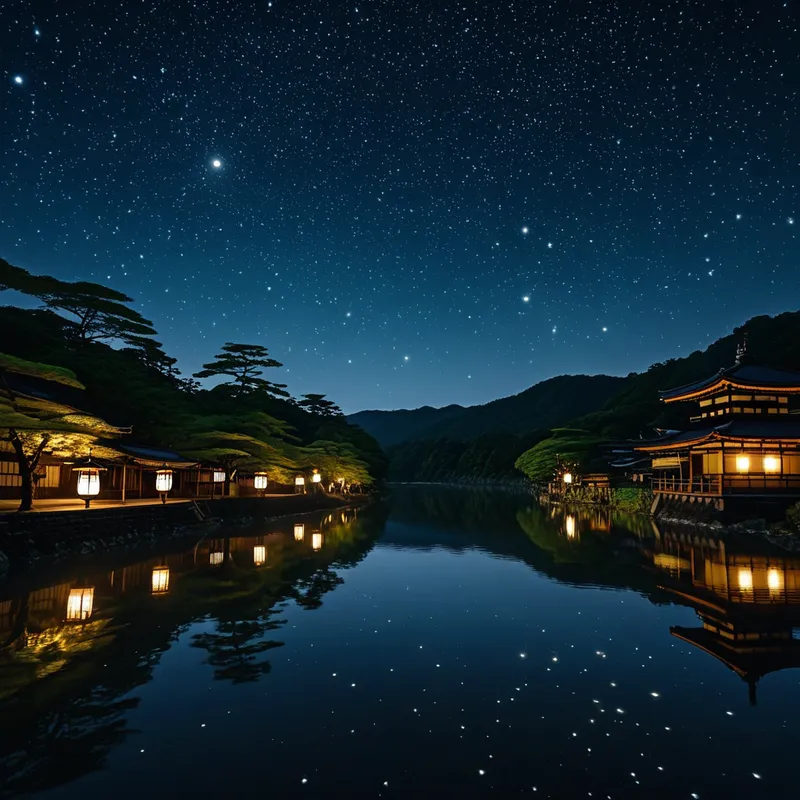
Obon Festival Ancestors Myth Meaning & Symbolism
A monk's vision of his mother suffering in the afterlife leads to a ritual of liberation, creating a festival where ancestors return to be welcomed and fed.
The Tale of Obon Festival Ancestors
Listen, and let the heat of the summer moon draw the story from the stones.
There was a monk named Mokuren. He walked [the earth](/myths/the-earth “Myth from Hindu culture.”/) with eyes that could pierce the veils of the six realms, a gift and a curse from his deep meditation. His heart, however, remained tethered to a single, human anchor: his mother. She had passed, and his filial love was a constant, quiet prayer.
One day, in the deep stillness of his practice, he turned his sight inward and downward. He sought her. Through the realms of gods and humans, of battling Asuras and suffering animals, he looked. His search plunged him into the realm of the Gaki. There, in a desolate landscape of shadow and craving, he found her.
She was a wraith of want. Her form was emaciated, her throat thin as a needle, her belly swollen with a hunger that could never be sated. She scrabbled at phantom food that turned to ash in her grasp. She suffered, not from malice in life, but from a simple, human selfishness—she had often withheld charity from monks. This [karma](/myths/karma “Myth from Hindu culture.”/) now bound her in eternal, desperate thirst.
Mokuren’s vision shattered into a cry of anguish. His spiritual power meant nothing if he could not lift this torment from the one who gave him life. He ran, heart hammering against his ribs, to [the Buddha](/myths/the-buddha “Myth from Buddhist culture.”/). He fell at the Enlightened One’s feet, his robes dusty with despair. “Master! I have seen my mother in the realm of the Gaki! What can I do? What offering, what prayer can possibly reach her?”
The Buddha, his compassion as vast and calm as a mountain lake, regarded his grieving disciple. “The virtue of one son is a small light,” he said. “But the combined merit of the many is a sun that can dispel any darkness. Go. On the fifteenth day of the seventh month, when the monastic community ends its summer retreat, prepare a feast. Offer it not just to your mother, but to the entire [Sangha](/myths/sangha “Myth from Buddhist culture.”/). The collective purity and merit generated by this offering will be a raft strong enough to carry her across [the river](/myths/the-river “Myth from Buddhist culture.”/) of suffering.”
Mokuren did as instructed. With a devotion that blurred the line between ritual and prayer, he gathered the finest foods—simple, pure, and abundant. He presented them to the assembled Sangha. As the monks accepted the offering, a profound silence, thick with generated merit, filled the air.
Back in his chamber, Mokuren looked again. The vision had transformed. The desolate plain was gone. His mother’s form, once twisted by hunger, was now peaceful, whole. She looked at him, her eyes clear, and in that look was an ocean of released gratitude. She had been freed. Not just fed, but liberated. She ascended from the lower realm, her journey onward unburdened.
And then, a miracle within the miracle. She did not simply vanish into [the void](/myths/the-void “Myth from Buddhist culture.”/) of peace. That same night, moved by joy and love, she returned. Mokuren felt a presence, a familiar warmth in the cool night air. He saw her, not as a suffering ghost, but as a gentle spirit, drawn back to [the world](/myths/the-world “Myth from Tarot culture.”/) of form by the power of his remembrance and the shared merit of the community. She had come home, if only for a visit, to share in his joy and to bless him.
From this single, powerful act of a grieving son, a river of return was born. It was decreed that each year, as summer begins to wane, the gates between the worlds grow thin. The ancestors, guided by the lanterns of memory and the scent of offerings, make their journey back. They walk the familiar paths, drawn to the light left on the home altar, to the Ohakamairi graves cleaned with care, to the rhythm of the Bon Odori that echoes the joy of their liberation. For three days, the living and the dead share a household, bound by an unbroken thread of love, before the ancestors are gently sent back across the [water](/myths/water “Myth from Chinese culture.”/), their spirits fed, their connection renewed, on floating lanterns of fire.
Cultural Origins & Context
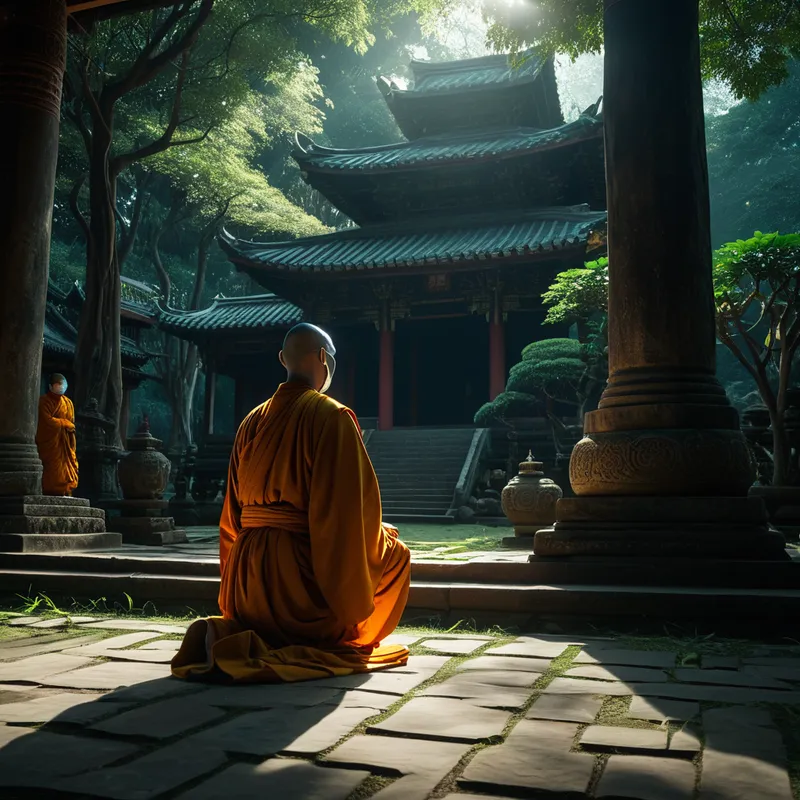
The story of Mokuren is the Buddhist heart grafted onto the ancient, animist soul of Japan. It entered the archipelago with Buddhist scriptures, most notably the Ullambana [Sutra](/myths/sutra “Myth from Hindu culture.”/), and found fertile ground in pre-existing Shinto traditions of ancestral veneration. In Shinto, the dead become Kami—protective, watchful family deities. Obon, or simply Bon, became the ritual calendar’s most poignant expression of this relationship.
The myth was propagated not by bards, but by monks in temple sermons and through emaki scrolls that depicted Mokuren’s vision. Its societal function was multifaceted: it provided a Buddhist ethical framework (the consequences of selfishness, the power of communal charity), it offered profound emotional consolation for the bereaved, and it cemented the family unit as a spiritual continuum stretching beyond death. The festival that grew from it, typically observed in mid-July or August, became a societal reset—a time when cities empty as people return to their ancestral hometowns (furusato), graves are cleaned, and the entire community dances together. It is a collective act of memory that reinforces social bonds among the living as much as it honors the dead.
Symbolic Architecture
At its core, the Obon myth is a masterful map of the [psyche](/myths/psyche “Myth from Greek culture.”/)’s [relationship](/symbols/relationship “Symbol: A representation of connections we have with others in our lives, often reflecting our emotional state.”/) with its own past and its inherited burdens.
The ancestral spirit is not a foreign ghost, but the living memory of our own origin, carrying both the blessing of continuity and the karma of unresolved patterns.
Mokuren represents the conscious ego, gifted with [insight](/symbols/insight “Symbol: A sudden, deep understanding of a complex situation or truth, often arriving unexpectedly and illuminating hidden connections.”/) (his supernatural [sight](/symbols/sight “Symbol: Sight symbolizes perception, awareness, and insight, representing both physical and inner vision.”/)) yet paralyzed by a discovered complex—the suffering, “hungry” [mother](/symbols/mother “Symbol: The symbol of ‘Mother’ represents nurturing, protection, and the foundational aspect of one’s emotional being, often associated with comfort and unconditional love.”/). This mother is the symbolic embodiment of unattended familial karma, a psychic content in [the personal unconscious](/myths/the-personal-unconscious “Myth from Jungian Psychology culture.”/) (and by extension, the [collective unconscious](/symbols/collective-unconscious “Symbol: The Collective Unconscious refers to the part of the unconscious mind shared among beings of the same species, embodying universal experiences and archetypes.”/)) that is starved for acknowledgment and [integration](/symbols/integration “Symbol: The process of unifying disparate parts of the self or experience into a cohesive whole, often representing psychological wholeness or resolution of internal conflict.”/). Her [realm](/symbols/realm “Symbol: The symbol of ‘Realm’ often signifies the boundaries of one’s consciousness, experiences, or emotional states, suggesting aspects of reality that are either explored or ignored.”/), the Gaki-do, is a brilliant [symbol](/symbols/symbol “Symbol: A symbol can represent an idea, concept, or belief, serving as a powerful tool for communication and understanding.”/) of a psychological state: the hell of insatiable repetition, of patterns that consume [energy](/symbols/energy “Symbol: Energy symbolizes vitality, motivation, and the drive that fuels actions and ambitions.”/) but provide no nourishment—addictions, generational traumas, frozen [grief](/symbols/grief “Symbol: A profound emotional response to loss, often manifesting as deep sorrow, yearning, and a sense of emptiness.”/).
The [Buddha](/symbols/buddha “Symbol: The image of Buddha embodies spiritual enlightenment, peace, and a quest for inner truth.”/)’s instruction is the voice of the transcendent function, [the Self](/myths/the-self “Myth from Jungian culture.”/) that guides toward wholeness. The [solution](/symbols/solution “Symbol: A solution symbolizes resolution, clarity, and the overcoming of obstacles, often representing a sense of accomplishment.”/) is not a solitary heroic feat, but a communal offering. [The Sangha](/myths/the-sangha “Myth from Buddhist culture.”/) symbolizes the integrated psyche itself—the various subpersonalities and archetypes unified in a conscious [purpose](/symbols/purpose “Symbol: Purpose signifies direction, meaning, and intention in life, often reflecting personal ambitions and core values.”/). The offering to this “internal [community](/symbols/community “Symbol: Community in dreams symbolizes connection, support, and the need for belonging.”/)” generates the psychic energy (merit) needed to transform the complex.
The ancestors’ return is the most potent symbol of all. It represents the cyclical, necessary [dialogue](/symbols/dialogue “Symbol: Conversation or exchange between characters, representing communication, relationships, and narrative flow in games and leisure activities.”/) between [consciousness](/symbols/consciousness “Symbol: Consciousness represents the state of awareness and perception, encompassing thoughts, feelings, and experiences.”/) and the unconscious. We do not simply “solve” our past; we learn to [host](/symbols/host “Symbol: The symbol of a ‘host’ often represents nurturing, hospitality, or the willingness to offer support and guidance to others.”/) it. We prepare for it, welcome it, acknowledge its [presence](/symbols/presence “Symbol: Presence in dreams often signifies awareness or acknowledgment of something significant in one’s life.”/), share our “[food](/symbols/food “Symbol: Food in dreams often symbolizes nourishment, both physical and emotional, representing the fulfillment of basic needs as well as deeper desires for connection or growth.”/)” (conscious [attention](/symbols/attention “Symbol: Attention in dreams signifies focus, awareness, and the priorities in one’s life, often indicating where the dreamer’s energy is invested.”/) and [emotion](/symbols/emotion “Symbol: Emotion symbolizes our inner feelings and responses to experiences, often guiding our actions and choices.”/)), and then respectfully let it recede back into the [depths](/symbols/depths “Symbol: Represents the subconscious, hidden emotions, or foundational aspects of the self, often linked to primal fears or profound truths.”/) from which it came, now pacified and integrated.
The Dreamer’s Resonance
When this myth stirs in the modern dreamer, it often manifests not as a literal festival, but as a profound somatic and emotional process centered on return and hospitality.
The dreamer may find themselves cleaning a long-neglected, ancestral house—a direct symbol of the psyche preparing for a visitation. They may dream of setting an extra place at a dinner table with a mix of anxiety and anticipation, or of seeing the faces of departed loved ones in a crowd, peaceful and observing. There is often a powerful somatic component: a feeling of a “presence” in the room upon waking, a chill or a sudden warmth, a sense of being watched not with menace, but with poignant familiarity.
Psychologically, this indicates a process of anamnesis—the opposite of amnesia—a “re-membering.” The psyche is gathering scattered, perhaps painful, fragments of personal and familial history. The conflict in the dream is rarely with the ancestors themselves, but with the dreamer’s own capacity to host them. Can they make space? Can they offer the “food” of acknowledgment without being overwhelmed? The dream is [the threshold](/myths/the-threshold “Myth from Folklore culture.”/) ritual, preparing the conscious self for the conscious integration of what has been forgotten or repressed.

Alchemical Translation
The alchemical journey modeled by the Obon myth is not one of slaying dragons, but of sacred hospitality. It is the transmutation of ghostly complexes into guiding ancestors.
The [prima materia](/myths/prima-materia “Myth from Alchemical culture.”/), the base matter, is the discovered suffering—Mokuren’s vision of his mother in torment. This is the initial, painful confrontation with a shadow element, often linked to the mother or father complex, that feeds on our psychic energy (the “hunger”). The first operation is confessionio—the heartfelt acknowledgment and lamentation Mokuren brings to the Buddha. He does not hide the wound.
The key alchemical stage is the offering (sacrificium). This is not a sacrifice in the sense of loss, but in its original meaning: to make sacred. [The ego](/myths/the-ego “Myth from Jungian culture.”/) (Mokuren) must offer its energy and devotion not directly to the chaotic complex, but to the higher, ordering principle of the Self (the Sangha as symbol of the integrated psyche). This is the act of engaging in conscious ritual, therapy, or creative practice—the structured vessel that contains the transformation.
Individuation is the festival where we learn to be a gracious host to every ghost in our lineage, transforming their hunger into a story that feeds the soul.
The liberation of the mother is the [solutio](/myths/solutio “Myth from Alchemical culture.”/)—the dissolving of the complex’s compulsive, torturous form. It is freed from its fixed, suffering state. Finally, the return of the ancestors is the coagulatio—the complex reappears, but now in a new, sanctified form. It is no longer a hungry ghost draining us in the shadows, but a remembered ancestor who visits, shares wisdom, and blesses. It is integrated. The psychic energy once bound in repression and symptom is now available to consciousness as wisdom, connection, and a sense of rooted continuity.
Thus, the ultimate alchemical gold forged in this process is sacred continuity. The individual no longer feels like an isolated self, but as a living link in a great chain of being. They hold the past not as a burden, but as a gathered community of memory within, whose annual return—whether in meditation, reflection, or actual ritual—becomes a source of strength, identity, and profound peace.
Associated Symbols
Explore related symbols from the CaleaDream lexicon: