Obon Myth Meaning & Symbolism
A monk's profound grief for his mother leads him to the underworld, revealing the path to liberate the suffering dead and creating a festival of ancestral return.
The Tale of Obon
Listen, and let the veil between worlds grow thin.
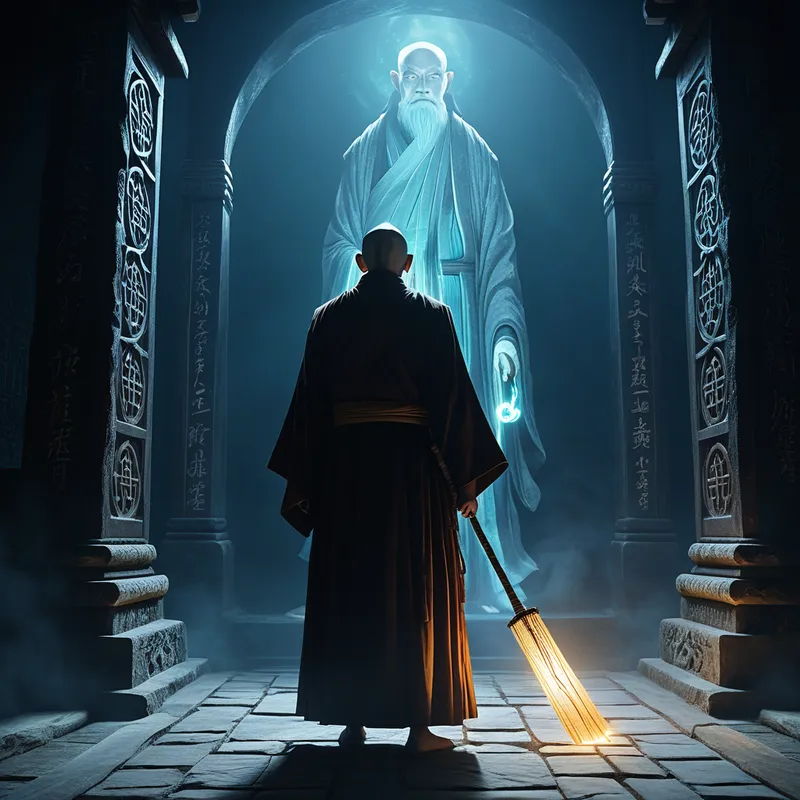
In a time when the mountains spoke and the rivers remembered, there lived a monk named Mokuren. He was a man of profound discipline, his mind a clear lake reflecting the teachings of the Buddha. Yet, beneath that tranquil surface, a deep, cold current ran: a grief for his mother, who had passed from this world. He missed the sound of her voice, the shape of her kindness.
Through the power of his deep meditation, Mokuren’s vision pierced the fabric of reality. He sought her, not in memory, but in truth. His spirit journeyed through the realms of existence, and what he found shattered his enlightened calm. He did not find his mother in a peaceful heaven or a quiet rest. He found her in Gaki-do, the Realm of Hungry Ghosts.
She was a wraith of torment. Her form was emaciated, her throat as thin as a needle, her belly swollen and empty with a hunger that could never be sated. She was surrounded by offerings of food and drink, but when she reached for them, they burst into flame or transformed into filth. This was her karma, the fruit of a life lived with greed and selfishness. Seeing his beloved mother in such eternal, desperate agony, Mokuren’s heart broke like a dry branch. The serene monk was consumed by a disciple’s helpless grief.
Weeping, he rushed to the Buddha. He prostrated himself and begged, “Master! My mother suffers unimaginably! What merit I have gained, I give to her! What can I do?”
The Buddha, his compassion as vast as the sky, saw the depth of Mokuren’s filial love. “The karma of one being cannot be easily undone by another,” he said, his voice both gentle and firm. “But the power of a compassionate act, performed by the many for the sake of the one, can create a tide that lifts all boats. Go. On the fifteenth day of the seventh month, when the monastic retreat ends and the community is pure, prepare a great offering. Fill bowls with the purest food and drink. Dedicate the merit of this act not only to your mother, but to all suffering ancestors and forgotten spirits.”
Mokuren did as instructed. He gathered the monastic community. Together, they prepared a feast not for living mouths, but for hungry souls. With focused intent and boundless compassion, they offered the fruits of their practice.
And then, a miracle unfolded. In Gaki-do, the flames around the offerings died. The polluted food became pure. Mokuren’s mother, for the first time in an eternity, could eat. She could drink. The agonizing hunger ceased. In her relief, her heart, clenched tight by selfishness in life, softened. In that moment of grace, she remembered not lack, but love. The karma of her past was not erased, but its grip was loosened by the compassionate energy directed toward her.
Freed from her immediate torment, she danced. A dance of joy, of gratitude, of release. It was this dance of liberation that Mokuren witnessed from our world. His tears then were not of sorrow, but of profound relief and awe. The Buddha smiled. “Henceforth,” he declared, “this shall be a time when the gates between worlds open. The living shall make offerings to ease the journey of the dead, and the dead, comforted, shall return to bless the living.” And so, Obon was born.
Cultural Origins & Context
The story of Mokuren (Sanskrit: Maudgalyayana) is rooted in the Urabon Sutra, which entered Japan from China alongside Buddhism in the 6th and 7th centuries. It did not replace the existing indigenous veneration of ancestors but rather provided a powerful narrative framework and ritual structure for it. In pre-Buddhist Japan, the spirits of the dead, or shirei, were believed to return to the community during specific times of the year, a concept that seamlessly fused with the Buddhist tale.
Obon became the pinnacle of this ancestral dialogue. It was traditionally told not just by monks, but within families, by grandparents to grandchildren, as they cleaned graves and prepared offerings. Its societal function was multifaceted: it was a ritual of filial piety, a communal act of charity that extended even to lonely, forgotten spirits (muenbotoke), and a crucial mechanism for maintaining social and cosmic order. By caring for the dead, the living ensured the ancestors’ benevolent protection and purified the collective karma of the community, reinforcing the interdependent web connecting all beings, past and present.
Symbolic Architecture
At its core, the myth of Obon is a masterful map of the psychology of grief, guilt, and integration. Mokuren represents the conscious mind, disciplined and seeking enlightenment. His mother symbolizes the unresolved, shadowy contents of the personal and collective past—the aspects of our lineage and our own psyche that we have relegated to a state of suffering and neglect, “hungry” for acknowledgment.
The Hungry Ghost is not merely a tormented ancestor; it is the image of any part of the self, or our history, that we have abandoned to a state of insatiable lack.
The Realm of Hungry Ghosts is not a literal hell but a profound psychological state: the prison of unattended trauma, repetitive compulsion, and emotional starvation that results from actions (karma) born of ignorance and selfishness. Mokuren’s journey to this realm is the necessary, painful descent into one’s own underworld to face what is suffering there.
The Buddha’s instruction is the alchemical key. Personal grief alone cannot heal the ancestral wound; it requires a communal, ritualized act of compassion. The offering is not just food, but conscious attention and loving intention directed toward the wounded fragment. This transforms the energy around it, allowing the “ghost” to finally “eat”—to be integrated, its story heard, its pain held. The mother’s dance is the symbol of liberation that follows acknowledgment, the release of bound energy back into the flow of life.

The Dreamer’s Resonance
When the pattern of Obon stirs in the modern dreamer, it signals a profound somatic and psychological process: the call of the unattended dead. This may not be literal ancestors, but the “ghosts” of past relationships, abandoned talents, childhood wounds, or family secrets that haunt the basement of the psyche.
Dreams may feature empty, endless hallways (Gaki-do), figures who are frail and reaching, or recurring images of spoiled feasts. One might dream of preparing a meal for someone unseen, or of a parent figure trapped behind a thin, impassable barrier. The somatic experience is often one of a hollow ache, a tightness in the throat or gut—the very physiology of the Hungry Ghost. This is the psyche’s ritual time, its internal “seventh month,” demanding that the dreamer stop and make an offering of their attention to what has been left unfed. The emotional tone is not of horror, but of deep, melancholic longing and a responsibility that feels both heavy and sacred.

Alchemical Translation
The Obon myth models the complete cycle of psychic transmutation, or individuation. It begins with Awareness (Mokuren’s Vision): the conscious ego, through introspection or crisis, becomes aware of a suffering, neglected complex within the greater Self.
This leads to the Descent (Journey to Gaki-do): one must courageously turn toward the pain, exploring the personal and often ancestral underworld without flinching. This is the shadow-work.
Then comes the Ritual Offering (The Buddha’s Instruction): raw awareness is not enough. The alchemical act is to ritualize compassion. This translates psychologically as creating a dedicated, respectful inner space—through journaling, active imagination, therapy, or art—to “offer” presence to the wounded part. It is the act of witnessing without judgment, of giving the hunger a voice.
The offering transmutes the energy of guilt and grief into the energy of responsibility and connection.
The result is Integration & Release (The Mother’s Feast and Dance): as the complex is fed with consciousness, its tormented, ghostly form dissolves. Its locked-up energy is released, not as chaos, but as a blessing—a new sense of vitality, creativity, or peace that flows back into the personality. The ancestor is no longer a hungry ghost demanding tribute, but a supportive ancestor offering wisdom. The past is reconciled, and the individual is more whole, carrying their history not as a burden, but as an integrated part of their tapestry. The festival lights that guide the spirits home are, in the end, the lanterns we light within our own souls.
Associated Symbols
Explore related symbols from the CaleaDream lexicon: