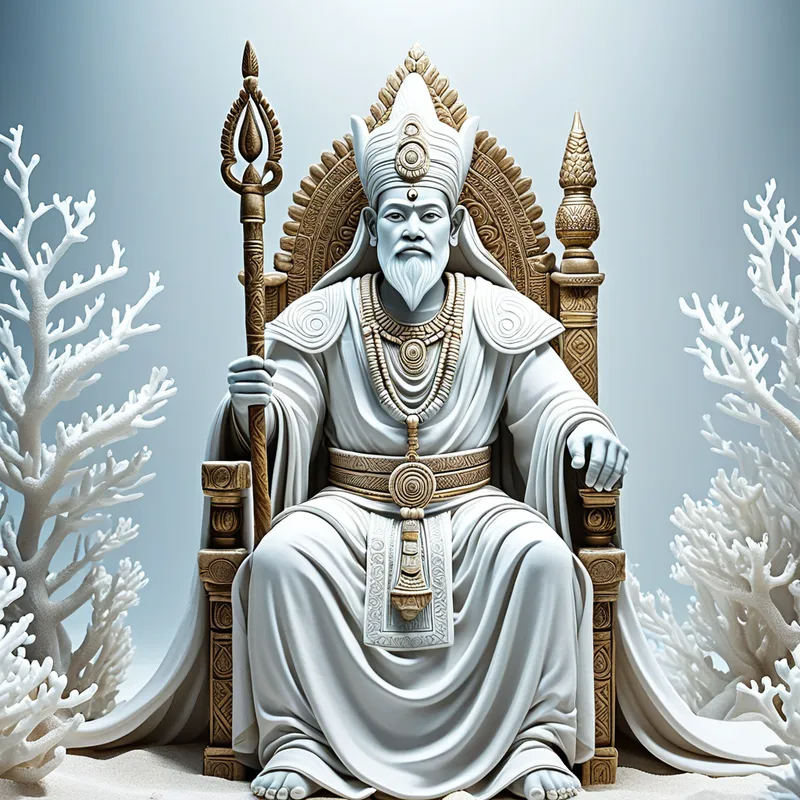
Obatala Myth Meaning & Symbolism
The story of the divine sculptor who shaped humanity from clay, his fall from grace through intoxication, and his path of redemption through patience and order.
The Tale of Obatala
In the time before time, when the world was a marshy, formless expanse of water and mist, the Supreme Source, [Olodumare](/myths/olodumare “Myth from Yoruba culture.”/), looked upon the void. From the company of the Orisha, one was chosen for a task of supreme gravity. His name was Obatala, whose essence was cool, clear thought and meticulous intention. To him, [Olodumare](/myths/olodumare “Myth from Yoruba culture.”/) gave a sacred snail shell filled with earth, a five-toed hen to scatter it, and a single, luminous palm nut containing the spark of life.
Obatala descended the great chain from Orun to Aye, alighting upon the vast waters. He poured the earth upon the primordial sea. The hen scratched and scattered, and the earth spread, forming the solid land of Ile-Ife. There, under a sky of molten brass, Obatala began his work. From the clay of the new earth, he sculpted forms. With hands guided by divine patience, he shaped heads, torsos, limbs, pouring into each vessel the breath of life from the palm nut. These were the first humans, and Obatala watched over them as a careful father.
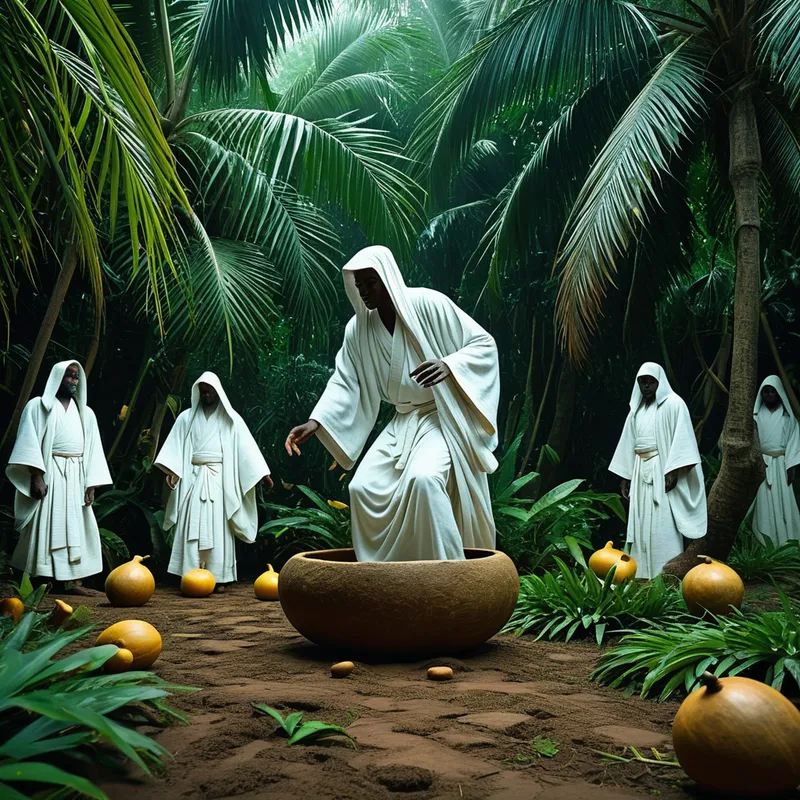
But creation is a labor that stretches the soul. The heat of the young world was immense. To soothe his weariness, Obatala tapped a palm tree and drank its sweet, fermenting sap. The wine was cool and pleasant. He drank more. The world softened at its edges; his legendary precision began to blur. In this state of divine intoxication, his hands lost their surety. The figures that emerged from the clay were no longer perfect. Some were blind, some lame, some bore marks of difference. He worked on, unaware, until sleep overcame him.
When he awoke, clear-headed and horrified, he saw his legacy. Amidst the perfectly formed beings stood those shaped by flawed hands. A profound sorrow filled Obatala, a weight heavier than any mountain. He made a vow then, a covenant that would define his essence for all ages: never again would he drink of the palm wine. He would cloak himself only in white, the color of purity, clarity, and remorse. He became the protector of all those he had shaped, the perfect and the imperfect alike, swearing to be their compassionate advocate before Olodumare. Thus, the Creator became the Redeemer, and his flaw became the foundation of his boundless compassion.
Cultural Origins & Context
The myth of Obatala is central to the spiritual and cosmological worldview of the Yoruba people of West Africa, with roots extending deep into the ancient past of the Ile-Ife kingdom. This is not a mere story but a foundational itan, transmitted orally for centuries by priests (Babalawo) and storytellers. It was performed during festivals, most notably the Olojo, and invoked in the complex systems of Ifá and Orisha worship.
Its societal function is multifaceted. It establishes the sacred origin of humanity and the city of Ile-Ife. It provides a divine rationale for human diversity and physical difference, teaching that all life, regardless of form, is intrinsically sacred and under the protection of a creator who understands imperfection intimately. The myth also codifies important social values: the virtue of patience (Suuru), the dangers of intemperance, and the paramount importance of clear intention (Iwa pele). Obatala’s story is a moral compass, a theodicy explaining suffering, and a charter for the compassionate inclusion of all people into the community.
Symbolic Architecture
At its core, the myth of Obatala is a profound [allegory](/symbols/allegory “Symbol: A narrative device where characters, events, or settings represent abstract ideas or moral qualities, conveying deeper meanings through symbolic storytelling.”/) for the act of creation and the inevitable encounter with the [creator](/symbols/creator “Symbol: A figure representing ultimate origin, divine power, or profound authorship. Often embodies the source of existence, innovation, or personal destiny.”/)‘s own [shadow](/symbols/shadow “Symbol: The ‘shadow’ embodies the unconscious, repressed aspects of the self and often represents fears or hidden emotions.”/). Obatala represents the archetypal principle of [Consciousness](/symbols/consciousness “Symbol: Consciousness represents the state of awareness and perception, encompassing thoughts, feelings, and experiences.”/), Order, and Form imposing itself upon the [Chaos](/symbols/chaos “Symbol: In Arts & Music, chaos represents raw creative potential, uncontrolled expression, and the breakdown of order to forge new artistic forms.”/) of the unmanifest.
The first act of creation is separation: land from water, form from formlessness. This is the birth of distinction, the prerequisite for identity.
The Waters of the beginning symbolize the undifferentiated, potential-filled unconscious. The [Earth](/symbols/earth “Symbol: The symbol of Earth often represents grounding, stability, and the physical realm, embodying a connection to nature and the innate support it provides.”/) is the [emergence](/symbols/emergence “Symbol: A process of coming into being, rising from obscurity, or breaking through a barrier, often representing birth, transformation, or revelation.”/) of the conscious ego, a [platform](/symbols/platform “Symbol: A platform symbolizes a stage for expression, support, or a foundation upon which something is built.”/) from which to work. Obatala’s tools—the [snail](/symbols/snail “Symbol: The snail represents patience, slow progress, and introspection due to its deliberate movement.”/) [shell](/symbols/shell “Symbol: Shells are often seen as symbols of protection, transition, and the journey of personal growth.”/) (wisdom, containment), the hen ([activity](/symbols/activity “Symbol: Activity in dreams often represents the dynamic aspects of life and can indicate movement, progress, and engagement with personal or societal responsibilities.”/), manifestation), and the [palm](/symbols/palm “Symbol: The palm tree symbolizes resilience, victory, and peace, often associated with tropical climates.”/) nut (the animating [spirit](/symbols/spirit “Symbol: Spirit symbolizes the essence of life, vitality, and the spiritual journey of the individual.”/), the Self)—represent the necessary resources of the psyche for bringing inner potentials into [reality](/symbols/reality “Symbol: Reality signifies the state of existence and perception, often reflecting one’s understanding of truth and life experiences.”/).
His intoxication is the critical turn. The Palm [Wine](/symbols/wine “Symbol: Wine often symbolizes celebration, indulgence, and the deepening of personal connections, but it can also represent excess and escape.”/) symbolizes the seductive pull of the unconscious, the numbing agent that allows repressed or unintegrated aspects to bypass the censoring, ordering function of consciousness. In this state, the creator is not absent but compromised; the forms that emerge are shaped by the unrecognized contents of his own psyche—the flaws, the vulnerabilities, the “otherness” he had not consciously acknowledged.
Redemption is not found in erasing the flaw, but in soberly acknowledging it, taking responsibility for it, and weaving it into a new, more compassionate identity.
Thus, Obatala’s vow and his white [robes](/symbols/robes “Symbol: Robes symbolize social roles, authority, and spiritual or professional identity, often representing the persona one presents to the world.”/) signify the hard-won [integration](/symbols/integration “Symbol: The process of unifying disparate parts of the self or experience into a cohesive whole, often representing psychological wholeness or resolution of internal conflict.”/). He does not disown the “imperfect” creations; he becomes their sworn protector. The White is not the white of sterile perfection, but of clarified consciousness that has looked upon its shadow and chosen [responsibility](/symbols/responsibility “Symbol: Responsibility in dreams often signifies the weight of duties and the expectations placed upon the dreamer.”/) over denial.

The Dreamer’s Resonance
When this myth stirs in the modern dreamer, it often signals a profound process of self-encounter at the level of one’s creative identity and personal responsibility. To dream of shaping forms from clay or mud speaks to an active, formative period in the psyche, where one is attempting to give shape to an idea, a relationship, or one’s own life path.
Dreams of flawed sculptures, misshapen creations, or a sense of having “messed up” a delicate project while in a distracted or altered state point directly to the Obatala moment. The dreamer may be confronting the consequences of acting without full consciousness—perhaps making a life decision under the influence of an intoxicating emotion (rage, infatuation, pride), or a numbing avoidance (addiction, dissociation). The somatic feeling is often one of heavy regret, a sinking realization, or a weight on the chest: the burden of the creator’s guilt.
Conversely, dreams featuring clean white spaces, white garments, or a serene, authoritative figure offering calm guidance can signal the emergence of the integrative, redemptive Obatala energy. It is the psyche moving from the chaos of error into the phase of sober acknowledgment, patient repair, and the extension of compassion—first to the flawed aspects of oneself, and then to others.
Alchemical Translation
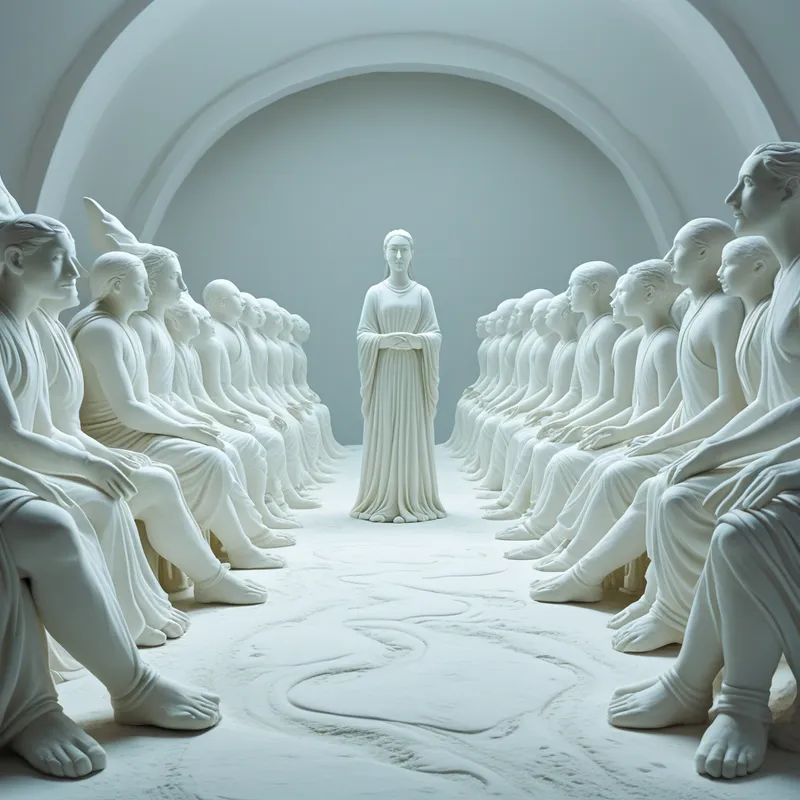
The Obatala myth is a masterful map for the alchemical process of psychic transmutation, central to Jung’s concept of individuation. It models the full cycle: from the nigredo (blackening) of failure and despair to the albedo (whitening) of purification and integration.
The initial, perfect creation represents the ego’s idealized self-image and its attempts to build a life according to a “perfect” plan. The intoxication and flawed creation are the inevitable nigredo—the confrontation with the shadow. Our intoxicant is whatever we use to avoid this confrontation: workaholism, dogmatic thinking, or any ideology that promises perfection by excluding the messy, human, “imperfect” parts of ourselves.
The palm wine is the lie that we can create without the participation of our whole selves.
Obatala’s awakening is the moment of painful ego-deflation, the end of inflation. This is not the end, but the crucial beginning of real psychological work. His vow is the commitment to the individuation process: to stay conscious, to forgo the numbing agents, and to face reality with clarity (Albedo).
The final stage is not a return to a pre-fall state, but an ascent to a higher synthesis. The integrated Obatala is the Senex in his positive aspect: not a rigid ruler, but a compassionate guardian of order born from experience. He holds the tension between the ideal of form and the reality of flaw. For the modern individual, this translates to building a personality that is no longer brittle in its pursuit of perfection, but resilient in its acceptance of complexity. We become the creators of our lives not by avoiding error, but by embracing the responsibility for our whole story—the straight lines and the crooked ones—and in doing so, finding the authority to advocate for the wholeness in others.
Associated Symbols
Explore related symbols from the CaleaDream lexicon:
- Clay — The primal substance of form and potential, representing the malleable material of the self and life that is shaped by conscious intention or unconscious impulse.
- Water — The primordial chaos, the unconscious mind from which all form emerges and into which the unintegrated self can dissolve.
- Mountain — The lofty ideal, the peak of conscious achievement and clarity that Obatala represents, and the heavy burden of responsibility he carries after his fall.
- Cup — The vessel of experience, specifically the calabash of palm wine, symbolizing the container for intoxicating emotions or escapes that lead to a loss of conscious control.
- Order — The fundamental principle Obatala embodies, the divine impulse to structure chaos into harmonious, intelligible form, both in the cosmos and the psyche.
- Father — Obatala as the progenitor, the archetypal father who creates, provides structure, and whose legacy is defined by both his skill and his failure.
- Grief — The profound, transformative sorrow that follows the realization of one’s own flawed creation, the necessary catalyst for the vow of redemption.
- Healing — The process initiated by Obatala’s vow, representing the long, patient work of integrating flaw into wholeness and extending compassion to wounded parts.
- Light — Not a blinding light of perfection, but the clear, white light of sober consciousness, clarity of purpose, and enlightened responsibility that follows the period of darkness.
- Ritual — The embodied practice of remembrance and transformation, symbolized by Obatala’s donning of white and his festivals, marking the commitment to a new, conscious way of being.