
Oaths to Odin Myth Meaning & Symbolism
A myth of binding oaths sworn on the ring of Odin, where broken words summon the god's fury, revealing the sacred terror of a spoken promise.
The Tale of Oaths to Odin
Listen, and hear the price of a word.
In the days when the wind spoke with the voice of giants and the roots of the Yggdrasil drank from wells of memory and fate, a word was not a breath. It was a thing forged, a weapon shaped, a chain willingly taken up. And the master of all such bindings was Odin, the One-Eyed, the Hanged God.
He who had traded an eye for a drink from Mímir’s Well. He who had hung nine nights on the windy tree, a spear in his side, to win the runes. He understood the terrible algebra of the cosmos: nothing of worth is gained without a cost given. And so, he became the witness, the enforcer, the sacred terror behind the spoken vow.
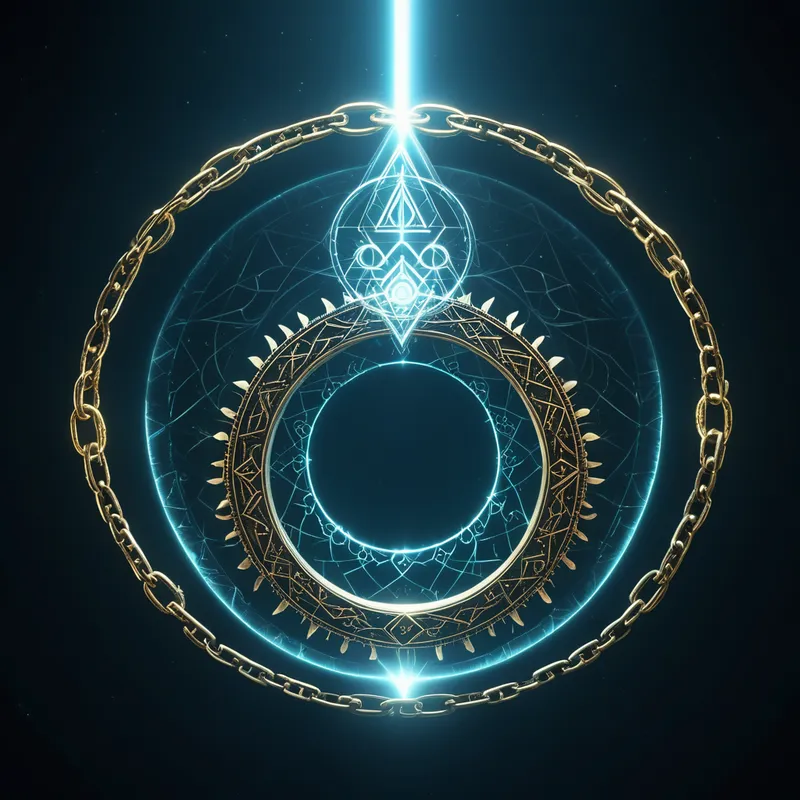
When kings would meet to settle blood-feuds, or chieftains to forge alliances, they did not call upon gentle gods. They called upon him. The scene was never one of light, but of solemn twilight—in a smoke-hazed hall, the firelight dancing on drawn swords and anxious faces, or upon a windswept promontory under a grey sky. The ring-oath was prepared. Not a simple band, but the ring of Odin itself, or its earthly echo: a massive arm-ring, often kept on a temple altar, cold and heavy with the weight of promises.
The one who would swear would step forward. The air would grow still, as if the world held its breath. He would lay his hand upon the ring, its metal biting into his palm. He would feel the gaze of the others upon him, but more than that, he would feel another gaze—a distant, piercing focus from beyond the roof of the hall, from the high seat of Valhalla. Odin was listening.
The words were spoken then, clear and hard as stones dropped into a deep pool. “I swear by Odin, by the ring and the spear, that I shall…” And the vow would unfold, binding land, loyalty, life. In that moment, a thread was spun from the swearer’s very being and knotted into the tapestry of ørlög. The ring was not just a symbol; it was the socket, the anchor point. To break the oath was to tear that thread, to unravel not just a pact, but a part of the cosmic order Odin upheld.
And the Hanged God did not forget. The one who broke faith would find the luck, the hamingja, draining from his life like blood from a wound. Battles would turn against him. Friends would become foes. The land itself might grow barren. And in the end, it was said, Odin’s chosen, the Einherjar, might be forbidden to him. His name would be cursed, not just by men, but by the structure of reality. The oath-breaker was cast adrift, outside the sacred law, and into the waiting maw of chaos.

Cultural Origins & Context
This mythic understanding was not confined to a single story but was the bedrock of Norse social and legal reality. It was a pre-literate society’s binding contract law, underwritten by divine fury. The practice is attested in sagas like the Heimskringla and the Landnámabók, and in the eddic poetry. The ring-oath was a public, ritual act, transforming a personal intention into a cosmic fact.
The tellers of this “myth” were every chieftain, every goði (priest-chieftain), every father in a hall. It was lived theology. The societal function was paramount: in a world of fragile alliances and constant threat, a man’s word had to be his absolute bond for society to cohere. The fear of Odin’s retribution was a more powerful deterrent than any earthly court. It created a web of sacred obligation that held the volatile Viking Age world together, making reputation and honor the most valuable currencies one possessed.
Symbolic Architecture
At its core, the myth of Oaths to Odin is about the terrifying creative power of speech and the absolute integrity of the self. Odin, the god of wisdom won through extreme sacrifice, represents the transcendent consciousness that holds the pattern of order against chaos. The oath is a microcosm of that order—a personal cosmos created by a declaration.
To swear an oath is to plant a seed of your future self in the soil of the present. To break it is to poison your own roots.
The ring symbolizes wholeness, eternity, and binding. To place your hand upon it is to willingly encircle your own will, to limit your future choices for the sake of a greater structure. The spear, Gungnir, represents the piercing, unavoidable consequence that follows a broken word—fate itself, aimed and thrown.
Psychologically, Odin is the archetype of the inner sovereign, the part of the psyche that seeks structure, meaning, and wisdom. The oath represents a commitment made from this place of sovereignty—a vow to one’s own highest values, a promise to the soul. The terror of breaking it is the psychic catastrophe of self-betrayal, which leads to a loss of inner authority, a fragmentation of identity, and a descent into what feels like cursed luck or existential chaos.
The Dreamer’s Resonance
When this myth stirs in the modern unconscious, it rarely appears as Vikings and arm-rings. It manifests as dreams of binding contracts signed in dread, of making a solemn promise to a shadowy, authoritative figure, or of being pursued for a debt whose nature is unclear but feels sacred. One might dream of their own voice echoing with unnatural power, or conversely, of being unable to speak while something vital hangs in the balance.
Somatically, this can feel like a constriction in the throat or chest—the “word” stuck, or the weight of a promise felt physically. Psychologically, the dreamer is likely at a crossroads where a significant commitment—to a relationship, a career path, a creative project, or a personal truth—is being weighed. The dream is the psyche’s ritual circle, asking: Are you willing to bind your future to this? Do you understand the cost of breaking faith with yourself? The anxiety is not pathological but initiatory, marking the threshold of a serious step into a new phase of identity.

Alchemical Translation
The alchemical process modeled here is the nigredo—the blackening, the dissolution of the old, careless self through the heat of sacred obligation. The first step is the sacrifice: the willing surrender of casual freedom (Odin’s eye) for the sake of a conscious goal (wisdom). Then comes the oath: the formal, ritualized binding of the will to that goal (hanging on the tree to win the runes).
Individuation is not freedom from promises, but the conscious, fearful, and glorious act of making the right promises to your own soul, and becoming the god who enforces them.
For the modern individual, the “ring of Odin” is any profound commitment that shapes identity: marriage vows, a dedication to a craft, the decision to become a parent, or the vow to heal a trauma. The “spear of consequence” is the inevitable, often painful, feedback from life when we are inauthentic or break faith with that commitment. The process of psychic transmutation occurs in the tension between the vow and its fulfillment. By holding to our oaths—especially those made to our deepest selves—we forge integrity. We move from being subject to random whims to being a sovereign, oath-bound entity, constructing a meaningful life one kept promise at a time. We become, in a sense, both the oath-swearer and the Odin who witnesses, the creature and the law that binds it, achieving a hard-won wholeness.
Associated Symbols
Explore related symbols from the CaleaDream lexicon: