
Oaths sworn on Gungnir Myth Meaning & Symbolism
A vow sworn on Odin's unerring spear binds the cosmos itself, weaving the speaker's fate into the fabric of destiny with unbreakable consequence.
The Tale of Oaths sworn on Gungnir
Hear now, and listen well, for I speak of the moment when words become chains, and breath becomes fate.
In the high hall of Valhalla, where the rafters are made of spears and the roof of shields, a silence fell that was deeper than the well of Mímisbrunnr. The din of feasting einherjar ceased. The whispers of the Óskmeyjar stilled. All eyes turned to the high seat, Hliðskjálf, where the All-Father sat. His one eye, a pool of frozen sky and ancient memory, saw not just the hall, but the tangled roots of all things that were and would be.
Before him stood two jarls, their faces etched with a conflict that threatened to spill the blood of their kin. Words had been thrown like axes, honor questioned, lineage insulted. The very air between them crackled with the promise of steel and fire. To let this strife run its course was to sow the seeds of a feud that would drown the land in red for generations.
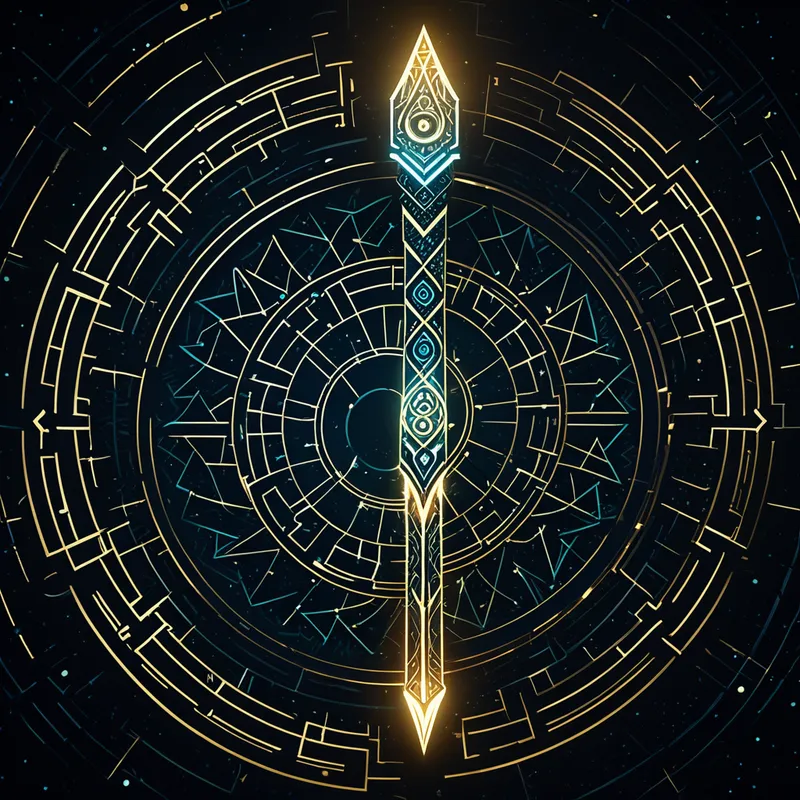
Odin rose. He did not speak. He simply lifted from beside his seat his spear, Gungnir. It was no mere weapon of ash and iron. Forged by the dark smiths, the Sons of Ivaldi, in the deep, singing caverns of the earth, it was a thing of cosmic law. Its shaft, dark as Yggdarsil’s heartwood, was carved with runes that hummed with a low, potent frequency—the same runes Odin had won with his own agony, hanging on the World Tree. Its point, eternally keen, never dulled, for it was honed not on a wheel but on the whetstone of destiny itself.
He planted the butt of Gungnir upon the stone floor of Valhalla. The sound was not a clang, but a thrum, a deep note that vibrated in the chests of all present and echoed out through the branches of the Yggdrasil, felt in Asgard, Jötunheimr, and even in the silent depths of Hel.
“Speak your peace,” Odin’s voice was the rustle of autumn leaves, the crackle of distant lightning. “But know this. Any oath sworn here, with hand upon this shaft, is sworn not to me, nor to your foe, but to the weave of ørlög itself. It becomes a thread in the great tapestry. To break it is not to offend a man; it is to unravel a piece of the world. The spear does not forget. The runes do not forgive. The Tree itself will enforce the binding.”
The first jarl, his beard flecked with grey, stepped forward. The firelight danced on the fear in his eyes, but deeper still was a resolve for peace. He placed his broad, scarred hand upon the cold runes of Gungnir’s shaft. He felt them move beneath his palm, not physically, but in his soul—a shifting, an aligning. He spoke his oath: to relinquish his claim, to pay the weregild, to let the blood-feud end with him. As the last word left his lips, a visible shudder went through him, as if a cold, invisible thread had been sewn through his heart and tied to the core of the universe.
The second jarl, younger, his anger still hot, hesitated. He looked from the implacable face of Odin to the deadly point of the spear, aimed eternally at the chaos of the unseen. He saw in it the end of all his grievances, the silencing of his pride. Swallowing the bitter draught of necessity, he too stepped forward. His hand touched the shaft beside his rival’s. He swore his oath: to accept the payment, to proclaim the matter settled before all his people, to raise no sword from this day forth. As he swore, the hall seemed to grow darker, the shadows longer, as if the oath drew substance from the very light around it, making it real.
Odin nodded, a slow, grave motion. He lifted Gungnir. The binding was complete. The tension in the hall broke like a thawing ice. The oaths were now part of the structure of things, as immutable as the mountains—until Ragnarök itself. The jarls departed, their conflict transformed from a wildfire into a sealed runestone, heavy with consequence but containing the peace.

Cultural Origins & Context
This practice of oath-swearing was not merely a poetic device of the skalds, but a reflection of a fundamental pillar in Norse and wider Germanic societal structure. In a world without centralized, bureaucratic law, where a man’s word and honor were his primary social currency, the oath was the sacred glue of society. It bound treaties between kings, sealed marriages, finalized property exchanges, and ended blood feuds.
The myths, preserved in texts like the Poetic Edda and the Prose Edda of Snorri Sturluson, served as the divine template for this human necessity. By projecting the act onto the gods, specifically onto Odin as the sovereign of cosmic order, it elevated the earthly oath to a cosmic principle. To swear an oath was to participate in a ritual that mirrored the gods’ own actions in binding the wolf Fenrir or in establishing the boundaries of the realms. The spear Gungnir, as Odin’s primary attribute, symbolized his unwavering will, his authority, and his connection to the fateful knowledge of the runes. Swearing upon it was to place oneself under the jurisdiction of the All-Father’s grim, farsighted justice.
Symbolic Architecture
At its core, the myth of oaths sworn on Gungnir is an archetypal drama about the moment the personal will encounters and submits to a transpersonal order. Gungnir is not just a weapon; it is the axis of law, the unwavering line of truth in a chaotic world.
The oath is the point where the fluidity of intention crystallizes into the architecture of destiny.
The spear itself is a profound symbol. As a piercing, directional object, it represents focused intent, decisive action, and the penetration of chaos to establish order. Its “unerring” quality signifies the inescapable truth of a promise once made—it will find its mark, either in fulfillment or in the retribution of its breaking. The runes carved upon it are the raw, grammatical code of reality, the laws of existence written in a divine language. To touch them while swearing is to literally “sign your name” on the cosmic contract.
The act of swearing symbolizes the conscious sacrifice of personal ambiguity for the sake of a created reality. The jarls sacrifice their potential futures—the future of vengeance, of unchecked pride, of chaotic conflict—to gain a different future: one of peace, order, and stability. It is a sacred trade, mediated by the ultimate sovereign archetype, Odin.
The Dreamer’s Resonance
When this myth pattern stirs in the modern unconscious, it rarely appears as a scene of Vikings and spears. Instead, the dreamer may find themselves in a stark, pressurized situation where they are compelled to “give their word” on something of immense consequence. They may be signing a contract that feels unnervingly final, speaking a promise that echoes with too much weight, or standing before a faceless authority figure demanding a commitment.
The somatic experience is key: a feeling of coldness (the touch of the spear’s shaft), a tightening in the chest or throat (the binding of the invisible thread), and a profound sense of the dream-space itself listening and recording. This dream signals a crossroads in the dreamer’s psychological life. An inner conflict—perhaps between desire and responsibility, between freedom and commitment, or between two irreconcilable parts of the self—has reached a pitch where it demands resolution. The unconscious is presenting the ultimatum: you must consciously choose a path and swear to it, or the internal civil war will continue to rage, consuming psychic energy. The dream is the psyche’s own “All-Father” insisting on an oath to one’s own deeper law.

Alchemical Translation
The alchemical process mirrored here is Coagulation—the stage where the volatile, fluid elements of the prima materia (the raw conflict, the ambiguous desires) are fixed into a solid, durable form. The psychic chaos of indecision, competing loyalties, and unresolved anger is the raw ore. The conscious, agonizing decision to make a binding promise is the fire of the forge. Gungnir is the mold.
Individuation requires us to become our own oath-giver and oath-bound, to plant the spear of our own authority in the ground of our being and swear to the truths we have wrested from chaos.
For the modern individual, this myth models the terrifying and necessary act of self-binding. We are not summoned before Odin; we must summon the Odinic principle within ourselves—the part that can see long consequences, that values the structure of a life over the fleeting heat of every impulse. To “swear on Gungnir” is to make a vow to oneself: to quit the destructive habit, to commit to the creative project, to choose the difficult but meaningful relationship, to finally forgive. It is to recognize that without such sacred, self-imposed bonds, the psyche remains in a state of childish flux, incapable of building the enduring structures of a mature identity.
The myth warns that this is not done lightly. The oath extracts a price—the sacrifice of other possibilities, the burden of integrity. But it also offers the reward: the peace of Valhalla, the inner order that comes from having one’s word and one’s being aligned into a single, unerring point of purpose. It is how we weave our own thread, consciously and responsibly, into the tapestry of our fate.
Associated Symbols
Explore related symbols from the CaleaDream lexicon: