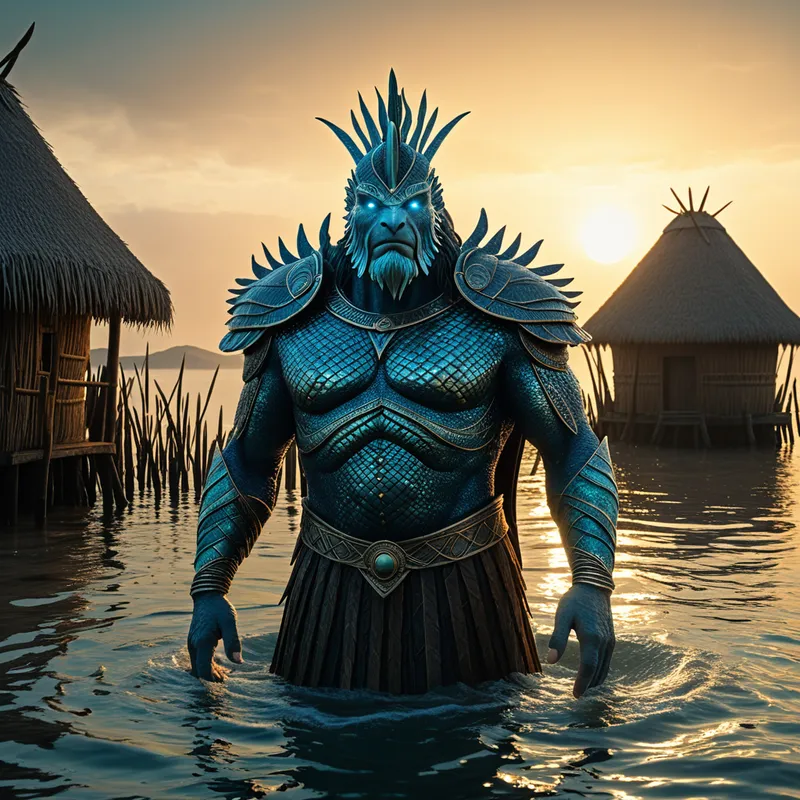
Oannes Myth Meaning & Symbolism
A primordial being emerges from the sea to teach humanity the arts of civilization, then returns to the deep, leaving a legacy of knowledge.
The Tale of Oannes
In the first time, when the world was young and soft, humanity lived like the beasts of the field. They knew no cities, no laws, no letters. They ate the grasses of the earth with their mouths and dwelled in confusion. The land was a formless whisper, and the people were shadows upon it.
Then, from the womb of the Erythraean Sea, a stirring began. It was not a storm, but a rising. In the place where the dawn first touches the water, a form breached the surface. It was Oannes.
His body was the body of a fish, vast and scaled, glistening with the deep's own darkness. Yet, from this piscine form rose the head and torso of a man, bearded and ancient, with eyes that held the patience of abyssal currents. His voice, when it came, was not of the air but of the water made sound—a resonant murmur that settled upon the land and into the bones of those who heard.
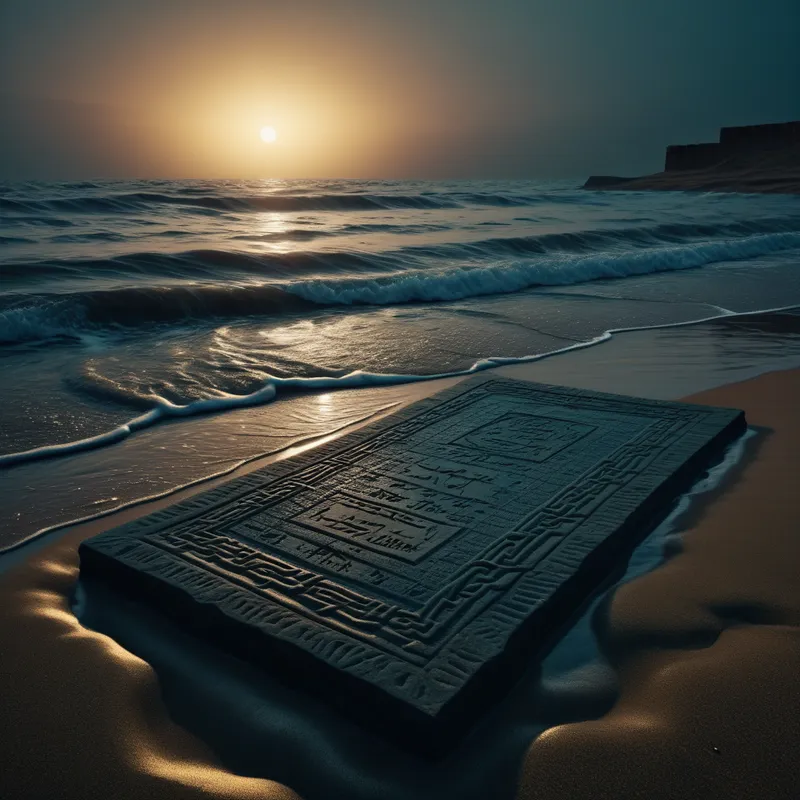
He did not walk upon the land, for his fish-body remained in the salt foam. But he spoke, and his words were seeds. He taught the people the secrets of the grain and the vine, how to sow and how to reap. He laid bare the principles of geometry, so they might measure the earth and raise walls against the chaos. He gave them the art of writing, the shaping of cuneiform in soft clay, so memory and law would not fade like breath on the wind. He spoke of cities, of temples, of the motions of stars, and the proper ways to honor the gods.
All day he would instruct, his form a strange altar at the boundary of sea and shore. As the sun bled into the west, Oannes would turn. Without farewell, he would submerge back into the deep, returning to his own realm beneath the waves. But with each new dawn, he would emerge again, a perennial gift from the primordial waters.
This was his sacred rhythm for generations. He bestowed the foundations of all things: justice, agriculture, architecture, and scripture. He carved order from the formless clay of human existence. And when his work was complete, when the blueprint of civilization was firmly placed in the human heart, Oannes performed his final act. He gazed upon the people—now builders, scribes, priests—and then turned forever seaward. The waters parted to receive him, and he sank into the abyss from whence he came, leaving behind only his teachings and the eternal mystery of his nature.
Cultural Origins & Context
The myth of Oannes comes to us from the fragments of Berossus, who wrote in Greek to translate and preserve the lore of his homeland. His work, the Babyloniaca, is largely lost, but passages concerning Oannes were preserved by later historians. This tells us the myth was considered a foundational origin story, crucial enough for a priest-scholar to translate for a foreign audience.
Oannes, or Uanna, was the first of the Apkallu, the seven sages of antiquity who arose before the Great Flood. In Mesopotamian cosmology, these beings were sent by the god Ea (Enki) to act as civilizing intermediaries between the divine realm and raw humanity. The myth functioned as a sacred charter, legitimizing the entire apparatus of Mesopotamian civilization—its kingship, its priesthood, its scribal arts—as gifts of divine origin. It answered the profound question: "How did we become us?" The answer lay not in human ingenuity alone, but in a transformative encounter with the Other, a being from the unconscious deep of the world.
Symbolic Architecture
Oannes is the archetype of emergent consciousness. He rises from the Apsu, the sweet-water abyss that represents the undifferentiated, unconscious source of all life. His hybrid nature is the perfect symbol of this transition: the fish-body anchored in the instinctual, collective deep; the human head and voice capable of articulating logos, structure, and culture.
He is the moment when the formless potential of the deep acquires a voice and speaks order into being.
The sea represents the unconscious psyche in its totality—chaotic, fertile, and terrifying. The shore is the threshold of ego-consciousness. Oannes exists precisely at this liminal space, never fully crossing over. His teachings—writing, law, agriculture—are the tools of consciousness: they differentiate, name, bound, and cultivate. He does not make humans gods; he gives them the means to structure their world and thus become human. His daily return to the deep signifies that consciousness is not a permanent state but a rhythmic emergence, forever reliant on and returning to its source. His final departure marks the point where the cultural complex becomes autonomous, internalized within the human community, even as its origins recede into mystery.

The Dreamer's Resonance
When this myth stirs in the modern psyche, it often manifests in dreams of profound, alien guidance. One might dream of a wise, non-human figure emerging from a lake, ocean, or even a pool of dark water in a basement. This figure offers a tool, a book, a key, or speaks an incomprehensible yet deeply meaningful phrase. There is a somatic quality of awe, a chilling recognition mixed with gratitude.
Psychologically, this signals a critical phase of psychic reorganization. The dreamer is at the shore of their own unconscious, and a structuring principle is emerging autonomously from it. This is not a product of willful ego analysis, but a gift from the deeper Self. It often occurs during life transitions—the start of a creative endeavor, a new career path, or a spiritual awakening—where old, "instinctual" ways of being are no longer sufficient. The Oannes figure brings the "civilizing" code needed to navigate this new inner landscape. The process can feel alien and integrating at once, as one must accept guidance from a part of the psyche that feels utterly other.

Alchemical Translation
The alchemical journey modeled by Oannes is the solve et coagula—dissolve and coagulate—applied to the psyche. First, one must dwell in the solve, the formless, watery state of the Apsu. This is a period of potential chaos, where old identities and structures are dissolved. From this fertile murk, the lapis or philosopher's stone—symbolized by Oannes himself—emerges.
The goal is not to leave the sea, but to learn its language and let it form a speaking part of you.
The individuation process here is the integration of this hybrid sage. One does not become fully "the fish" (regressed to unconsciousness) nor fully "the human on land" (an arid, over-conscious ego). One learns to inhabit the shoreline, to let the deep wisdom periodically emerge and inform the structures of daily life. The "arts of civilization" he brings are the internal disciplines: the "writing" of one's own narrative, the "laws" of personal ethics, the "architecture" of a coherent soul, the "astronomy" of navigating by inner stars. The triumph is the establishment of a sustainable, rhythmic exchange between the depths and the surface, where the Self, like Oannes, is both of the abyss and the bearer of its luminous, ordering light.
Associated Symbols
Explore related symbols from the CaleaDream lexicon: