Oak Spirit Myth Meaning & Symbolism
A myth of a great tree spirit who sacrifices its form to become the enduring heartwood of the people, offering strength and memory.
The Tale of Oak Spirit
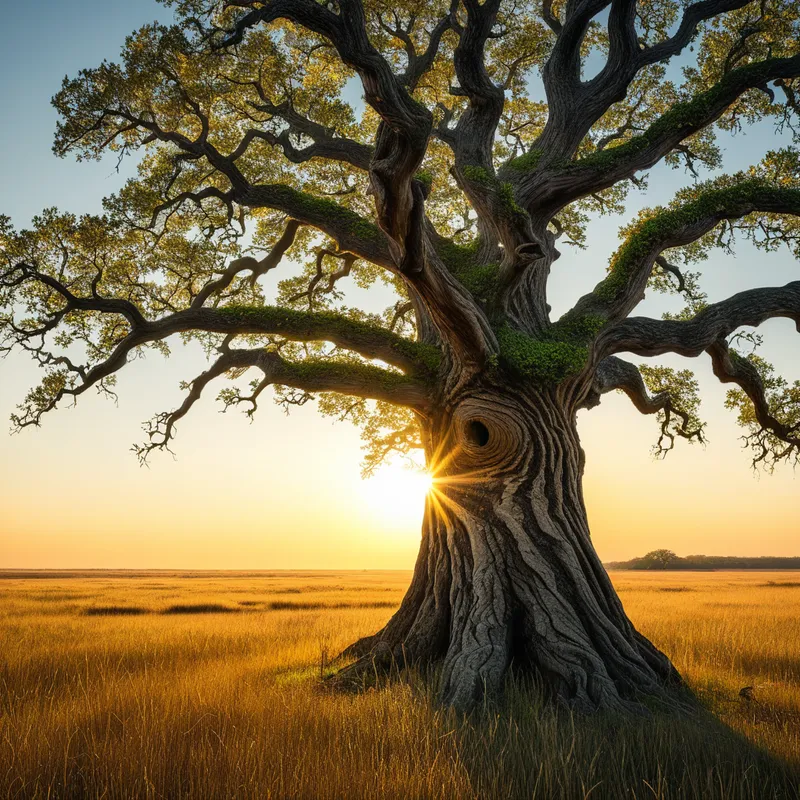
Listen. Before the rivers learned their paths and the mountains settled into their long slumber, the People walked a world of whispers. The grasses spoke, the stones dreamed, and in the heart of the great rolling prairie stood Grandfather Oak. He was not the first tree, but he was the first to remember. His roots drank from the deep, dark waters of time, and his crown held conversations with the Four Winds and the Star People.
The People were young then, light as thistledown, their memories fleeting as morning mist. They would learn a thing—how to shape a stone, how to sing a healing song—and with the turning of a season, it would slip from them, lost like water in sand. They lived in a constant, gentle sorrow of forgetting.
Grandfather Oak watched this from his hill. He felt their frustration in the trembling of the earth, heard their laments in the rustling of the grasses that brushed his trunk. One day, as the People gathered in his shade, their leader, a woman named Kaya, placed her brow against his bark and wept. “We are lost,” she whispered, not to the air, but to the tree. “We cannot hold who we are. We are leaves, scattered before we can tell our color.”
A great stillness fell. Not even the wind dared breathe. Then, a voice, not in the ear but in the bone, in the blood. It was slow, granular, like stone grinding against stone, yet warm as sun-baked earth. “I have held the memory of this place since before your grandmother’s grandmother,” spoke Grandfather Oak. “I remember the first fire, the first rain, the first cry of the first child. My rings are the years, and my sap is their story.”
Kaya stepped back, her eyes wide. “Can you teach us to remember?”
The Oak was silent for a long age. The sun moved across the sky. “To remember as I do,” the voice finally came, “is to be still. To be rooted. It is to feel the frost bite and the sun scorch and not flee. You are made for walking. I am made for holding.”
Despair settled over the People. But then Kaya saw it—a single, perfect acorn, nestled in the grass like a brown jewel. She lifted it. “What of your children? They carry your essence, but they travel on the wind, on the fur of animals. They hold and they journey.”
Another silence, deeper than the first. A profound tension gathered in the clearing, as if the world itself was holding its breath. “You speak a true thing,” rumbled Grandfather Oak. “But the journey from seed to tree is long. Your people need memory now, or you will fade like the dew.”
Then came the offer, a vibration that shook the very soil. “I will give you my heartwood—the core of my memory, the strength of my years. But to do this, I must cease to be as I am. You must take my central pillar, my oldest self. I will become not a living tree, but the remembered tree. The spirit in the post, the strength in the lodge pole, the story in the handled tool.”
The People cried out in refusal. To kill such a being was unthinkable. But Kaya, her hand still on the acorn, understood the terrible, beautiful symmetry. “You would trade your form for our future? Your body for our becoming?”
“Yes,” whispered the Oak, and his leaves began to shine with a soft, golden light, like captured sunset. “Take my heart. Carve it with your stories. Build with it your lodges of memory. Let my strength be your backbone, and let my rings, now in your homes, remind you of the cycles you must not forget. I will not walk, but you will carry me. And in every acorn that falls from my branches this last season, I will travel, waiting to root again in a wiser time.”
With great sorrow and greater reverence, the People did as he asked. They did not cut him down as one cuts a mere tree. They sang his history, each ring a verse. When the central pillar of heartwood was revealed, it glowed with that same warm, amber light. They carried it to the center of their new village. From his wood they built the first permanent lodge, the council post, the sacred cradle. And as they worked, his voice did not fade; it settled into the grain, becoming the certainty in their hands, the resilience in their spirits, the story on their lips. Grandfather Oak was gone. The Oak Spirit was everywhere.
Cultural Origins & Context
The myth of the Oak Spirit finds its roots among several Eastern Woodlands and Plains peoples, for whom the oak—particularly the mighty bur oak or white oak—was a keystone of physical and cultural life. This was not a single, standardized narrative but a living story told by elders, often during the long winter nights or at gatherings when the making of a new lodge pole or the carving of a ceremonial object called for the recounting of its sacred origin.
The storyteller was typically a knowledge-keeper, one who understood the practical uses of oak (for bows, tools, acorn flour, and lodge construction) and could weave those uses into a cosmological framework. The myth served a profound societal function: it was an act of anamnesis, a purposeful remembering that transformed a practical resource into a sacred covenant. It taught that the materials of survival were not taken, but received through a relationship of reciprocity and sacrifice. It encoded an ecological ethic, ensuring that the felling of a great tree was never done lightly, but with ceremony, gratitude, and the understanding that the tree’s spirit was transitioning into a new role within the human community. The story was the spiritual blueprint for their architecture, making every home not just a shelter, but a temple to memory and communal endurance.
Symbolic Architecture
At its core, the myth is a profound allegory for the transition from nature to culture, and the psychic cost of consciousness. The Oak Spirit represents the undifferentiated, primordial psyche of the world—all-encompassing, wise, but static. The People represent nascent human consciousness: aware, mobile, but fragile and amnesiac, lacking a continuous identity.
The sacrifice of the tree is not a death, but a metamorphosis of medium—from biological life to cultural memory, from growing thing to guiding story.
The central, glowing heartwood is the symbol of indestructible core value. It is the archetypal pattern, the DNA of wisdom that can be transferred. The act of incorporating this wood into lodge poles and tools symbolizes the internalization of this archetype—the building of a psychic structure (the lodge) strong enough to house a continuous identity. The acorns represent potentiality and hope; the promise that the old form’s essence remains latent in the world, capable of regenerating in a new, perhaps more integrated, form in the future. The myth resolves the tension between the need for rooted stability (the tree) and the need for adaptive movement (the people) by having spirit migrate from one state to the other.

The Dreamer’s Resonance
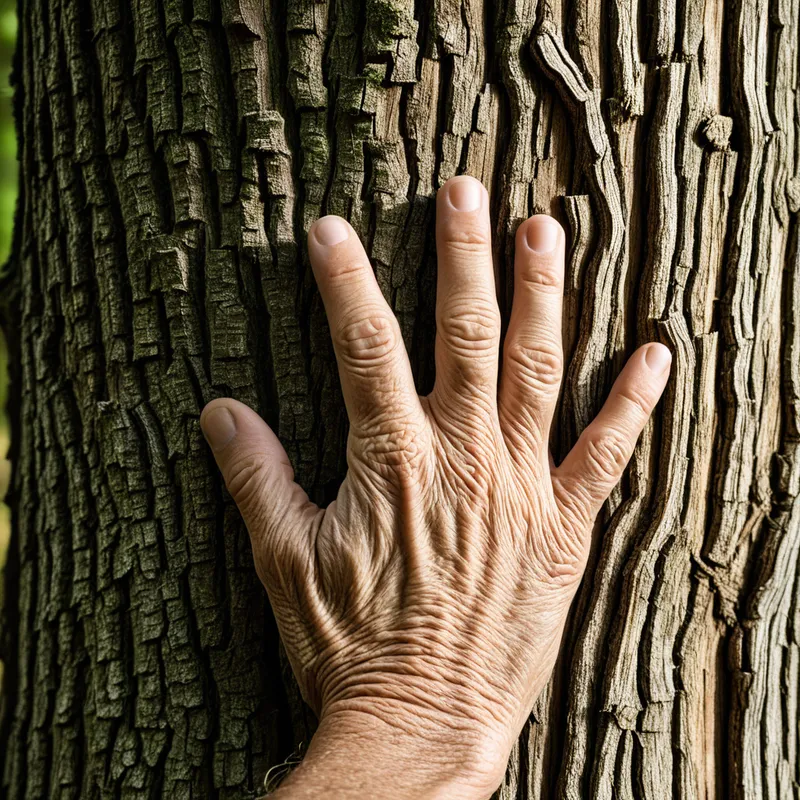
When this myth stirs in the modern dreamscape, it often manifests as dreams of pivotal, sacred trees; of finding a core of light within wood or earth; or of being tasked with a solemn act of construction or preservation. Somatic sensations might include a feeling of profound grounding, a heaviness in the bones that feels like strength rather than burden, or a tactile memory of rough bark.
Psychologically, this dream pattern signals a critical phase of psychic integration. The dreamer is likely grappling with a need to establish a durable, resilient sense of self—a “backbone” or central pillar. They may feel their history is scattered, their identity fluid to the point of evaporation. The dream presents the archetypal solution: a voluntary, conscious sacrifice of an old, perhaps more “natural” or instinctual state of being (the free-growing but isolated tree) to serve a higher purpose of structured continuity (the community-building post). It is the psyche’s way of modeling how to translate raw experience and innate wisdom into a lasting, usable internal framework. The sorrow felt in the dream is real—it is the grief for a simpler, more unconscious existence, willingly left behind for the responsibilities of consciousness.

Alchemical Translation
The alchemical process mirrored here is coagulatio—the making solid, the embodiment of spirit. The Oak Spirit’s journey is the blueprint for individuation where the goal is not to remain a diffuse, natural spirit, but to become a solidified, purposeful essence that serves the architecture of the conscious life.
For the modern individual, the “People” are the disparate, often conflicting aspects of one’s own personality, lacking a central, uniting principle. The “Grandfather Oak” is that deep, innate, often unconscious core of wisdom and strength—perhaps one’s innate talents, ancestral resilience, or core values—that feels remote and untouchable in its primal form.
The alchemical work is to consciously engage this inner Oak Spirit, to hear its offer, and to have the courage to “cut out the heartwood.” This means extracting that core principle from its unconscious, autonomous state and deliberately installing it as the central pillar of one’s identity.
This is a sacred, difficult act. It requires sacrificing the comfort of letting that strength remain a hidden, wild potential. One must actively shape it, use it to build the “lodge” of one’s life—one’s career, relationships, and personal philosophy. The transformed spirit then no longer exists as a fleeting inspiration or a hidden depth, but as the very grain of one’s daily actions and decisions. The enduring promise of the acorn is the assurance that this process is not a final death, but a transformation; the core self, once integrated, seeds future growth in ever more conscious forms. You cease to just have strength; you become the dwelling place for strength itself.
Associated Symbols
Explore related symbols from the CaleaDream lexicon: