Nyi Pohaci Rice Spirit Myth Meaning & Symbolism
A sacred myth of life from death, where the body of a divine maiden transforms into the first rice, binding human survival to cosmic sacrifice.
The Tale of Nyi Pohaci Rice Spirit
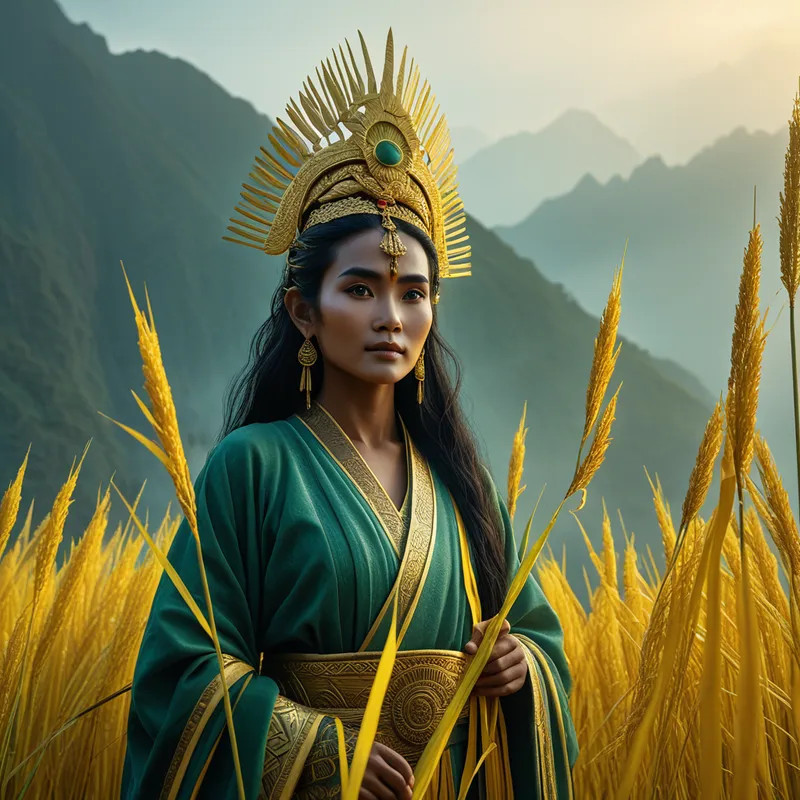
Listen, and hear the story whispered by the wind through the rice paddies. It begins not on earth, but in the high, mist-wreathed realm of the gods, in the kingdom of Sang Hyang Kersa. There lived a maiden of such unbearable beauty and virtue that the very stars paused in their courses to admire her. Her name was Nyi Pohaci Sanghyang Asri, and she was the daughter of the sun and the dew.
Her presence was a blessing, a fragrance of jasmine and fertile soil. Yet, within the heart of Batara Guru, the ruler of the gods, a shadow stirred. It was not malice, but a profound, consuming longing—a desire that shook the pillars of heaven. He watched her, and his divine mind grew fevered with a love that was forbidden, a passion that threatened the cosmic order.
The other gods saw the turmoil in their king. They saw the danger: a god’s illicit desire could unravel creation. In a hushed and solemn council beneath the Waringin tree, they made a terrible, necessary decision. For the sake of all realms, Nyi Pohaci must die. But hers would not be a death of oblivion.
A plan was woven with fate’s own threads. The divine physician, Batara Narada, was summoned. With a heavy heart, he administered not a poison, but a potion of transformation. Nyi Pohaci, feeling a sudden weakness, a sweet dizziness like the coming of dusk, lay down upon the heavenly earth. Her breath grew shallow, her brilliant light dimmed. A great silence fell over the celestial court.
Batara Guru, his desire now replaced with a crushing grief, ordered her sacred body buried in the heart of the divine realm. But the gods’ decree was already in motion. From the grave of the beloved maiden, a miracle began.
First, soft green shoots pierced the dark soil. Then stalks, tall and graceful, swayed as if in a dance she would never finish. They thickened, bearing clusters that swelled with life. When the husks split, they revealed not seeds, but pearls of pure white—the first rice. From her eyes grew coconut palms; from her hair, fragrant plants and flowers; from her flesh, the life-giving tubers; from her bones, the sturdy bamboo. Her spirit did not vanish. It poured itself into the grain, becoming its essence. The gods, in awe, sent this sacred gift down to the barren earth. Where the grains fell, the first rice paddies flourished, turning the world from a place of hunger into a realm of sustenance. Nyi Pohaci was gone, yet she was everywhere, in every bowl, in every harvest, a caregiver for all humanity.

Cultural Origins & Context
This myth is rooted deeply in the Sundanese and Javanese cultures of Indonesia, where rice is not merely a crop but the literal backbone of life and civilization. It is an agricultural myth, a charter myth that sanctifies the entire cycle of planting, growth, and harvest. Passed down orally through generations by village elders and dalang (puppet masters), the tale was performed in wayang and recited during key agricultural rituals.
Its societal function was multifaceted. It explained the origin of staple foods, provided a divine rationale for the hard labor of farming, and established a sacred covenant between humans, the earth, and the unseen world. The myth mandated respect for rice—grains must never be wasted or stepped upon, for they are the body of the goddess. Rituals like Seren Taun (the annual harvest thanksgiving) and the placement of rice stalks (parengpeng) in homes are direct enactments of this story, keeping the memory and blessing of Nyi Pohaci alive. She is the ultimate ancestral spirit of nourishment.
Symbolic Architecture
At its core, the myth of Nyi Pohaci is a profound [alchemy](/symbols/alchemy “Symbol: A transformative process of purification and creation, often symbolizing personal or spiritual evolution through difficult stages.”/) of [death](/symbols/death “Symbol: Symbolizes transformation, endings, and new beginnings; often associated with fear of the unknown.”/) into [life](/symbols/life “Symbol: The symbol of ‘Life’ represents a journey of growth, interconnectedness, and existential meaning, encompassing both the joys and challenges that define human experience.”/), [spirit](/symbols/spirit “Symbol: Spirit symbolizes the essence of life, vitality, and the spiritual journey of the individual.”/) into matter, and individuality into communal sustenance. It is not a [story](/symbols/story “Symbol: The symbol of ‘Story’ represents the narrative woven through our lives, embodying experiences, lessons, and emotions that shape our identities.”/) of tragedy, but of necessary, sacred [transmutation](/symbols/transmutation “Symbol: A profound, alchemical process of fundamental change where one substance or state transforms into another, often representing spiritual evolution or personal metamorphosis.”/).
The most profound nourishment is always born of a sacred death. The grain must die in the soil to become the stalk; the self must be offered to become soul.
Nyi Pohaci represents the pristine, potential life force—[consciousness](/symbols/consciousness “Symbol: Consciousness represents the state of awareness and perception, encompassing thoughts, feelings, and experiences.”/) in its pure, beautiful, yet unsustainable form. Batara [Guru](/symbols/guru “Symbol: A Guru represents a teacher or guide, often embodying wisdom, knowledge, and spiritual insight.”/)‘s desire symbolizes the ego’s attempt to possess and incorporate this wholeness for itself, a act which would corrupt it. Her mandated death is the crucial [dissolution](/symbols/dissolution “Symbol: The process of breaking down, dispersing, or losing form, often representing transformation, release, or the end of a state of being.”/) of this pure form. It is the sacrifice of the individual, intact “spirit” so that it may be redistributed as tangible “spirit” for all. The rice is her fragmented, yet eternally generative, [body](/symbols/body “Symbol: The body in dreams often symbolizes the dreamer’s self-identity, personal health, and the relationship they have with their physical existence.”/). She becomes immanent, no longer a distant [goddess](/symbols/goddess “Symbol: The goddess symbolizes feminine power, divinity, and the nurturing aspects of life, embodying creation and wisdom.”/) to be worshipped, but a substance to be ingested, literally becoming part of the [community](/symbols/community “Symbol: Community in dreams symbolizes connection, support, and the need for belonging.”/)‘s flesh and [blood](/symbols/blood “Symbol: Blood often symbolizes life force, vitality, and deep emotional connections, but it can also evoke themes of sacrifice, trauma, and mortality.”/).
The [river](/symbols/river “Symbol: A river often symbolizes the flow of emotions, the passage of time, and life’s journey, reflecting transitions and movement in one’s life.”/) that often features in related rituals symbolizes the flow of this life force from the divine [realm](/symbols/realm “Symbol: The symbol of ‘Realm’ often signifies the boundaries of one’s consciousness, experiences, or emotional states, suggesting aspects of reality that are either explored or ignored.”/) ([mountain](/symbols/mountain “Symbol: Mountains often symbolize challenges, aspirations, and the journey toward self-discovery and enlightenment.”/)) to the [human](/symbols/human “Symbol: The symbol of a human represents individuality, complexity of emotions, and social relationships.”/) world ([rice paddy](/symbols/rice-paddy “Symbol: A rice paddy symbolizes sustenance, community, and fertility, highlighting the essential role of agriculture and the cycle of life in sustaining cultures.”/)). The act of planting mirrors her [burial](/symbols/burial “Symbol: A symbolic act of laying something to rest, often representing closure, transformation, or the release of past burdens.”/); the harvest, her resurrection.
The Dreamer’s Resonance
When this myth stirs in the modern dream, it rarely appears as a literal retelling. Instead, one might dream of being consumed in a gentle, non-violent way—melting into a landscape, dissolving into a pool of light that then causes gardens to bloom. There is often a somatic sense of sweet sorrow, a poignant letting go.
Such dreams can surface during life transitions where a cherished identity, a pristine talent, or a self-contained phase of life must end to feed a larger purpose. The dreamer may be the “dying” Nyi Pohaci, feeling a sacred exhaustion, or the grieving Batara Guru, learning that love sometimes means relinquishment. The process is one of psychic digestion: breaking down a whole but isolated psychic complex (beauty, virtue, a specific skill) so its energy can be composted into the soul’s soil to nurture broader, more grounded growth. It is the psyche preparing for a rebirth where one’s essence becomes useful, nourishing, and interconnected.
Alchemical Translation
For the individual on the path of individuation, Nyi Pohaci’s journey is a masterful map of psychic transmutation. It models the move from being a contained, ideal self-image (the perfect, admired goddess in heaven) to becoming an integrated, life-giving function.
The first stage is the “divine longing”—the ego’s inflation, believing it can possess an archetypal force (beauty, wisdom, power) wholly for itself. This creates a dangerous imbalance. The necessary, often painful, intervention is the acceptance of sacrifice. This is not a punishment, but the operation of a deeper, guiding wisdom within the psyche (the council of gods) that insists on transformation.
Individuation demands the burial of the perfect ideal so that the nourishing real may grow.
The “death” is the de-integration of a complex. The “burial” is the conscious work of submitting this raw material to the dark, fertile ground of the unconscious. Then comes the patient waiting—the incubation period where one tends the field without seeing immediate results. Finally, the “harvest” is the emergence of new capacities: not as dazzling, isolated virtues, but as practical, sustaining “food”—creativity that feeds others, insight that nourishes community, love that sustains relationships. The individual becomes, like the rice, a vessel of life force. They achieve a grounded, incarnate spirituality, where their soul’s essence is no longer just for them, but becomes part of the world’s sustenance.
Associated Symbols
Explore related symbols from the CaleaDream lexicon:
- Rice Paddy — The transformed earth and the sacred field where the spirit becomes sustenance, representing the cultivated, fertile ground of the soul where sacrifice yields growth.
- Sacrifice — The central, voluntary act of dissolution that transforms spiritual potential into tangible, life-giving reality, essential for both cosmic and psychic order.
- Rebirth — The core promise of the myth; not a return to the old form, but a resurrection into a new, proliferating mode of being that nourishes an entire world.
- Mother — Nyi Pohaci as the ultimate nourishing archetype, whose body becomes the source of life, embodying the caregiver who gives her very substance for her children.
- Earth — The receiving womb and final resting place of the goddess, symbolizing the material realm that is sanctified and made fertile by the descent of spirit.
- Goddess — The divine feminine principle in its aspect of generative sacrifice, representing beauty, fertility, and the cyclical nature of life-through-death.
- Grain — The fundamental unit of transformed spirit, a perfect symbol of condensed life force, potential, and the fragmentation of wholeness into nourishing pieces.
- Blood — Symbolic of life force and lineage; ingesting the rice (the goddess’s body) is akin to sharing her sacred blood, creating a kinship bond between humanity and the divine.
- Ancestral Spirit — Nyi Pohaci as the foremost ancestor whose essence is literally consumed and remembered with every meal, connecting daily life to mythic origins.
- Circle — The endless cycle of planting (burial), growth (transformation), harvest (resurrection), and consumption that mirrors the myth and the seasonal rhythm of life.