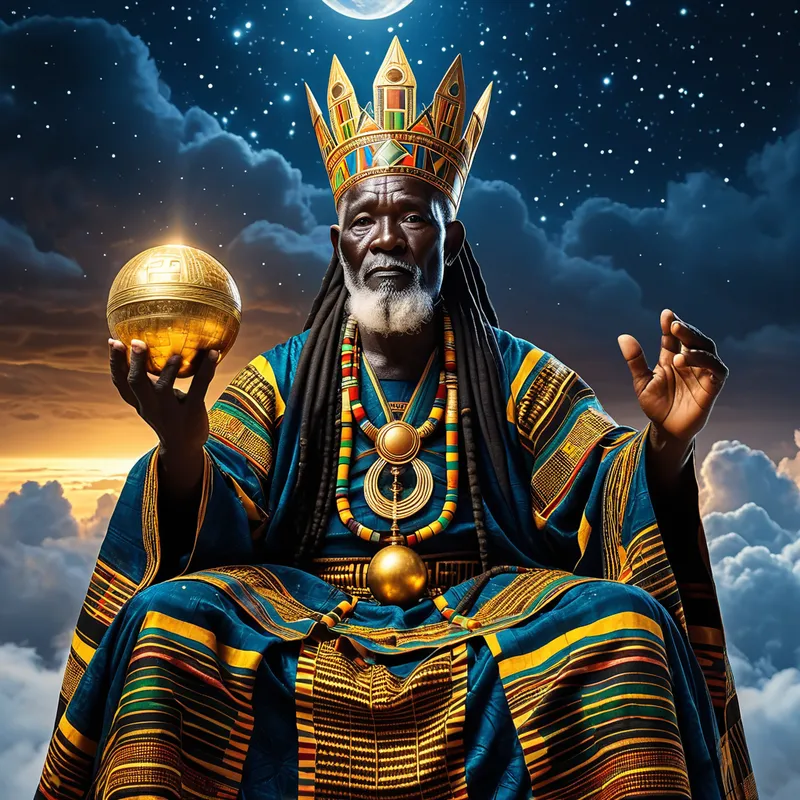
Nyame the Sky God Myth Meaning & Symbolism
The story of how Anansi the spider, through wit and sacrifice, brought the Sky God's wisdom, stories, and justice down to humanity.
The Tale of Nyame the Sky God
In the beginning, all things were separate. The warm, fecund Earth lay below, rich with life but silent of meaning. Above, in the infinite vault, dwelt Nyame, who held in his celestial keep all the things that make a world knowable: the stories that explain the why of things, the wisdom to navigate life’s sorrows and joys, and the strict, shining light of justice.
For humanity, this was a twilight existence. They lived, loved, and died in a beautiful but mute world, their hearts aching for a pattern, their minds thirsting for a reason. All the answers, all the fire of true understanding, remained locked in the sky, hoarded by the distant god. Nyame was not cruel, but he was separate, a sovereign who ruled the cosmos from a throne of clouds, his face the sun by day and the moon by night.
Then came Anansi. He was small, a creature of eight clever legs and a mind that spun plots as deftly as he spun silk. He looked upon the people’s quiet desperation and the god’s distant treasure, and a plan, intricate and daring, began to weave itself in his heart. He would bridge the impossible gap.
Anansi climbed the highest silk thread to the threshold of the sky and stood before Nyame. “Great Sky God,” he said, his voice a humble rustle. “I see you hold the Box of Stories, the Gourd of Wisdom, and the Horn of Justice. The people below are in shadow. Will you not share?”
Nyame’s voice was the rumble of distant thunder. “These are not for the giving. They are the pillars of my kingdom. Yet… if you can bring me the three most elusive things of the earth—Osebo the leopard of the terrible teeth, Mmoatia the fairy whom no one sees, and Mboro the python—then you may have what you seek.”
The tasks were a death sentence. But Anansi bowed, his mind already a whirlwind of cunning. He did not confront strength with strength. For Osebo, he dug a pit, covered it with brush, and lured the proud leopard with tales of a trapped goat. When the beast fell in, Anansi offered a rope of help, only to bind him fast. For the invisible Mmoatia, he carved a wooden doll, smeared it with sticky gum, and set out a bowl of yam paste. The fairy, curious and offended when the doll did not answer her greetings, struck it and became trapped. For Mboro, Anansi simply asked the great snake to prove he was as long as the palm branch Anansi carried. As the python stretched out beside it, Anansi quickly tied him to the branch.
One by one, the impossible captives were presented to Nyame. The Sky God was astonished. The small, seemingly weak spider had used not force, but perception, trickery, and an understanding of the nature of things to accomplish the divine tasks. True to his word, Nyame handed down the sacred vessels.
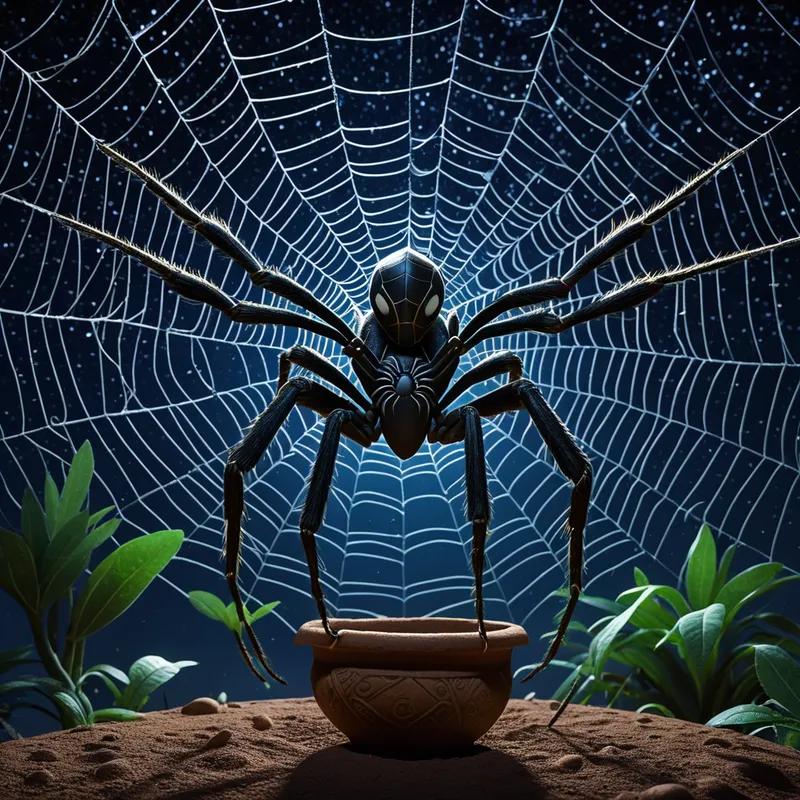
But how to carry them? The wisdom was heavy, the stories fragile, the justice piercingly bright. Anansi, the ultimate connector, spun a single, strong thread. He placed all the gifts into a great clay pot, tied his silken line, and began the careful, perilous descent. He lowered the pot of heaven’s light down, down through the vast emptiness, until it safely reached the waiting hands of humanity. From that day, stories flowed like rivers, wisdom took root like great trees, and the concept of justice gave shape to the human community. The sky was no longer a locked ceiling, but a conversant dome, connected to the earth by the memory of a spider’s thread.
Cultural Origins & Context
This myth originates from the Akan people of West Africa, particularly present-day Ghana. It is a foundational narrative, belonging to the rich corpus of Anansi tales. These stories were not mere entertainment; they were the living library of the people, transmitted orally by griots (storytellers, historians, and poets) and elders under the moonlit sky or in the communal compound.
The societal function was multifaceted. It was a etiological myth, explaining how essential cultural elements—narrative, law, philosophy—came to humanity. It reinforced social values: the virtue of cleverness over brute strength, the importance of perseverance, and the sacred contract that even the highest power must honor a promise. Furthermore, it established a cosmological order. Nyame represents the ultimate, somewhat detached source of authority and structure, while Anansi represents the human (and divine) ingenuity required to translate that cosmic order into lived, earthly reality. The myth legitimized the Akan political and judicial systems, which were seen as earthly reflections of Nyame’s celestial justice.
Symbolic Architecture
At its heart, this is a myth about the acquisition of consciousness. Nyame’s hoard in the sky symbolizes the latent, unintegrated potential of the human psyche—the totality of knowledge, pattern, and moral understanding that exists in the collective unconscious, but is not yet accessible to the individual or the tribe.
The quest is not for a physical object, but for the tools of meaning-making itself.
Anansi, the Trickster, is the necessary agent of this psychic revolution. He is the embodiment of the cunning, adaptive, and often amoral intelligence required to confront an overwhelming, established order (the Sky). His methods—trapping, tricking, binding—are not “heroic” in the classical sense, but they are effective. He represents the psyche’s ability to use indirect means, wit, and a deep understanding of the weaknesses and vanities of powerful forces (whether external gods or internal complexes) to achieve a transformative goal.
The three creatures—Leopard, Fairy, Python—are not random monsters. They are symbolic guardians of the threshold. Osebo the leopard represents raw, predatory instinct and pride. Mmoatia the fairy represents the elusive, invisible, and often irrational aspects of the psyche (spirits, moods, intuitions). Mboro the python symbolizes the deep, coiling, chthonic wisdom of the earth and the unconscious. To capture them is not to destroy them, but to master and present these wild, foundational aspects of nature and self to the ruling consciousness (Nyame). Only by integrating these powerful, earthy, and elusive forces can one earn the gifts of higher consciousness.
The Dreamer's Resonance
When this myth pattern stirs in the modern dreamer, it signals a profound phase of psychic negotiation. The dreamer may feel that essential “wisdom” or “clarity” is impossibly distant, held by an inaccessible authority (a boss, a parent, an internalized ideal, or simply “fate”). There is a deep yearning for order, story, and justice in one’s life.
Dreams of impossible tasks, of negotiating with towering figures, or of ingeniously trapping wild animals point directly to this archetypal drama. The somatic feeling is one of tension, of a cunning focus—a quiet, determined plotting rather than explosive action. The dreamer is in the Anansi phase: feeling small and perhaps insignificant, yet discovering an unexpected capacity for strategic thinking. They are learning to use their unique perception (their “web”) to bind the chaotic, instinctual, or elusive forces (rages, fears, addictive patterns, depressions) that roam their personal landscape. The climactic dream of lowering a precious, fragile vessel from a great height speaks to the careful, vulnerable process of bringing a hard-won insight from the unconscious into the light of conscious life and community.

Alchemical Translation
The individuation process modeled here is not one of slaying dragons, but of capturing and presenting them. It is the alchemy of transforming raw, unconscious content into the gold of cultural and personal value.
First, the Separatio: The initial condition is the painful separation between the ego (earthbound humanity) and the Self (Nyame, the wholeness of the psyche). The gifts are there, but unreachable, creating a state of spiritual poverty.
Second, the Coniunctio is facilitated by the Trickster: The ego, in its Anansi aspect, must acknowledge its desire and undertake the quest. This is the spark of intention. The capturing of the creatures is the Nigredo—the difficult, dark work of confronting and engaging with the shadow aspects (the leopard’s aggression, the fairy’s invisibility, the python’s primal wisdom). One does not eliminate these forces; one brings them under a degree of conscious control.
The prize is not taken by storm, but earned through a demonstrated understanding of the nature of the obstacles.
Finally, the Transmutatio: Presenting the captured forces to Nyame symbolizes the ego submitting its integrated work to the greater authority of the Self. The Self then releases its treasures. The careful descent with the pot is the final, crucial stage: the embodiment of the insight. The wisdom, stories, and laws are not to be kept as private spiritual trophies. They must be lowered, shared, and woven into the fabric of one’s earthly existence—into one’s relationships, work, and creative life. The spider’s thread becomes the umbilical cord connecting the transcendent to the immanent, ensuring that the psyche is no longer a collection of separate realms, but a unified, communicating whole.
Associated Symbols
Explore related symbols from the CaleaDream lexicon:
- Spider — The weaver of fate and the cunning intellect; Anansi represents the connective strategy that bridges impossible gaps between the divine and the human.
- Sky — The realm of the transcendent, of ultimate authority, consciousness, and stored potential; the domain of Nyame where all cosmic order originates.
- Earth — The realm of embodied experience, humanity, and fertile potential awaiting the seeds of wisdom and story from above.
- Wisdom — The hard-won prize from the sky, representing deep understanding, discernment, and the patterns that make life comprehensible.
- Justice — The divine law and moral order brought down to humanity, providing structure, fairness, and the foundation for community.
- Story — The narrative consciousness itself, the gift that explains origins, encodes values, and allows experience to be shared and made meaningful.
- Trickster — The archetypal force of change, boundary-crossing, and cunning that disrupts stagnant order to facilitate necessary transformation.
- Journey — The perilous quest from the known world into the realm of the gods and back again, a metaphor for the descent into and return from the unconscious.
- Bridge — The spider’s silken thread, representing the fragile, self-made connection that allows transmission between separated realms of being.
- Sacrifice — The offering of captured primal forces (the animals) to the higher power, which is the necessary exchange for receiving the gifts of consciousness.
- Light — The illuminating quality of the received wisdom and justice, which dispels the shadow of ignorance and gives form to the world.
- Order — The ultimate goal and gift, the cosmic and social structure that emerges from the integration of celestial law into earthly life.