Nüwa Myth Meaning & Symbolism
The primordial goddess who shaped humanity from clay and, in a supreme act of care, repaired the shattered pillars of the sky to save all creation.
The Tale of Nüwa
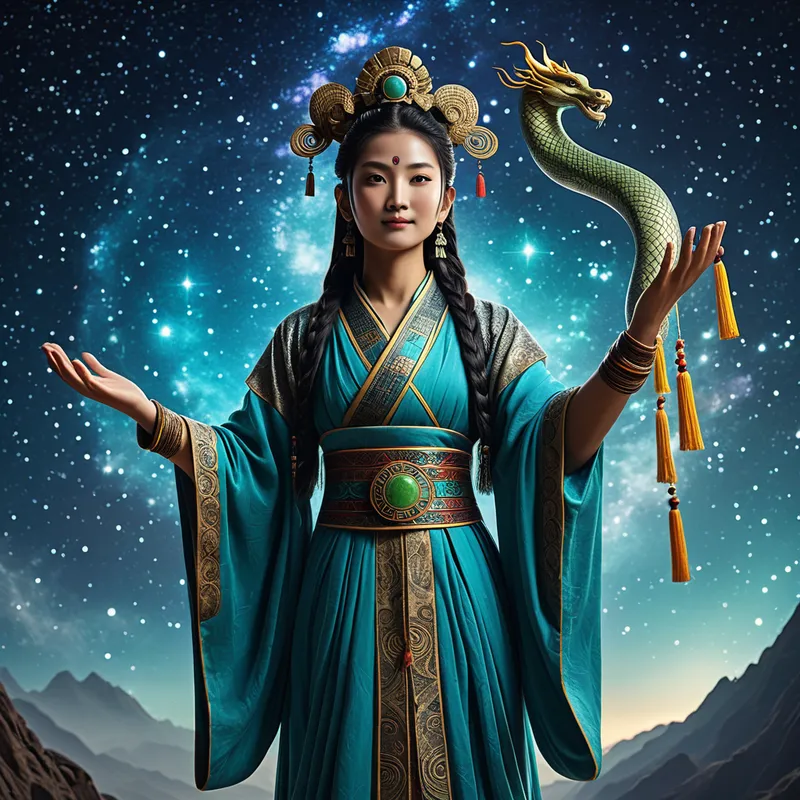
In the time before time, when the world was a formless broth of potential, there was a silence so deep it was a sound. From this primordial womb emerged Nüwa, her being both serpent and woman, earth and spirit. She wandered the vast, beautiful desolation, her heart echoing in the emptiness. Moved by a loneliness that was the loneliness of the cosmos itself, she knelt by a yellow river. Taking the rich, yielding clay in her hands, she began to shape. With each careful press of her fingers, a figure took form—a small, upright creature. She breathed upon it, and it stirred with life. She crafted many this way, with love and artistry, and they became the first people, filling the silent world with laughter and song.
For an age, harmony reigned under the watchful dome of heaven. But deep in the watery abyss, a titanic struggle erupted. Gonggong, the god of water, in a rage of defeat, smashed his head against the great pillar Buzhou Mountain. The sound was the shattering of the world. The pillar, which held up the sky in the northwest, cracked and crumbled. A section of the azure firmament tore open, and a flood of stars and chaos poured through. The earth split along its seams, fires erupted from the depths, and terrible beasts crawled from the cracks. The waters of the world, unmoored, rose in a great deluge.
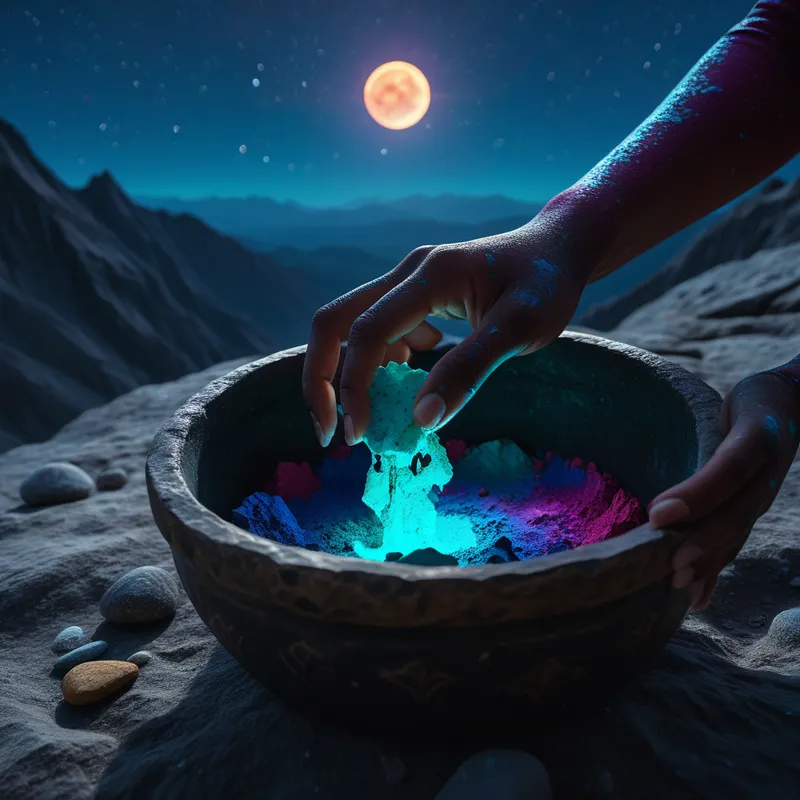
The people cried out, their voices swallowed by the cataclysm. Nüwa witnessed her children perish, her creation drowning in fire and flood. Her sorrow was not passive; it crystallized into a resolve as hard as diamond. She would not allow the story to end here. She journeyed to the sacred river, gathering stones of five brilliant colors—azure, crimson, gold, obsidian, and jade. With a divine fire, she melted them into a luminous, molten paste. Then, rising on coils of power against the screaming winds, she began her work. With her bare hands, she daubed and sealed the ragged tear in the sky, stitch by celestial stitch, until the breach was closed and the stars were fixed once more.
But the sky still sagged, unstable. She hunted a giant turtle, severed its four mighty legs, and set them as pillars at the four corners of the world, propping up the heavens. She then subdued the black dragon and the raging fires, channeled the floodwaters back into their courses, and piled reeds into ashes to soak up the remaining waters. Exhausted, her divine essence spent in the labor of repair, she looked upon a world saved, yet forever altered. The sky tilted where Buzhou had fallen, explaining why the sun, moon, and stars now move toward the west, and why the rivers of China flow eastward to the sea. Her work complete, she retreated, becoming one with the mended order she had preserved.
Cultural Origins & Context
The myth of Nüwa is woven into the earliest strata of Chinese cultural memory, appearing in texts such as the Classic of Mountains and Seas and the philosophical writings of the Huainanzi (2nd century BCE). She predates the more structured pantheons of later dynasties, belonging to a shamanistic, animistic layer of understanding where deities were intimately tied to natural forces and cosmic functions. As a myth transmitted orally long before being recorded, her story served multiple societal functions: it was an etiological narrative explaining cosmic phenomena (the tilted sky, east-flowing rivers), a foundational story of human origins, and a profound parable about order versus chaos. She represents a primal, maternal, and practical form of divinity—not a distant ruler, but a hands-on creator and repairer, a model of resilient response to catastrophe that resonated deeply with an agrarian society vulnerable to floods and disasters.
Symbolic Architecture
Nüwa is the archetypal principle of coniunctio oppositorum made manifest: the serpent (instinct, earth, cyclical wisdom) united with the human (consciousness, spirit, compassion). She is not a virgin birth-giver but a craftswoman, shaping humanity from the very mud of the earth, symbolizing our inextricable bond with the physical world and the humble, earthy origins of our consciousness.
The first act of creation is an act of love born from sacred loneliness; the second act is an act of repair born from sacred responsibility.
Her myth presents a revolutionary sequence: Creation, then Catastrophe, then Mending. The catastrophe is not a punishment but a cosmic accident, a rupture in the fabric of being. Nüwa’s response is the core of her symbolism. She does not destroy the enemy or start over. She gathers (the five-colored stones), transforms (melts them), and integrates (patches the sky). The five colors are often associated with the five elements and the directions, meaning her repair is a restoration of the entire cosmic system. She uses what is at hand—stones, a turtle’s legs, reeds—demonstrating a pragmatic, resourceful intelligence. Her work is meticulous, physical, and exhausting, a divine model of diligent, caring labor.
The Dreamer’s Resonance
When the pattern of Nüwa stirs in the modern psyche, it often manifests in dreams of profound personal cataclysm. The dreamer may experience their world—a relationship, career, identity, or inner state—as violently ruptured. The sky is falling; foundational pillars have crumbled; chaotic floods of emotion or circumstance threaten to drown everything. This is not merely anxiety, but a felt sense of cosmic personal collapse.
The Nüwa energy in the dream may appear as the dreamer themselves engaged in a desperate, meticulous act of repair—gluing together a priceless shattered vase, trying to stitch a torn tapestry, or rebuilding a collapsed sandcastle against an incoming tide. Alternatively, Nüwa may appear as a guiding figure, often serene and determined, demonstrating how to work with the fragments. The somatic feeling is one of deep fatigue coupled with unwavering focus. The psychological process is the acknowledgment of a rupture too great to ignore and the slow, often painful, activation of the inner bricoleur—the part of us that can gather the scattered pieces of our experience and, with patience and care, begin to fashion a new integrity, even if the scars of the mending remain visible.

Alchemical Translation
For the individual on the path of individuation, Nüwa’s myth models the critical stage following the necessary death or deconstruction of an old psychic structure (the shattered pillar). The heroic quest for a new treasure is replaced by the creator’s duty of repair. The alchemical operation here is coagulatio—the making solid, the bringing together of disparate elements into a new body.
Individuation is not only about discovering the gold of the Self; it is, more often, about having the courage to melt down the colorful fragments of our broken heavens and use them to mend the vessel of our soul.
The “five-colored stones” represent the collected aspects of our lived experience—joys (gold), passions (crimson), intellects (azure), shadows (obsidian), and growth (jade)—which, in their raw state, are just memories or traits. The alchemical fire is the heat of conscious attention and emotional processing. Melting them is the painful but necessary step of losing their rigid, separate forms to create a pliable, luminous substance: insight. The act of daubing this insight onto the tears in our personal cosmos is the daily work of integration—applying hard-won understanding to heal fractures in our relationships, self-image, and worldview. The new pillars we erect are not pristine ideals, but practical, enduring strengths carved from the beasts we have subdued within ourselves (the black dragon of rage, the flood of grief). The outcome is not a return to a naive, pre-cataclysmic state, but a stronger, more conscious order, beautifully tilted, where the waters of life flow in a new, accepted direction. We become, like Nüwa, the enduring caretaker of our own mended world.
Associated Symbols
Explore related symbols from the CaleaDream lexicon: