Number 18 Myth Meaning & Symbolism
A myth where cosmic forces clash, a hero's sacrifice forges order from chaos, and the number 18 becomes a symbol of ultimate harmony and transformation.
The Tale of Number 18
Listen, and hear the tale written not on paper, but in the bones of [the earth](/myths/the-earth “Myth from Hindu culture.”/) and the breath of [the sky](/myths/the-sky “Myth from Persian culture.”/). In the time before time, when [the world](/myths/the-world “Myth from Tarot culture.”/) was a canvas of raw potential, the heavens were not a dome but a churning sea. In its depths, two great powers stirred: the Yang, a force of brilliant, relentless expansion, and the Yin, a power of deep, gathering stillness. They were not enemies, but lovers locked in an eternal, chaotic dance, their union birthing the ten thousand things—but also birthing chaos.
From the heart of this primordial tumult, nine suns were born. They were not the gentle orb we know, but fierce, untamed brothers who raced across the sky without rhythm, scorching the land. From the depths of the Yin, nine moons emerged in answer—pale, cold sisters whose erratic light brought not reflection, but a creeping frost of despair. The earth groaned. Rivers boiled and then froze solid in the same day. Seasons were a forgotten dream. Life clung on, a whisper against the roar of celestial discord.
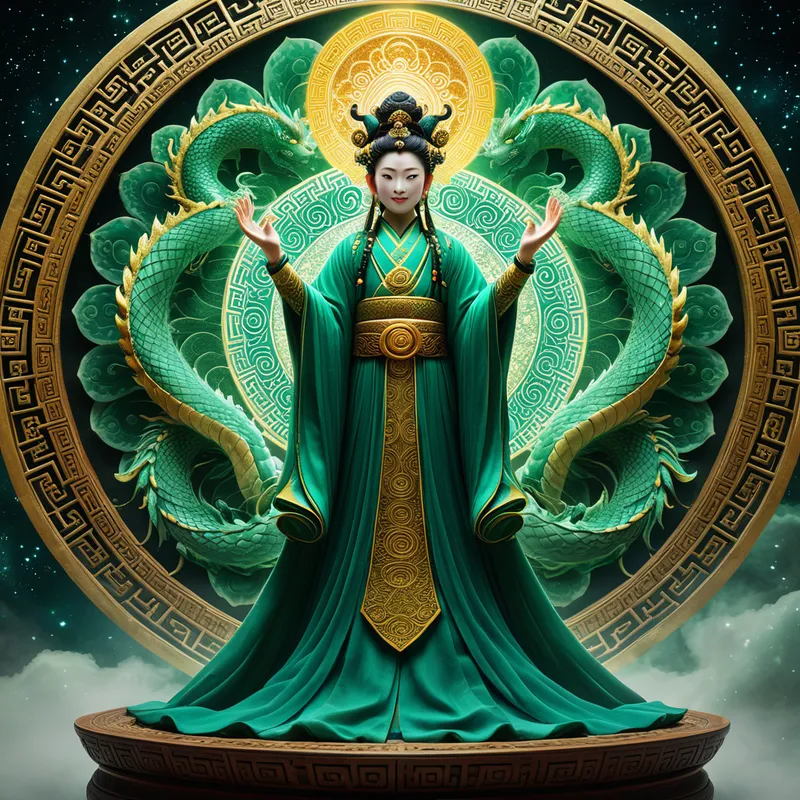
The people cried out to the August Personage of Jade, the [Jade Emperor](/myths/jade-emperor “Myth from Chinese culture.”/), in his court of clouds. But even his celestial mandate seemed frail against this fundamental rift. The answer did not come from the highest throne, but from the heart of the suffering world. It came in the form of a being known as Huang Di, [the Yellow Emperor](/myths/the-yellow-emperor “Myth from Chinese culture.”/). He was not just a ruler, but a crucible where heaven and earth met. He heard the harmony that could be, the silent music beneath the cacophony.
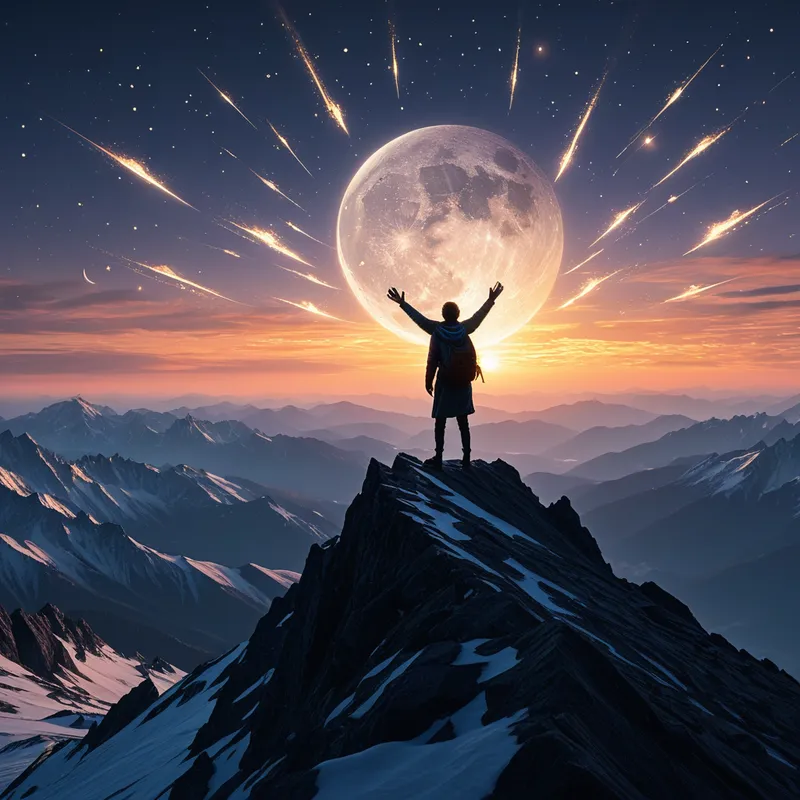
His journey was not across mountains, but into the very fabric of conflict. He did not raise an army, but stilled his own spirit, becoming a conduit. He climbed the world-axis mountain, Kunlun, and stood at the nexus of the warring skies. The nine suns blazed at him, a fury of light that sought to burn away all form. The nine moons cast their beams, a silence that sought to dissolve all will into void.
Huang Di did not fight them. He opened his arms, and in a act of unimaginable integration, he invited the conflict into himself. One by one, the raging suns and the desolate moons were drawn from the sky, not destroyed, but tempered. They streamed into his being—the scorching heat of the nine suns, the paralyzing cold of the nine moons. His form became a battlefield of cosmos, a vessel containing the ultimate imbalance.
For nine days and nine nights he held this agony, this impossible totality. On the tenth dawn, a soundless vibration emanated from him. It was not an explosion, but an emanation of perfect order. From his heart, a new pattern unfolded into the heavens: a single, harmonious sun and a single, reflective moon, moving in their eternal, balanced dance. The eighteen chaotic celestial bodies were gone, but their essence was not lost. They had been alchemized within him. The number of their sum, eighteen, became the signature of this transformation—not a count of warring parts, but a symbol of the whole that emerges from reconciling extreme opposites. The world breathed a sigh of deep, abiding peace, and the number 18 was etched into the memory of the cosmos as the mark of order wrested from chaos, of harmony forged in [the crucible](/myths/the-crucible “Myth from Alchemical culture.”/) of a hero’s soul.
Cultural Origins & Context
This myth, while not a singular canonical text like those of Greece or Rome, is woven from the deep threads of Chinese cosmological thought, Daoist philosophy, and folk numerology. It finds its roots in the ancient understanding of the universe as a dynamic system of complementary forces ([Yin-Yang](/myths/yin-yang “Myth from Taoist culture.”/)) and the belief in a celestial bureaucracy mirroring the earthly one. The figures of the Jade Emperor and the [Yellow Emperor](/myths/yellow-emperor “Myth from Chinese culture.”/) are central pillars of Chinese mytho-history, blending the divine with the legendary sage-king.
The story was passed down not by a single bard, but through a mosaic of oral traditions, local temple dramas, and philosophical allegories. It served a crucial societal function: to explain the origins of cosmic order and validate the Confucian and Daoist ideal of the virtuous ruler. Huang Di’s act models the ultimate responsibility of leadership—to bear the chaos of the realm and transform it into harmony for the people. Furthermore, it provided a narrative foundation for the profound cultural reverence for the number 18, which permeates Chinese life as a symbol of prosperity, harmony, and good fortune, seen in gifts, architecture, and celebrations.
Symbolic Architecture
At its core, this myth is a masterclass in the [psychology](/symbols/psychology “Symbol: Psychology in dreams often represents the exploration of the self, the subconscious mind, and emotional conflicts.”/) of opposites. The nine suns and nine moons are not merely celestial bodies; they are archetypal representations of psychic extremes. The suns symbolize unchecked [consciousness](/symbols/consciousness “Symbol: Consciousness represents the state of awareness and perception, encompassing thoughts, feelings, and experiences.”/), fiery ego, relentless [activity](/symbols/activity “Symbol: Activity in dreams often represents the dynamic aspects of life and can indicate movement, progress, and engagement with personal or societal responsibilities.”/), and rational tyranny that burns out all [subtlety](/symbols/subtlety “Symbol: Subtlety in arts and music represents nuanced expression, delicate details, and layered meanings that require attentive perception.”/). The moons symbolize the overwhelming unconscious, cold inertia, emotional floods, and a dissolutive pull into formlessness.
The hero’s task is not to choose a side, but to become the vessel that can contain the war.
Huang Di represents the nascent Self. His [journey](/symbols/journey “Symbol: A journey in dreams typically signifies adventure, growth, or a significant life transition.”/) up Kunlun is the [ascent](/symbols/ascent “Symbol: Symbolizes upward movement, progress, spiritual elevation, or striving toward higher goals, often representing personal growth or transcendence.”/) into heightened [awareness](/symbols/awareness “Symbol: Conscious perception of self, surroundings, or internal states. Often signifies awakening, insight, or heightened sensitivity.”/), where one can fully perceive the internal civil war. His sacrifice—taking the conflict into himself—is the critical move from [projection](/symbols/projection “Symbol: The unconscious act of attributing one’s own internal qualities, emotions, or shadow aspects onto external entities, people, or situations.”/) to [integration](/symbols/integration “Symbol: The process of unifying disparate parts of the self or experience into a cohesive whole, often representing psychological wholeness or resolution of internal conflict.”/). We often project our inner opposites onto the external world (a scorching job, a frozen [relationship](/symbols/relationship “Symbol: A representation of connections we have with others in our lives, often reflecting our emotional state.”/)). The myth instructs us to withdraw these projections and face the heat and the cold within our own [psyche](/myths/psyche “Myth from Greek culture.”/).
The [number 18](/symbols/number-18 “Symbol: The number 18 symbolizes life, luck, and spiritual awakening, often representing cycles of completion and new beginnings.”/) itself is symbolically potent. In [Chinese](/symbols/chinese “Symbol: Chinese symbolism represents a rich tapestry of culture, traditions, and philosophical beliefs originating from China.”/) [numerology](/symbols/numerology “Symbol: The study of numbers’ mystical significance, suggesting divine patterns, life paths, and hidden meanings in numerical sequences.”/), 1 (一, yī) signifies unity and beginnings, while 8 (八, bā) signifies prosperity and growth. Combined, they speak of a prosperous unity. But in the myth’s deeper [structure](/symbols/structure “Symbol: Structure in dreams often symbolizes stability, organization, and the framework of one’s life, reflecting how one perceives their environment and personal life.”/), 9 + 9 = 18. Nine is the [number](/symbols/number “Symbol: Numbers in dreams often symbolize meaning, balance, and the quest for understanding in the dreamer’s life, reflecting their mental state or concerns.”/) of completion and the celestial in [Chinese](/symbols/chinese “Symbol: Chinese symbolism represents a rich tapestry of culture, traditions, and philosophical beliefs originating from China.”/) tradition (the [Nine Heavens](/symbols/nine-heavens “Symbol: A spiritual concept representing celestial realms, divine hierarchy, and ultimate transcendence across multiple traditions.”/)). Thus, eighteen represents the completion and integration of two full celestial cycles, a double completeness. It is the numerical signature of a [system](/symbols/system “Symbol: A system represents structure, organization, and interrelated components functioning together, often reflecting personal or social order.”/) that has reconciled its own totality.
The Dreamer’s Resonance
When this myth stirs in the modern dreamer, it often manifests as dreams of overwhelming duality or impossible containment. You may dream of being caught between a blazing fire and an encroaching glacier, or of trying to hold two powerful, opposing magnets in your bare hands. You might see the number 18 glowing on a door, carved into a tree, or repeating on a digital screen in a looping, urgent code.
Somatically, this can correlate with feelings of being pulled apart, of hot flashes coupled with chills, or of a tense, vibrating stillness in the body—the physical echo of containing opposites. Psychologically, this dream pattern emerges during life’s major polarizations: a career demand (solar) vs. a family need (lunar); a rigid belief (sun) challenged by a transformative emotion (moon); or the tension between your public [persona](/myths/persona “Myth from Greek culture.”/) and your private shadow. The dream is not a warning, but an announcement: the psyche is ready for a higher-order synthesis. The chaos you are experiencing is the raw material of your own 18.
Alchemical Translation
The myth of Number 18 is a precise map for the Jungian process of individuation. The first step is the recognition of the conflict (the chaotic skies). This is the conscious realization that one’s life is ruled by irreconcilable extremes. The second is the ascent to the observing position (climbing Kunlun). This is the difficult work of gaining enough psychological distance to see the conflict as a systemic pattern, not just as a series of crises.
The pivotal alchemical stage is the sacrificial containment (Huang Di drawing the bodies into himself). This is the active, courageous engagement with the opposites. It means ceasing to blame external circumstances or other people for your inner war, and instead, holding the tension of the opposites in full conscious awareness without collapsing into one side or the other. It is a form of psychic suffering that is purposeful.
The fire of the sun and the water of the moon, held in the same vessel, do not destroy each other; they create the steam that powers transformation.
The final stage is the emanation of a new pattern (the single sun and moon). This is the birth of the transcendent function, the third [thing](/myths/thing “Myth from Norse culture.”/) that arises from the sustained tension of opposites. It is not a compromise, but a novel solution, a new attitude, a deeper harmony that could not have been predicted from either pole alone. Your personal “Number 18” becomes the symbol of your hard-won wholeness—a prosperity of spirit born not from avoiding conflict, but from transmuting it into the very structure of your being. You become the ruler of a now-harmonious inner cosmos.
Associated Symbols
Explore related symbols from the CaleaDream lexicon: