Norns Myth Meaning & Symbolism
Three ancient beings weave destiny at the roots of the World Tree, embodying the inescapable past, the unfolding present, and the unknown future.
The Tale of the Norns
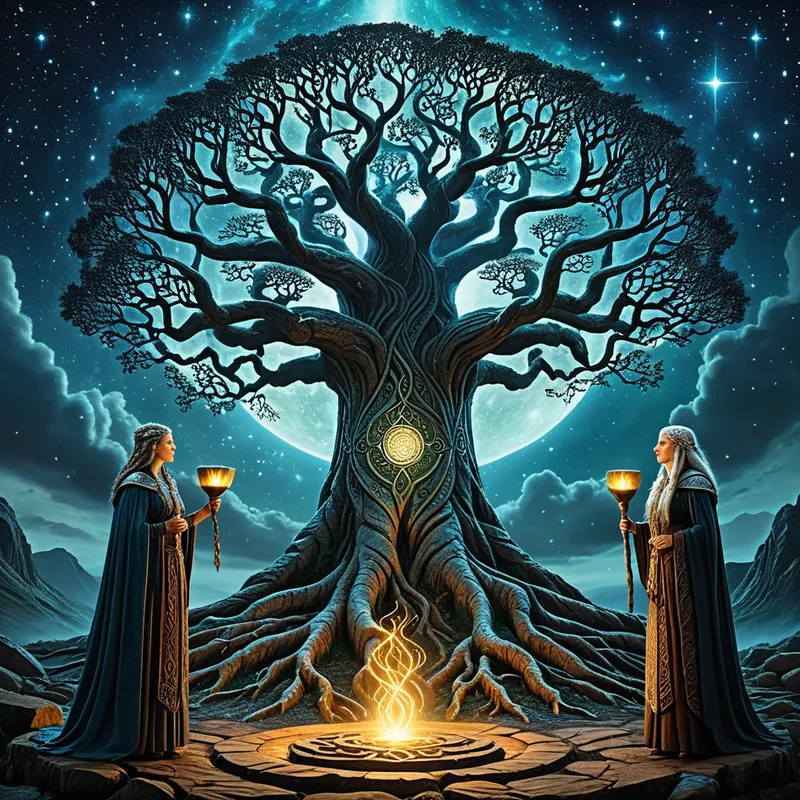
Listen, and hear of the weavers in the deep. Not in the golden halls of the gods, nor on the sunlit fields of Midgard, but down, down in the dark, damp earth where the greatest of roots coil. Here lies Urðarbrunnr, the Well of Fate, whose waters are memory itself, black and still and older than time.
From this place, they come. Three sisters, but not as mortals understand sisters. They are the Urðr, Verðandi, and Skuld. Urd is ancient, her face a map of all that has ever been, her eyes holding the depth of the well. Verdandi stands in the eternal now, her gaze clear and unwavering, her hands always in motion. Skuld is veiled, her form shifting, holding a scroll that is forever sealed, for what is written there is not yet come to pass.
Each day is the same, and each day is the making of all days. They draw the thick, sacred water from the well, and with it, they mix the rich, dark earth that cradles the root of the Yggdrasil. This mud is not mere dirt; it is the paste of reality. They plaster it upon the great root, a balm to the eternal tree that groans under the weight of nine worlds. But this is not their only work. Oh, no.
For they also weave. Their loom is time itself. Urd pulls the thread from the well—a thread spun from what was, strong and unchangeable. Verdandi takes it in her hands, the thread of the becoming, and with a shuttle of decision, she passes it through the warp. Skuld waits with her shears, the thread of what shall be held taut, ready to be cut or left to run. Their tapestry is the ørlög of all things: gods, giants, elves, dwarves, and every mortal who draws breath. The pattern is vast, terrible, and beautiful. They carve runes into the root of the tree, and as the knife bites, so is a life shaped, a battle turned, a kingdom risen or fallen.
Even Odin, the All-Father, who gave an eye for wisdom and hung nine nights on the wind-swept tree to grasp the secrets of the runes, comes here. He comes not to command, but to listen. He brings his ravens, Huginn and Muninn, but even their whispers are mere echoes of the song the Norns hum as they work. They do not speak to him of hope or despair. They simply show him the weave, the unbreakable threads, the pattern that even he is part of. He drinks from the well, and the knowledge is a weight that bows his shoulders. For here, at the root, all boasts are silent. Here, there is only the slow, inevitable drip of water into clay, the scratch of the knife on wood, and the whisper of the thread passing through the loom, writing the story of everything that is, was, and will be.
Cultural Origins & Context
The Norns emerge from the rich, complex tapestry of pre-Christian Norse and wider Germanic belief, primarily preserved in the 13th-century Icelandic texts, the Poetic Edda and Snorri Sturluson's Prose Edda. They are not gods of the Æsir or Vanir, but exist in a category of their own—potent, impersonal forces of cosmic order.
Their societal function was profound. In a world perceived as inherently chaotic and hostile, governed by frost giants and destined for a final, cataclysmic battle (Ragnarök), the concept of ørlög provided a framework of meaning. The Norns personified this framework. They answered the terrifying question of life's randomness with a difficult but potent truth: life is not random, it is woven. This weaving was not necessarily benevolent or malevolent; it was simply the structure of existence. Their myth was likely told not to offer comfort, but to foster a specific kind of courage—the courage to face a predetermined destiny with honor and resolve, a core tenet of the heroic ethos.
Symbolic Architecture
The Norns represent the tripartite structure of time as an active, creative, and binding force. They are not passive record-keepers but the very architects of temporal reality.
Urd (That Which Became) is the Past. She is the accumulated weight of all actions, decisions, and events—the unalterable foundation upon which the present moment is built. Psychologically, she is Memory, the personal and collective unconscious, the "because" of our current state. She is the clay from the well, the hardened facts of our history.
Verðandi (That Which Is Becoming) is the Present. She is the active point of manifestation, the knife carving the rune now, the hand passing the shuttle now. She represents consciousness, attention, and the perpetual act of choice within the constraints of the threads Urd provides. She is the moment of decision where potential becomes actual.
Skuld (That Which Shall Be) is the Future. Often mistranslated simply as "future," Skuld's name is related to "debt" and "guilt." She is not just what will happen, but what ought to happen as a consequence of the past and present. She is obligation, consequence, and potentiality. Her veil signifies the fundamental mystery of the future, yet her shears imply a finality—the debt will come due.
Their location is paramount. By dwelling at the root of Yggdrasil, they signify that fate is the foundational principle of the cosmos, the root system that nourishes and binds all of existence. They water the root to keep the tree alive, meaning destiny is not a dead script but a living process essential to the world's continuation.
The Dreamer's Resonance
When the pattern of the Norns appears in modern dreams, it often signals a profound confrontation with the concept of personal destiny, time, and agency. Dreaming of three ancient, powerful women (or sometimes, three figures of any gender) engaged in a silent, purposeful activity—weaving, carving, measuring—points to a somatic and psychological process of reckoning.
The dreamer may be feeling the weight of Urd: the inescapable influence of family history, past traumas, or life choices that feel "set in stone." Verdandi's presence manifests as intense anxiety or focus about a current, pivotal decision, a feeling of carving one's name into the tree of life with every present-moment action. Skuld appears as dread or awe about the future, a sense of an impending "reckoning" or a veil over one's path that feels both mysterious and fated.
This dream constellation invites the dreamer to ask: Where am I rigidly bound by the "past" thread? Where am I actively weaving in the "now"? And what future "debt" am I creating by my current actions? It is a dream of deep responsibility and the search for meaning within life's predetermined contours.
Alchemical Translation
The alchemical process modeled by the Norns is the individuation journey of coming to terms with one's own ørlög—the unique, inborn pattern of the psyche. It is the work of moving from being an unconscious thread in a tapestry to becoming a conscious co-weaver at the root of one's own world-tree.
The first stage is Nigredo, the descent to the roots. This is confronting Urd: doing the shadow-work of examining one's personal and ancestral past, drinking from the dark well of memory to understand the "clay" one is made from. It is acknowledging the unchangeable facts of one's existence without denial.
The second stage is Albedo, the purification and conscious engagement. This is embracing the role of Verdandi. It is the clarifying work of taking the raw material of the past and, with full conscious attention (the now), making choices, carving one's values (runes) into the substance of daily life. It is accepting the power and limitation of the present moment.
The final stage, Rubedo, is the integration of Skuld. It is not about controlling the future, but about understanding that the future (Skuld) is the rightful heir to the past and present. By consciously working with Urd and Verdandi, one aligns with one's destiny. The "debt" to the future becomes not a burden, but the mature acceptance of consequence and the mysterious, veiled purpose of one's life. The shears are no longer feared, for the tapestry woven is authentic. The individual becomes, like Odin at the well, a humble witness to the grand pattern, finding their sovereign place within it, not through defiance of fate, but through profound alignment with its deep, root-level truth.
Associated Symbols
Explore related symbols from the CaleaDream lexicon: