Nonius Myth Meaning & Symbolism
A Roman magistrate's sacred grove is spared by the gods, making him a living sanctuary, a profound symbol of the self as hallowed ground.
The Tale of Nonius
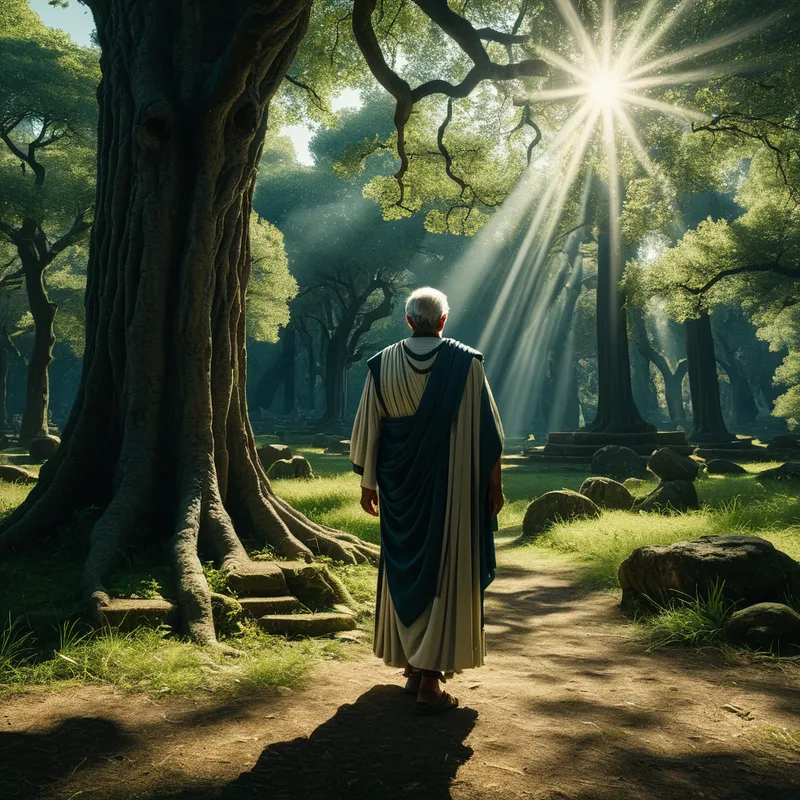
Hear now a tale not of thunderous war, but of a quiet, earth-shaking grace. In the days when the Republic’s stones were still warm with ambition, there lived a man named Nonius. He was a man of the law, a praetor, whose mind was a ledger of precedent and whose heart beat in time with the Senate’s rhythms. Yet, within his family’s estate, beyond the trimmed hedges and the colonnaded walks, lay a tract of land untouched by the surveyor’s line—a sacred grove.
It was no ordinary wood. This was a lucus, a dwelling place of the numina. Ancient oaks, their limbs heavy with centuries, whispered secrets to the breeze. The air hummed with the presence of the divine. Nonius, though a man of the forum, honored this silence. He made offerings there, not out of grandiose piety, but from a deep, ancestral knowing that some ground is not meant for the plow or the auction block.
Fate, however, wears the boots of legionaries. A great public work was decreed—a new road to speed the march of legions and the flow of commerce. The surveyors came with their groma, and their straight, unyielding line ran directly through the heart of Nonius’s grove. The order was given: the grove must be cleared.
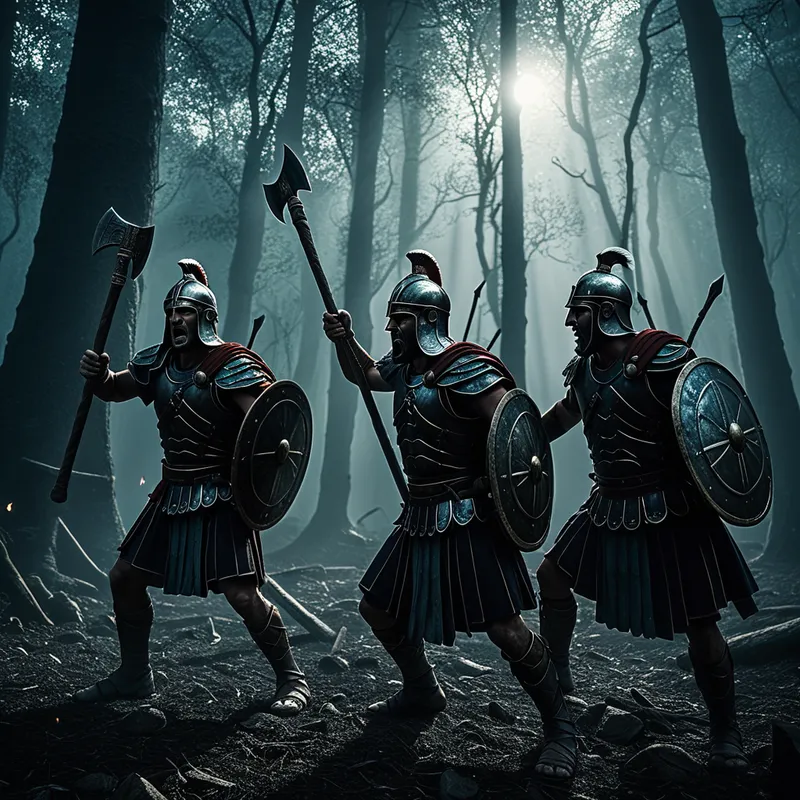
On the appointed day, soldiers arrived with axes. The sun was high, casting sharp, judgmental shadows. Nonius stood at the edge of the clearing, not as a magistrate commanding halt, but as a supplicant. He did not plead. He simply stood, a man between two worlds—the world of human decree and the world of divine compact.
As the first axe rose, a strange stillness fell. Not a silence, but a presence, thick as honey. The axe-bit, destined for the gnarled bark of the eldest oak, seemed to strike an invisible, resilient membrane. The soldier staggered back, his arm numb. A murmur, like distant water, rose from the earth itself. The very leaves of the grove began to shimmer with a soft, gold-green light, not of the sun, but from within.
The divine will was made manifest. The grove was not merely protected; it was declared inviolable. The gods themselves had drawn a boundary. And in that moment, the miracle attached not only to the land, but to the man who was its steward. A decree, more powerful than any senatus consultum, echoed in the souls of all present: This man, Nonius, is as the grove. He is sanctuary.
From that day, Nonius carried the grove within him. To harm him was to profane hallowed ground. He walked through the intrigues of Rome untouched, a living temenos. He became not a powerful man, but a sacred one. His authority was no longer of office, but of essence. The conflict was resolved not by battle, but by a breathtaking act of recognition—the recognition of the sacred within the civic, the eternal within the temporal.
Cultural Origins & Context
The story of Nonius is preserved not in epic verse, but in the drier, yet profoundly revealing, pages of Marcus Terentius Varro and the later compiler Nonius Marcellus, who may have drawn upon the tale for his own name’s legacy. It belongs to a class of Roman foundation myths that are less about heroic action and more about sacred legality and divine sanction.
This was a myth told by antiquarians and priests, a exemplum of the core Roman religious principle: pax deorum (the peace of the gods). Rome’s success depended on meticulously honoring contracts with the divine. Nonius’s story illustrates the converse—the gods honoring a contract with a righteous man. It served a societal function of validating the sanctity of certain ancient land rights (fas) over utilitarian civil law (ius), and of modeling the ideal Roman aristocrat: one whose private virtue (virtus) and piety (pietas) are so complete they garner tangible, public divine favor. It reinforced that true authority springs from correct relationship with the unseen order.
Symbolic Architecture
At its heart, the myth of Nonius is about the establishment of an inner sanctum. The sacred grove represents the primordial, untamed Self—the core of one’s being that exists before and beyond social roles (the Praetor) and collective demands (the road).
The most profound boundaries are not walls we build, but sanctuaries we discover within, which the world instinctively recognizes and dares not violate.
The conflict arises when the linear, utilitarian, and collective consciousness (the surveyed road) seeks to cut through this inner wildness. The resolution is not compromise, but a miraculous differentiation: the Self is declared inviolable. Nonius’s transformation from a man who owns a grove to a man who is the grove is the ultimate symbol of psychological integration. The sacred is no longer external; it is incarnate. The persona of the magistrate is suffused with the power of the inner Self. He becomes a walking pomerium, a living boundary between the profane and the sacred.
The Dreamer's Resonance
When this myth stirs in the modern soul, it often manifests in dreams of unexpected protection or profound personal boundaries. One might dream of a familiar room in their house suddenly revealing a hidden, ancient forest that cannot be entered by others. Or they may dream of facing an aggressor, only to have their own body emit a calm, immobilizing light that halts all hostility.
Somatically, this can correlate with a release of chronic tension—the shoulders dropping, the jaw unclenching—as the psyche internalizes the truth that it does not need to fight for its space; its right to exist is inherent and divinely sanctioned. The psychological process is one of moving from defending one’s values to embodying them so fully that they require no defense. It is the dream-state resolution of burnout, where the exhausted caregiver or pressured executive discovers an indestructible core of peace that cannot be commodified or compromised.
Alchemical Translation
The alchemical process mirrored here is coagulatio—the descent of spirit into matter, the fixing of the volatile into a durable, sacred form. Nonius begins as a man of societas (society). The grove represents the animus mundi (the world soul) or the unconscious. The impending destruction is the nigredo, the darkening, where the demands of the outer world threaten to annihilate the inner truth.
The alchemy of the Self occurs when the divine spark within is not just visited occasionally, but invited to take up permanent residence, transmuting the base metal of the personality into living gold.
The miraculous intervention is the albedo, the whitening, a divine illumination that reveals the true, sacred nature of the substance. Nonius does not do anything active; he witnesses the revelation. His final state is the rubedo, the reddening, where the sacred becomes incarnate. He is the Philosopher’s Stone—the ordinary mortal transformed into a vessel of incorruptible, self-sustaining value. For the modern individual, this models the culmination of individuation: not becoming special or powerful in a worldly sense, but becoming so authentically and wholly oneself that one’s mere presence establishes a field of integrity. One becomes a sanctuary, and in doing so, offers the possibility of sanctuary to others. The road of collective ambition must, and will, bend around this unshakable truth.
Associated Symbols
Explore related symbols from the CaleaDream lexicon: