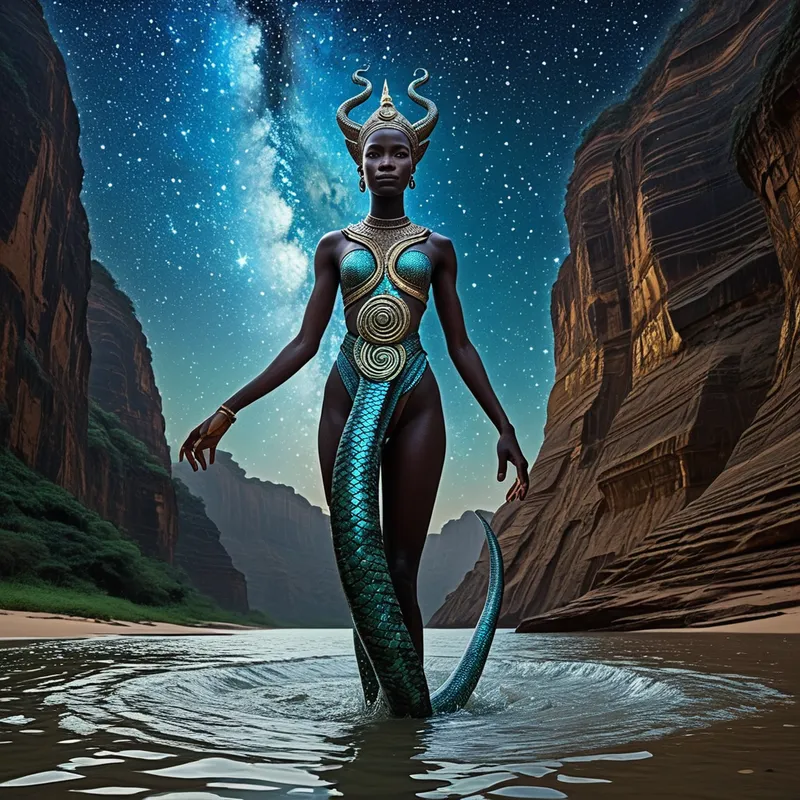
Nommo Myth Meaning & Symbolism
The myth of Nommo, the primordial amphibious being who sacrificed himself to bring order, water, and the principles of civilization to a chaotic world.
The Tale of Nommo
In the time before time, when the egg of the world lay cracked and steaming, there was only the echo of a thought. The sky was empty, a dry bowl of fired clay. The earth was formless, a restless, heaving thing of dust and shadow. From the womb of this chaos, the Amma brought forth the first seeds of existence.
But the first birth was a calamity. Ogo, the wild jackal, burst forth. He tore at the placenta of the heavens, stealing pieces of the primordial soul to create a barren, dry land for himself. His rebellion scarred the universe; his act was a theft of order, leaving a world parched and spinning in confusion.
Then, in answer to this primal fracture, came the second birth. From the sacred waters held within Amma’s intention, the Nommo emerged. They were complete. Their torsos were human, radiant and androgynous, expressions of perfect potential. Their lower bodies were the powerful, fluid forms of the serpent-fish, creatures of both the deep waters and the fertile earth. Their eyes held the calm of deep pools and the fire of distant stars. They were the word made flesh, the principle of life given form.
Yet, the world Ogo had scarred remained—a cracked vessel unable to hold the grace of the Nommo. So, the great sacrifice was made. The principal Nommo, the perfect one, allowed itself to be dismembered. Its body was scattered across the barren cosmos. Its flesh became the moist, fecund soil. Its blood flowed as the first rivers, snaking through the desolation. Its breath became the wind that carries seed and song. From its fragments, the eight original ancestors of humanity were fashioned, each imbued with a spark of the Nommo’s divine essence.
The Nommo did not die. It transformed. It became the very fabric of the ordered world, the hidden moisture in the stone, the rhythm in the heartbeat, the grammar in the first spoken word. It descended in a great arc—a celestial granary of wisdom—bringing not just water, but language, agriculture, social order, and the very knowledge of the stars to the waiting people at the foot of the Bandiagara Escarpment. The world was no longer a dry echo, but a living, speaking being, baptized in the sacrifice of the amphibious sage.

Cultural Origins & Context
This profound narrative is the cornerstone of the spiritual and cosmological system of the Dogon people of Mali. For centuries, their society has been intricately woven into the stark, majestic landscape of the Bandiagara Escarpment, a place that itself mirrors the mythic descent from heaven to earth. The myth of Nommo is not merely a story; it is a living, breathing map of reality, transmitted through generations with meticulous care.
The primary custodians of this knowledge were the Hogon, the spiritual elders. This wisdom was passed down through initiatory degrees, with deeper layers of symbolic and astronomical understanding revealed over a lifetime. The myth served as the ultimate reference point, explaining the origin of social structures, agricultural cycles, and intricate ritual practices. The famed Dogon knowledge of the Sirius star system, for instance, is intricately linked to the Nommo narrative, with Sirius B seen as the "seed" of the universe, connected to the Nommo's creative essence. The myth functioned as a complete ontological framework, answering why the world is ordered, why sacrifice is necessary for renewal, and how humanity is fundamentally connected to a cosmic, intelligent principle of life.
Symbolic Architecture
At its heart, the myth of Nommo is a grand allegory for the emergence of consciousness from the unconscious, and of culture from nature. It describes the painful but necessary process of differentiation that creates a habitable world of meaning.
The primordial unity must be broken for the manifold world to be born; the self must be sacrificed to become the soul of the system.
Ogo represents the necessary but destructive first impulse of individuation—the ego bursting forth in a chaotic, selfish act that separates itself from the whole. This creates the "dry land" of isolated consciousness, a barren state of alienation. The Nommo symbolizes the compensating force of the Self, the archetype of wholeness and ordering intelligence. Its amphibious nature is key: it is the mediator between the deep, unconscious waters (the fish/serpent tail) and the structured world of human consciousness and society (the human torso).
The dismemberment is not a punishment, but the ultimate creative act. It represents the dissemination of psychic energy—the libido or life force—into all aspects of existence. The Nommo becomes the anima mundi, the world soul. Its fragmentation into the eight ancestors signifies how the archetype of wholeness is distributed within the collective human psyche, a potential for completeness within each person, waiting to be recollected.

The Dreamer's Resonance
When the pattern of the Nommo stirs in the modern dreamer, it often signals a profound process of psychic irrigation. One may dream of arid landscapes suddenly finding water, of discovering hidden pools in familiar places, or of benevolent, wise aquatic beings offering gifts. The somatic sensation is often one of profound relief, a quenching of a deep, unnamed thirst.
Psychologically, this points to a confrontation with one's personal Ogo—the dry, restless, and selfish aspects of the ego that have created inner barrenness through fixation, control, or isolation. The emerging Nommo energy is the healing, integrative function of the psyche. It is the dream's solution to a life that has become spiritually or emotionally dehydrated. The dream is initiating a sacrifice of the old, fragmented ego-state so that a more nourishing, connected, and fluid sense of self can be reconstituted. The dreamer is being invited to allow their own rigid structures to be "dismembered" by the unconscious, to be remade into something that can sustain life.

Alchemical Translation
The myth of Nommo provides a stunning blueprint for the alchemical process of individuation—the journey toward psychic wholeness. The initial state is the massa confusa, the chaotic, "dry" world of Ogo, analogous to a life ruled by a fractured, anxious ego.
The first step is the recognition of the Nommo within—the call of the Self. This is the moment one senses a deeper, wiser, more connected potential beneath the surface of everyday identity. The central, terrifying, yet transformative operation is the sacrificium: the willing dismemberment of the old personality.
One does not find wholeness by adding more pieces to the ego, but by allowing the ego to be broken down and reconstituted by a greater intelligence.
This is the modern ordeal: allowing career, relationships, cherished self-images, and old traumas to be broken apart by the waters of the unconscious (through therapy, crisis, creative work, or deep reflection). It feels like a loss, a death. But as in the myth, this dissolution is creative. The scattered pieces—our talents, wounds, memories, and passions—do not vanish. They are reorganized and infused with new meaning. They become the rivers, grains, and words of a revitalized inner world.
The final stage is the descent of the "celestial granary." This is the establishment of a new, sustainable inner order. The wisdom (the grain) gathered from the sacrifice is stored and made useful. The individual becomes a vessel of this life-giving principle, able to speak a truer language, cultivate meaningful "crops" in their life, and understand their place within a larger cosmic order. They become, in a psychological sense, amphibious—fully capable in the world of consciousness while remaining rooted in the nourishing depths of the soul.
Associated Symbols
Explore related symbols from the CaleaDream lexicon: