Noah's Flood Myth Meaning & Symbolism
A divine deluge purges a corrupt world, sparing a righteous man and his family to preserve life and begin a new covenant with creation.
The Tale of Noah’s Flood
In the beginning of this end, [the world](/myths/the-world “Myth from Tarot culture.”/) was a cacophony of violence. [The earth](/myths/the-earth “Myth from Hindu culture.”/) was filled with the sound of it—the groaning of the land under the weight of human corruption, the weeping of the heavens at the sight. The hearts of men and women had turned inward, a black spiral of thought where only self existed, and the fabric of creation grew thin and stained.
But in the midst of the noise, there was a man who walked a different path. His name was Noah, a man of quiet integrity in a shouting age. He heard a different music, the silent rhythm of a righteous life. And one day, the silence spoke. The voice of Yahweh cut through the chaos of his heart, a clear, terrible, and intimate command: “Make yourself an ark.”
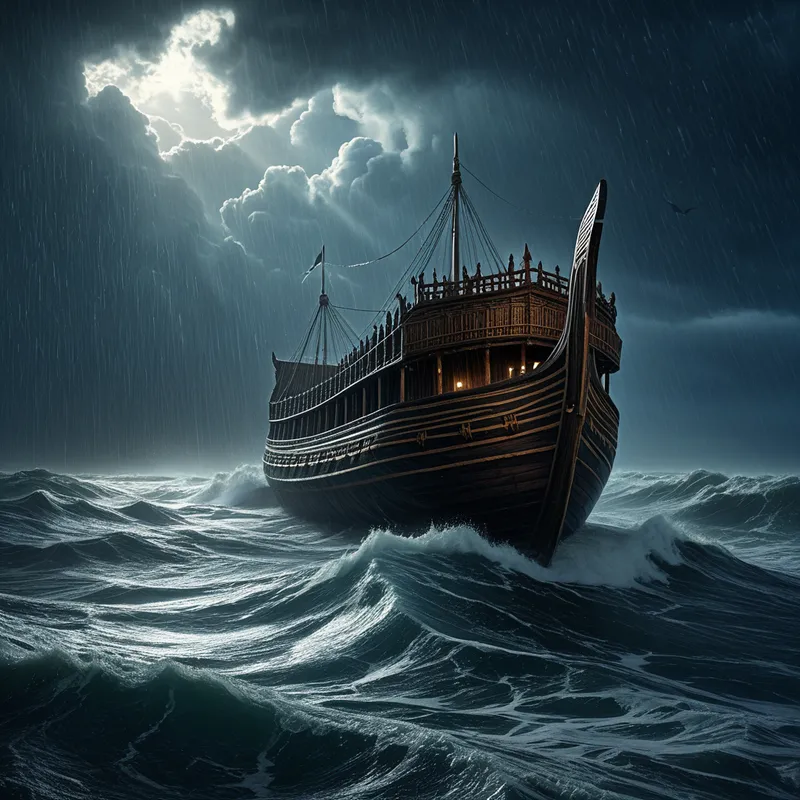
The command was a universe of paradox. Build a vast ship, a mountain of gopher wood and pitch, on dry land, under a clear sky. Gather a male and female of every creeping, flying, and walking [thing](/myths/thing “Myth from Norse culture.”/) that breathes. Prepare for a flood of waters to destroy all flesh. Noah, in the profound obedience of faith, became a spectacle. For decades, the sound of his hammer was the counter-rhythm to the world’s decay. He built the ark, a floating womb of salvation, while his neighbors built monuments to themselves.
Then the fountains of the great deep burst apart, and the windows of the heavens were opened. It was not merely rain; it was the unmaking of the boundary between the waters above and the waters below. [The deluge](/myths/the-deluge “Myth from Mesopotamian culture.”/) was a return to the primordial, formless deep of Tehom. For forty days and forty nights, the cataracts fell, and the ark was lifted, a speck of ordered life tossed on the chaos of a drowned world. Inside, the smell of damp wood, animal musk, and fear was thick. Outside, the roar was absolute—the death cry of an epoch.
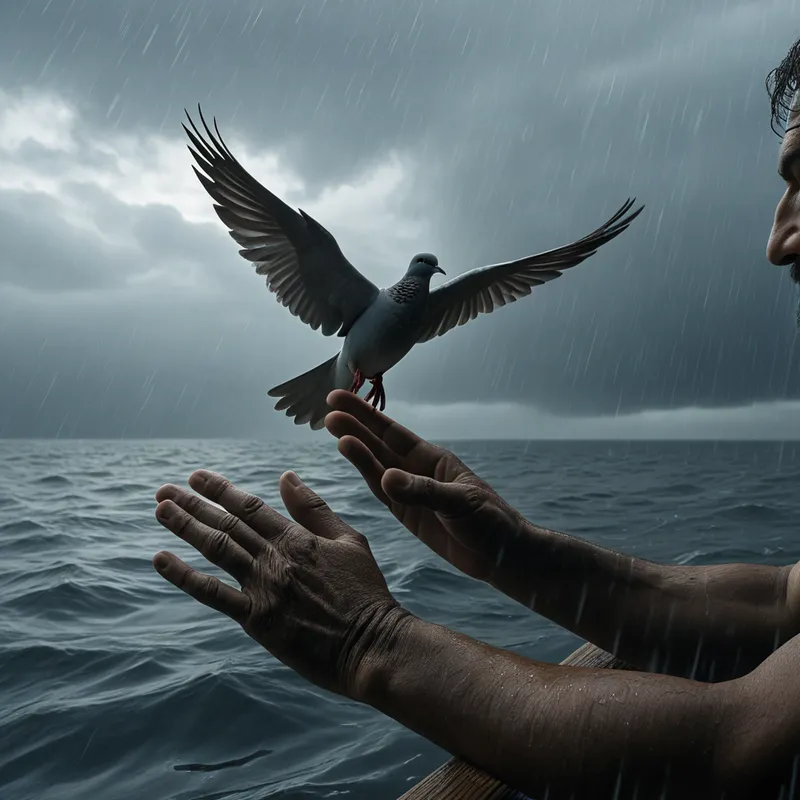
The waters prevailed upon the earth for one hundred and fifty days. Then, [Ruach Elohim](/myths/ruach-elohim “Myth from Abrahamic culture.”/) moved again over the face of the waters. A wind was sent, and the waters receded. The ark came to rest on the mountains of Ararat, a new world’s first dry peak. Noah sent forth a [raven](/myths/raven “Myth from Haida culture.”/), which flew to and fro. Then a dove, which found no rest. He waited. He sent the dove again, and it returned with a freshly plucked olive leaf in its beak—a green prayer against the grey. The third time, it did not return.
Noah removed the covering of the ark and looked out upon a washed, silent, and empty earth. He built an altar and offered a sacrifice. The scent of the offering rose, and Yahweh smelled the pleasing aroma. In his heart, a covenant was made: “Never again.” The bow was set in the cloud, a warrior’s weapon laid down, its arc now a bridge of light between heaven and earth—a promise etched in [the sky](/myths/the-sky “Myth from Persian culture.”/) itself.
Cultural Origins & Context
The story of [the Flood](/myths/the-flood “Myth from Biblical culture.”/) is not native solely to the Biblical tradition; it is an ancient, near-ubiquitous mythic memory, with profound parallels in Mesopotamian epics like the Epic of [Gilgamesh](/myths/gilgamesh “Myth from Mesopotamian culture.”/). Within the Biblical context, it is woven into the foundational Genesis narrative, serving as a pivotal reset between the primordial history and the patriarchal stories. It was a story told and retold by priests and scribes, a cornerstone of Israel’s understanding of their God’s character: utterly sovereign over creation, morally rigorous in judgment, yet fundamentally committed to preservation and promise.
Its societal function was multifaceted. It was a theodicy, explaining the presence of evil and suffering as a consequence of cosmic moral failure. It was a warning about the limits of divine patience. Most importantly, it was a story of covenant—a binding agreement that established the rules of engagement between the divine and the human. The Flood narrative set the stage for the later, more personal covenants with Abraham and [Moses](/myths/moses “Myth from Biblical culture.”/), framing the relationship as one where grace follows judgment, but within a framework of law and expectation.
Symbolic Architecture
At its core, the Flood is an [archetypal image](/symbols/archetypal-image “Symbol: A universal, primordial symbol from the collective unconscious that transcends individual experience and carries profound spiritual or mythic meaning.”/) of [nigredo](/myths/nigredo “Myth from Alchemical culture.”/)—the alchemical stage of blackening, [dissolution](/symbols/dissolution “Symbol: The process of breaking down, dispersing, or losing form, often representing transformation, release, or the end of a state of being.”/), and [putrefaction](/symbols/putrefaction “Symbol: A spiritual process of decay that transforms organic matter, symbolizing death, renewal, and the breakdown preceding rebirth in mythic cycles.”/). The world, having become spiritually and morally putrid, is dissolved back into its primal, watery state.
The floodwaters are not merely punishment; they are the necessary solvent for a corrupted form. The ego-structure of humanity had become calcified in violence and self-worship; only a total dissolution could allow for a new shape to emerge.
The Ark is the ultimate [symbol](/symbols/symbol “Symbol: A symbol can represent an idea, concept, or belief, serving as a powerful tool for communication and understanding.”/) of the [temenos](/myths/temenos “Myth from Greek culture.”/)—the sacred, protected [vessel](/symbols/vessel “Symbol: A container or structure that holds, transports, or protects something essential, representing the self, emotions, or life journey.”/) or container. In [psychology](/symbols/psychology “Symbol: Psychology in dreams often represents the exploration of the self, the subconscious mind, and emotional conflicts.”/), this is the therapeutic [space](/symbols/space “Symbol: Dreaming of ‘Space’ often symbolizes the vastness of potential, personal freedom, or feelings of isolation and exploration in one’s life.”/), the disciplined practice, or the intact [psyche](/myths/psyche “Myth from Greek culture.”/) itself that can hold the contents of the unconscious (the animal instincts, the paired opposites) during a [period](/symbols/period “Symbol: Periods in dreams can symbolize cyclical patterns, renewal, and the associated emotions of loss or change throughout life.”/) of catastrophic inner change. Noah’s obedience is [the ego](/myths/the-ego “Myth from Jungian culture.”/)’s [agreement](/symbols/agreement “Symbol: A harmonious arrangement in artistic collaboration, symbolizing unity, shared vision, and creative consensus.”/) to enter this container, to submit to a process whose full [horror](/symbols/horror “Symbol: Horror in dreams often symbolizes deep-seated fears, anxieties, and unresolved conflicts that the dreamer faces in waking life.”/) it cannot comprehend, trusting in a directive from a deeper, Self-level [authority](/symbols/authority “Symbol: A symbol representing power structures, rules, and control, often reflecting one’s relationship with societal or personal governance.”/).
The [sequence](/symbols/sequence “Symbol: The symbol of ‘sequence’ often signifies the order of events and the progression towards a desired outcome or goal.”/) of the [raven](/symbols/raven “Symbol: The raven is often seen as a messenger of the divine and a symbol of transformation, wisdom, and the mysteries of life and death.”/) and the dove represents the two movements of the psyche in [crisis](/symbols/crisis “Symbol: A crisis symbolizes turmoil, urgent challenges, and the need for immediate resolution or change.”/). The [raven](/symbols/raven “Symbol: The raven is often seen as a messenger of the divine and a symbol of transformation, wisdom, and the mysteries of life and death.”/), a scavenger, flies out and does not return—it is the part of us that goes out to dwell on the carnage, the [loss](/symbols/loss “Symbol: Loss often symbolizes change, grief, and transformation in dreams, representing the emotional or psychological detachment from something or someone significant.”/), the darkness. The dove is the [spirit](/symbols/spirit “Symbol: Spirit symbolizes the essence of life, vitality, and the spiritual journey of the individual.”/) of hope, of reconnaissance for new [life](/symbols/life “Symbol: The symbol of ‘Life’ represents a journey of growth, interconnectedness, and existential meaning, encompassing both the joys and challenges that define human experience.”/). Its return with the olive [leaf](/symbols/leaf “Symbol: A leaf symbolizes growth, renewal, and the cycles of life, reflecting both the natural world and personal transformations.”/) is the first signal that the process of [albedo](/symbols/albedo “Symbol: In alchemy, the whitening stage representing purification, spiritual ascension, and the emergence of consciousness from darkness.”/)—purification and [illumination](/symbols/illumination “Symbol: A sudden clarity or revelation, often representing spiritual awakening, intellectual breakthrough, or the dispelling of ignorance.”/)—has begun.
The Dreamer’s Resonance
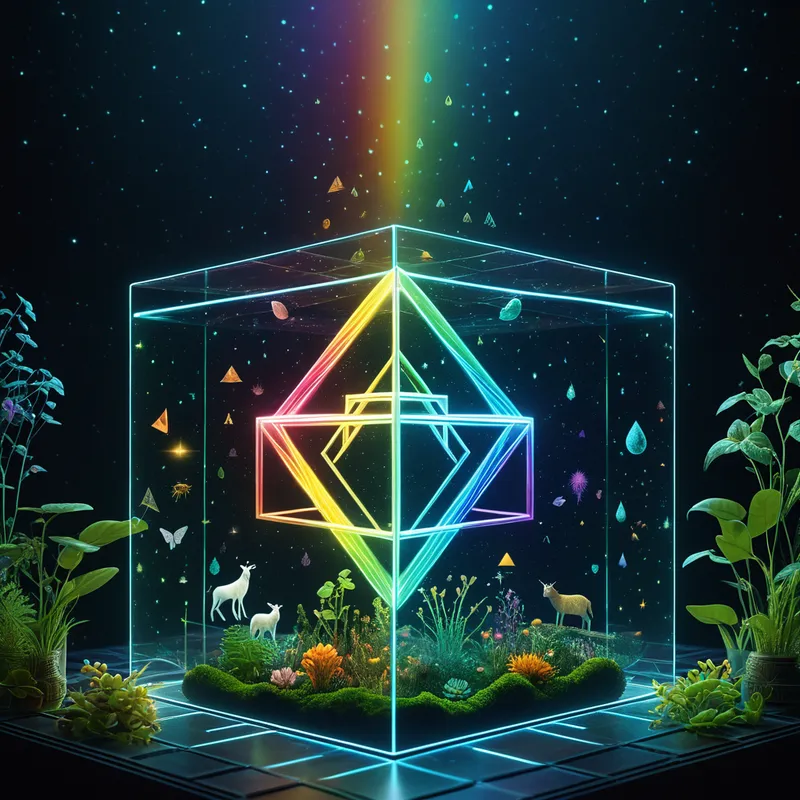
When this myth stirs in the modern dreamer, it often signals a profound psychological inundation. To dream of overwhelming floods, of saving animals, or of being in a large, enclosed vessel like a ship or ark, is to experience the somatic truth of [the nigredo](/myths/the-nigredo “Myth from Alchemical culture.”/).
The dream-ego may feel like Noah: tasked with an impossible, lonely preservation project while the familiar world dissolves. This is the psyche’s recognition that an old attitude, a long-held complex, or a life structure has become corrupt—perhaps through cynicism, resentment, or hollow routine—and must be dismantled. The floodwaters in dreams are the upwelling of the unconscious, threatening to drown conscious identity. The dream-ark is the nascent, fragile sense of Self that must be built before the crisis fully hits. Dreaming of saving pairs of animals can reflect the dreamer’s struggle to reconcile opposites within—masculine and feminine, aggression and passivity, wildness and domestication—to preserve the full spectrum of their instinctual life for the future.
Alchemical Translation
The journey of Noah is a master template for individuation. It begins with the call from [the Self](/myths/the-self “Myth from Jungian culture.”/) (the divine command), which often feels irrational: build an ark in [the desert](/myths/the-desert “Myth from Biblical culture.”/) of your life. This is the call to create an inner container—through analysis, art, meditation, or any disciplined practice—before the storm is visible.
The forty days in the ark represent the necessary period of incubation. This is the liminal space where one must endure the stink and confusion of one’s own inner contents, held in the dark, with only faith that the waters will recede. It is a passive, suffering phase where the old world is truly allowed to die.
The covenant with the rainbow is the symbol of the coniunctio oppositorum—the union of opposites. Heaven (the divine) and Earth (the human) are joined by a spectrum of light that contains all colors. This is the promise that emerges from the ordeal: that the psyche, having endured its dissolution, will not be abandoned. A new relationship between the ego and the Self is established.
For the modern individual, the alchemy of the Flood is the process of allowing a cherished but outworn identity to be washed away. It is the terrifying, liberating understanding that to be reborn, one must first consent to the flood. One must build the ark of a new consciousness, gather the scattered instincts, and ride out the storm, trusting that the dove will eventually bring back evidence of a new, green world, and that the final covenant is not of perfection, but of enduring, rainbow-hued grace.
Associated Symbols
Explore related symbols from the CaleaDream lexicon: