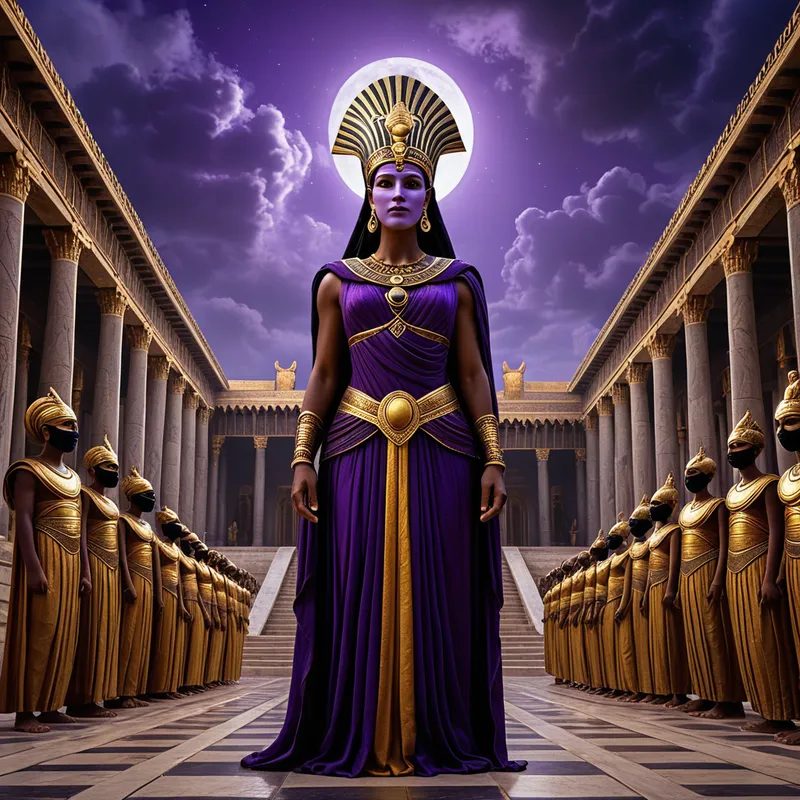
Niobe Myth Meaning & Symbolism
A queen's boast of superiority over the goddess Leto leads Apollo and Artemis to slay her fourteen children, transforming her into a weeping stone.
The Tale of Niobe
Hear now the story of Niobe, a tale not of heroes, but of a queen whose heart was a palace of pride, and whose sorrow became a monument for all time.
In the great city of Thebes, where the walls sang with the memory of Cadmus, Queen Niobe reigned. She was daughter of Tantalus, whose own torment in the underworld was a whispered family curse. To her, the king Amphion, she bore a bounty that seemed to defy fate itself: seven strong sons and seven radiant daughters. Fourteen stars in her domestic firmament. The palace halls echoed with their laughter, their footsteps a symphony of life. Niobe looked upon them, and her heart swelled not just with love, but with a towering, dangerous conviction. She believed her fortune was not a gift, but a proof of her own supreme worth.
It was during the festival of Leto that the poison of this pride spilled over. The women of Thebes had gathered, burning incense, offering hymns to the gentle, ancient mother of the twin archers. Niobe swept into their midst, her robes a storm of purple and gold. "Fools!" her voice rang, clear and cold as a winter stream. "Why do you worship a goddess you have never seen? Offer your prayers to me, who stands before you! Leto bore but two children. I have borne seven times that number. My wealth, my lineage, my progeny—they eclipse her faded glory. I am the goddess you should adore."
A silence fell, deeper than any ritual silence. The incense smoke seemed to coil and freeze in the air. The insult, vast and deliberate, did not linger in the Theban square. It traveled, swift as thought, to the clear heights of Mount Olympus, and then to the sacred isle of Delos.
Leto heard. She did not rage; her grief was too profound for noise. She went to her children. To Apollo, the god of the golden bow, and to Artemis, mistress of the silver arrow. "Your mother is shamed," she said, and that was all.
The twins said nothing. They took up their quivers and descended from the light of heaven into the mortal world. Over Thebes, the sun grew fierce and pitiless under Apollo's gaze; the shadows grew sharp and cold under Artemis's. The sons of Niobe were practicing their arts in the field—wrestling, racing, driving chariots. From a cloudless sky, Apollo's arrows fell. They were shafts of pure, unanswerable finality. One by one, the young men fell, each cry cut short, each strong body stilled in the dust. News, screaming and terrible, flew to the palace.
Niobe rushed out, her pride now a frantic shield against the horror. She gathered her daughters around her, a living wall of her remaining fortune. "You will not take these from me!" she cried to the uncaring sky. But Artemis was already there, her presence a chill in the very sunlight. The silver arrows flew, silent and sure. The daughters embraced their mother, and one by one, they slid lifeless to the marble, their warmth leaching into the stone.
In a single hour, the symphony was silenced. Fourteen bodies lay still. Amphion, upon seeing the carnage, took his own life. Niobe did not die. She stood in the courtyard of her obliterated world. She could not move. She could not speak. Her tears began to flow, a river from a source that seemed to have broken open beneath her soul. She wept for days, unceasing, untouched by food or drink. Her people, terrified, dared not approach.
And as she wept, a profound numbness began at her extremities. A coldness, not of death, but of cessation. The tears still flowed, but her feet rooted to the earth. Her skin hardened, lost its color, took on the grey hue of storm clouds. Her flowing robes stiffened into stony folds. Her head, bowed in endless grief, became a crag. The gods, in their final decree, granted her a bitter mercy: they whisked her away to a lonely mountain in her ancestral Lydia. There, upon the desolate slopes of Mount Sipylus, she completed her change. Queen Niobe became a stone. And from that stone, they say, a spring of water forever wells and trickles down the rock face—the only sign of the endless, petrified weeping within.

Cultural Origins & Context
The myth of Niobe is one of the most ancient and persistent in the Greek corpus, a stark folktale of divine punishment refined by epic and tragic poetry. It appears in the oldest surviving Greek text, Homer's Iliad (Book XXIV), where Achilles uses the story of Niobe's eternal petrification to persuade the grieving King Priam to finally eat. This placement is crucial; it frames the myth not as a mere cautionary tale, but as a profound, shared reference point for understanding the nature of grief itself—a grief so vast it must become part of the landscape.
The story was later expanded by poets like Hesiod and most famously by the tragedians. Sophocles is said to have written a lost play, Niobe, focusing on the queen's silent, stony grief. The myth functioned on multiple societal levels. For the pious, it was a direct and terrifying lesson in hubris, the cardinal sin of overstepping mortal bounds and challenging divine order. For the polis, it was a warning about the dangers of unchecked personal pride (hybris) destabilizing the social and religious fabric. For every parent, it was the nightmare of loss made mythic, a story that gave a terrifying, yet somehow validating, shape to the unspeakable.
Symbolic Architecture
Niobe represents the archetypal collision between human possession and divine law. Her children are not merely offspring; they are the externalized trophies of her ego, the living proof of her superiority. Her boast is not just pride in them, but a declaration that her mortal fecundity outshines divine creation itself. She confuses the gift for the giver, and the blessing for her own inherent worth.
The greatest human suffering often springs from mistaking a temporal blessing for an eternal, personal truth.
The vengeance of Apollo and Artemis is swift, absolute, and symbolic. They destroy not Niobe, but the very source of her pride—the evidence of her supposed superiority. The massacre is a brutal act of psychic surgery, removing the inflated identity she had constructed. Her transformation into a weeping stone is the central, chilling symbol. It is not death, but a state of eternal suspension. Grief, when it is absolute and refuses all movement, petrifies the soul. The weeping spring is the poignant paradox: the feeling remains (the water of tears), but the vessel for living, changing, and processing that feeling has turned to unyielding stone. She becomes a monument to her own emotion, forever defined by, and trapped within, a single catastrophic moment.

The Dreamer's Resonance
When the pattern of Niobe manifests in modern dreams, it rarely appears as a classical mythic tableau. Instead, the dreamer may experience the somatic reality of petrification—a terrifying paralysis as a wave of grief, shame, or shock hits. They may dream of a cherished home turning cold and empty, of family portraits where the faces slowly erode, or of themselves speaking words that come out as hard, clicking stones.
Psychologically, this dream pattern signals a profound identification with a loss or a blow to the ego so severe that the psyche has frozen in response. It is the state of traumatic arrest. The "children" slain in the dream could be one's actual children, but more often they represent one's "brainchildren"—cherished projects, a hard-won status, a professional identity, a role as a caregiver or provider, or the vitality of a relationship. The dream points to a prideful over-identification with these aspects of the self. The divine wrath, in the modern psyche, is not an external god, but the autonomous, corrective force of the Self—the archetypal regulator—acting to dismantle an inflated persona that has grown toxic and cut the individual off from the deeper flow of life.

Alchemical Translation
The alchemical journey modeled by Niobe's myth is one of the most severe: the mortificatio or blackening, where the prized substance is utterly destroyed to begin the work of transformation. Niobe's conscious attitude—her royal, maternal, abundant persona—is not reformed; it is annihilated. The fourteenfold light of her life is extinguished. This is the ego's total defeat.
The path of individuation here begins only in the aftermath, in the petrified state. The weeping stone is not the end of the process, but its most critical, liminal phase.
The stone is not the prison, but the prima materia—the raw, numb, heavy matter from which the new consciousness must be painstakingly extracted.
The eternal tear is the key. It represents the one thread of feeling that remains connected, the unconscious acknowledgment of the loss, even when the conscious self is frozen. The alchemical work for the modern individual experiencing a "Niobe complex" is to focus not on the lost "children" (the old identity), but on that single, persistent tear—the raw sensation of grief, shame, or failure. One must slowly, agonizingly, learn to feel the water without becoming the stone. This means allowing the emotion to flow, to be experienced in the body, without letting the story of "why I deserve this" or "who I am because of this" calcify around it.
The transmutation occurs when the petrified grief, through the slow drip of conscious acceptance, begins to erode the stone from the inside. The outcome is not a return to the queen in her palace. It is the dissolution of the monument and the liberation of the water back into the cycle of life—perhaps as wisdom, as compassion for universal suffering, or as a humble recognition of one's true, mortal, and beautifully fragile place in the order of things. The boastful ruler archetype dies, and from its stony ruins, the more integrated human being may, with time and relentless feeling, begin to emerge.
Associated Symbols
Explore related symbols from the CaleaDream lexicon: