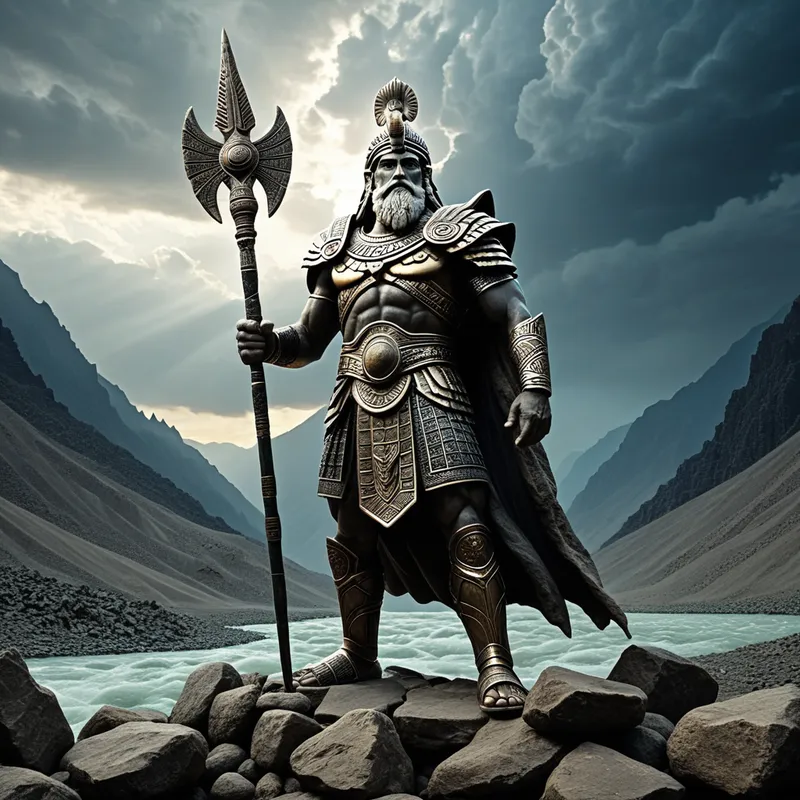
Ninurta Slaying the Asag Myth Meaning & Symbolism
The warrior god Ninurta confronts the monstrous Asag, a battle that restores the world's flow and transforms primordial chaos into sacred structure.
The Tale of Ninurta Slaying the Asag
Listen, and hear the tale from when the world was young and the order of things was not yet fixed. In the high halls of the Divine Assembly, a tremor of dread passed through the immortals. From the deep, unformed places of the Abzu, a horror had been born. Not a beast of flesh, but a being of pure, malignant essence—the Asag. It was a demon of stone and sickness, a creature whose very presence caused the mountains to crack with pain and the rivers to choke on their own beds. Where it walked, the earth bled pus, and the sweet waters turned to brine.
The gods looked to Enlil, the breath of the storm, but even he was troubled. This was a chaos that threatened the foundation of the world-order, Me. Then, a voice like thunder, young and fierce, spoke from among them. It was Ninurta, the champion of the gods, the son of Enlil. His heart burned with a warrior’s fire, and in his hand, he held Sharur, the mace that could speak, that could fly across the world and see all things.
Sharur returned from scouting the desolation, its voice a low hum of warning. “Lord, the Asag sits like a cancerous king upon the land. It has gathered an army of stones—great, rebellious rocks that rise from the plains and block the waters. The world is dying of thirst and paralysis.”
Ninurta needed no further summons. He donned his armor, the Melam, which shone with a terror of its own. His chariot, drawn by beasts of the storm, carried him to the front of chaos. The land he saw was a nightmare of stillness. Rivers ended in walls of granite. Fields were buried under scree. The air itself was thick with the silence of stagnation.
The Asag awaited him, not as a single form, but as the sickness of the landscape itself—a pulsing, mountainous core of malice surrounded by its loyal soldiers: the great stones Slain Hero, Courageous, and Flint. The battle was not of sword against claw, but of divine will against entropic defiance. Ninurta fought with the fury of a cleansing storm. Sharur flew from his hand, a bolt of divine judgment, striking the stone soldiers, shattering their rebellion.
But the Asag was cunning. It was the sickness behind the symptom. As Ninurta pressed the attack, a debilitating weakness seeped into his limbs. The demon’s power was that of fever and decay, sapping the hero’s strength. For a moment, the light of the Melam dimmed. The gods watched from afar, and a great cry of despair went up from his mother, Ninhursag.
Yet, in that moment of near-defeat, the wisdom of Sharur proved decisive. The mace whispered a strategy not of greater force, but of sacred transformation. Revived by this counsel, Ninurta rallied. He did not merely destroy the stone army; he redeemed it. With a mighty command, he called to the shattered rocks. He named them, gave them new purposes and stations in the world. The rebellious stones that had blocked the waters were now set as foundations for the mountains, or arranged to channel the rivers into fertile plains. He built the mighty stone of Hursag, the foothill, and decreed its abundance.
Finally, turning his full, restored fury upon the core of the malignancy, Ninurta slew the Asag. With its death, the psychic fever broke. The pus drained from the land, the rivers surged forth in their proper courses, and the mountains stood firm, not as enemies, but as pillars of the world. Ninurta returned to Ekur, not just as a conqueror, but as a healer-king who had turned chaos into cosmos.

Cultural Origins & Context
This myth, part of the epic narrative known as Lugal-e, was not mere entertainment for the people of Sumer. It was a foundational text, recited by temple scribes and likely performed during important state and religious festivals. Its primary function was theodicy—justifying the ways of the gods to humans—and reinforcing the cosmic and social order.
In the fragile, river-dependent world of Mesopotamia, the threat of chaos was not abstract. It was the salinization of fields, the unpredictable flood, the invading mountain tribe. The Asag represented all these existential threats. Ninurta’s victory was a divine guarantee that order (Me) would ultimately prevail over entropy. By detailing how Ninurta reorganized the stones, the myth also served as an etiological tale, explaining the origin of the region’s topography and the establishment of agricultural boundaries. The hero-god becomes the archetypal civilizer, modeling the king’s earthly duty to defend the land and manage its resources wisely.
Symbolic Architecture
At its core, this myth maps the perennial psychic drama of structure confronting dissolution. The Asag is not merely an external monster; it is the embodiment of formless, anti-life potential—the inner inertia that resists growth, the petrified grief that blocks emotional flow, the sickly complex that poisons the psyche.
The true battle is not against the monster, but against the paralysis it induces. The hero’s first task is to withstand the soul-fever.
Ninurta represents the focused, disciplined force of consciousness and will—the ego’s necessary capacity to take a stand against the encroaching unconscious. His near-defeat is crucial; it signifies that raw force is insufficient against a psychic poison. The talking mace, Sharur, symbolizes the guiding voice of a deeper intelligence—perhaps intuition, perhaps the Self—that offers the transformative strategy. The victory is not achieved through annihilation, but through a profound act of psychic alchemy: recognizing, naming, and redeeming the raw, chaotic energies (the stones) by integrating them into a greater, functional whole of the personality.

The Dreamer's Resonance
When this myth stirs in the modern unconscious, it often manifests in dreams of oppressive, immovable obstacles. Dreamers may find themselves in landscapes choked with rubble, trying desperately to clear a path or free a blocked stream. They may confront a looming, mountainous presence that induces a feeling of somatic illness or weakness.
These are dreams of the shadow in its most concrete, obstructive form. The “stones” are solidified complexes—habitual patterns of thought, old wounds, entrenched resentments—that have dammed the natural flow of libido (life energy). The dreamer is in the position of Ninurta before the wisdom of Sharur: feeling called to act, yet overwhelmed by the sheer, inert mass of the problem. The somatic feeling of fever or weakness mirrors the Asag’s power, indicating that the conflict is not intellectual, but has taken root in the body itself, demanding a holistic response.

Alchemical Translation
The journey of Ninurta provides a precise model for the individuation process. It begins with the eruption of chaos (the Asag), which is, paradoxically, a call to wholeness. The ego (Ninurta) must answer, armed with its tools of discipline and focus (the Melam, the chariot).
The critical alchemical turn is the moment of failure and counsel. This is the nigredo, the dark night of the soul, where one’s usual strength fails. It forces a reliance on a non-ego voice (Sharur). The resulting strategy is one of transmutation, not expulsion.
Individuation is the art of turning the rebellious stones of the psyche into the sacred geography of the soul.
The modern individual engaged in this work must learn to “name the stones.” What is this blockage? Is it a petrified anger (Slain Hero)? A rigid pride (Courageous)? A sharp, defensive trauma (Flint)? By bringing it to consciousness, acknowledging its power and its original protective intent, one can, like Ninurta, give it a new station. Rage becomes boundaries. Pride becomes self-respect. Trauma becomes resilience. The slain Asag is the core identification with the chaos itself, which dissolves when its constituent parts are redeemed. The final state is not a sterile peace, but a dynamic, flowing order—the Hursag, the fertile mountain, where once there was only a choking wasteland.
Associated Symbols
Explore related symbols from the CaleaDream lexicon:
- Mountain — The Asag itself is a malignant mountain, and Ninurta creates the benevolent mountain Hursag; it represents both the immense, obstructive problem and the enduring, structured self that results from conquering it.
- River — The blocked and freed waters symbolize the life force, emotion, and psychic energy that must flow for health, which is the central prize of the cosmic battle.
- Stone — The rebellious army and later the building blocks of the world; they represent solidified psychic complexes, burdens, or traumas that must be broken apart and reassigned with conscious intent.
- Hero — Ninurta is the archetypal hero who ventures into chaos on behalf of the collective, facing the ultimate danger of psychic dissolution for the sake of renewal.
- Thunder — The sound of Ninurta’s divine power and chariot, representing the shocking, disruptive force necessary to break a stagnant, petrified state.
- Order — The divine Me that the Asag threatens and Ninurta restores; it is the principle of meaningful structure against meaningless chaos, both cosmically and psychologically.
- Chaos — The Asag is its personification, representing the formless, entropic, and anti-structural force that exists before and outside of consciousness.
- Healing — Ninurta’s ultimate act is not destruction but world-healing, modeling the therapeutic process of integrating split-off parts of the self into a functional whole.
- Lightning — The swift, illuminating strike of Sharur and Ninurta’s judgment, symbolizing sudden insight, decisive action, and the electrifying force of consciousness.
- Earth — The very body of the world that is sickened by the Asag and healed by Ninurta, representing the grounded, somatic reality of the psyche where these battles are fought.
- Sumerian Tablet — The medium through which this myth reached us, a symbol of the enduring human need to record and understand our deepest struggles with order and chaos.