
Nigredo Stage Myth Meaning & Symbolism
The myth of the Nigredo Stage tells of the necessary descent into primordial chaos, the putrefaction of the old self, and the birth of insight from absolute darkness.
The Tale of Nigredo Stage
Listen, and hear the tale not of a hero, but of a substance. Not of a journey outward, but of a descent inward.
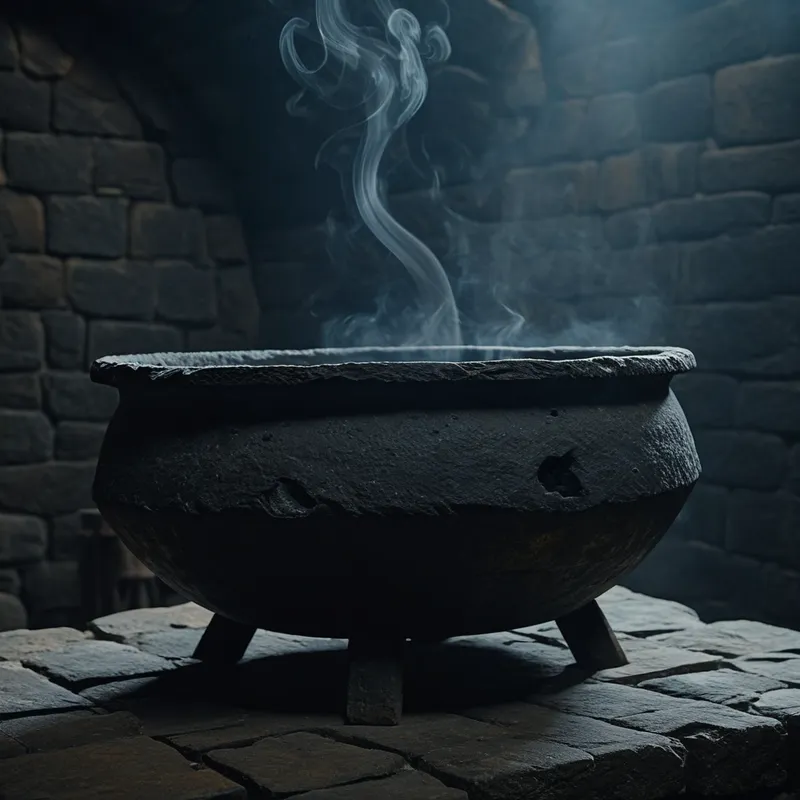
In the beginning, there is the Materia Prima. It is not noble, not gold, not silver. It is heavy, dull, and full of potential sleep. [The Alchemist](/myths/the-alchemist “Myth from Various culture.”/), whose name is forgotten for names are of the day, takes this substance. Not with greed, but with a solemnity reserved for graves. They seal it within the [Hermetic Vessel](/myths/hermetic-vessel “Myth from Alchemical culture.”/), a womb of glass and clay that is also a tomb.
Then begins the Great Fire. But this is no blaze of glory. It is the slow, persistent heat of a buried fever. The Alchemist tends it through watches of the night, as the stars turn cold overhead. Inside [the vessel](/myths/the-vessel “Myth from Alchemical culture.”/), a silence gathers. Then, a stirring. The matter does not melt, but rots. It blackens, not with soot, but from within. A profound darkness blooms, a [Nigredo](/myths/nigredo “Myth from Alchemical culture.”/) so complete it drinks the light from the furnace’s glow. The air grows thick with the scent of damp earth, of decay, of something ancient returning to its source.
The substance cracks and bubbles, not with life, but with a kind of agonized dissolution. All its colors flee. All its forms run like wax. It becomes a churning, starless night contained in glass. The Alchemist watches their own reflection warp in the vessel’s curve, their face swallowed by [the abyss](/myths/the-abyss “Myth from Kabbalistic culture.”/) they have nurtured. This is the stage of the [Raven](/myths/raven “Myth from Haida culture.”/)‘s Head, where the hopeful work seems ruined, where the only certainty is corruption.
For forty days and forty nights, the blackness reigns. It is the death of the known. The death of the shape. The death of hope. The Alchemist must sit vigil, not for a birth, but for a completion of death. They must resist the urge to break the vessel, to air out the stench of failure. They must learn to love the dark.
And then, on a night when despair is deepest, a change whispers. Not in the vessel, but in the darkness itself. The blackness, having consumed everything, becomes pure. It is no longer the black of confusion, but the black of potential. It becomes a velvet bed, a fertile void. From its absolute depth, a single, impossible point of moisture beads on the inside of the glass—not [water](/myths/water “Myth from Chinese culture.”/), but the first promise of a new liquidity. The Nigredo is complete. The matter has died. And in that death, the tale whispers, the first secret of life has been learned.
Cultural Origins & Context
The myth of the Nigredo is not a story told in taverns or sung by bards. It is a technical, spiritual, and deeply personal narrative encoded in the cryptic texts of European alchemists from the medieval period through the Renaissance. It was passed down in lavishly illustrated manuscripts like the [Rosarium Philosophorum](/myths/rosarium-philosophorum “Myth from Alchemical culture.”/) and in the dense, symbolic writings of figures such as Paracelsus.
Its primary audience was [the adept](/myths/the-adept “Myth from Alchemical culture.”/) alone in their laboratorium, which was as much an oratory as a workshop. The myth served a dual societal function. Exoterically, it was a coded recipe for a chemical process, protecting trade secrets. Esoterically, and more importantly, it was a precise map of an inner ordeal. It functioned as a guide and a reassurance for the individual undergoing a profound psychological crisis—the “dark night of the soul” described by mystics like St. John of the Cross. The myth said: This ruin is not an error. This despair is not an end. It is the first, and most necessary, operation.
Symbolic Architecture
The Nigredo is the archetypal [symbol](/symbols/symbol “Symbol: A symbol can represent an idea, concept, or belief, serving as a powerful tool for communication and understanding.”/) of the mortificatio—the killing of the old, outworn state of being. Psychologically, it represents the complete [breakdown](/symbols/breakdown “Symbol: A sudden failure or collapse of a system, structure, or mental state, often signaling a need for fundamental change or repair.”/) of the conscious [personality](/symbols/personality “Symbol: Personality in dreams often symbolizes the traits and characteristics of the dreamer, reflecting how they perceive themselves and how they believe they are perceived by others.”/)‘s familiar structures. [The ego](/myths/the-ego “Myth from Jungian culture.”/), with its certainties, identities, and defenses, is dissolved in the acid of its own unresolved conflicts and repressed [shadow](/symbols/shadow “Symbol: The ‘shadow’ embodies the unconscious, repressed aspects of the self and often represents fears or hidden emotions.”/) [material](/symbols/material “Symbol: Material signifies the tangible aspects of life, often representing physical resources, desires, and the physical world’s influence on our existence.”/).
The seed cannot sprout unless the husk rots. The soul cannot be reborn unless the persona dies.
The Hermetic [Vessel](/symbols/vessel “Symbol: A container or structure that holds, transports, or protects something essential, representing the self, emotions, or life journey.”/) is the total, inescapable container of this process—the therapeutic [space](/symbols/space “Symbol: Dreaming of ‘Space’ often symbolizes the vastness of potential, personal freedom, or feelings of isolation and exploration in one’s life.”/), the analytic [hour](/symbols/hour “Symbol: Represents the measurement and passage of time, often symbolizing urgency, mortality, or a specific moment of significance.”/), the committed [relationship](/symbols/relationship “Symbol: A representation of connections we have with others in our lives, often reflecting our emotional state.”/), or simply the courageous [decision](/symbols/decision “Symbol: A decision in a dream reflects the choices one faces in waking life and can symbolize the pursuit of clarity and resolution.”/) to face oneself without escape. The “fire” is the acute suffering and emotional heat that forces the transformation. The resulting blackness is not evil, but the Shadow made conscious, experienced in its totality. It is the depression that follows a great [loss](/symbols/loss “Symbol: Loss often symbolizes change, grief, and transformation in dreams, representing the emotional or psychological detachment from something or someone significant.”/), the nihilism after a shattered belief, the terrifying freedom of realizing everything you thought you were is now untenable.
The [Raven](/symbols/raven “Symbol: The raven is often seen as a messenger of the divine and a symbol of transformation, wisdom, and the mysteries of life and death.”/)‘s Head is a profound symbol of this [paradox](/symbols/paradox “Symbol: A contradictory yet true concept that challenges logic and perception, often representing unresolved tensions or profound truths.”/). The [raven](/symbols/raven “Symbol: The raven is often seen as a messenger of the divine and a symbol of transformation, wisdom, and the mysteries of life and death.”/) is a scavenger, feeding on [death](/symbols/death “Symbol: Symbolizes transformation, endings, and new beginnings; often associated with fear of the unknown.”/), yet in many myths (like [Noah’s Ark](/myths/noahs-ark “Myth from Biblical culture.”/)) it is also the first messenger sent to find new land. The Nigredo is thus a creative decay. It is the composting of experience, where the waste products of [life](/symbols/life “Symbol: The symbol of ‘Life’ represents a journey of growth, interconnectedness, and existential meaning, encompassing both the joys and challenges that define human experience.”/) are broken down into the fertile humus from which new [insight](/symbols/insight “Symbol: A sudden, deep understanding of a complex situation or truth, often arriving unexpectedly and illuminating hidden connections.”/) can grow.
The Dreamer’s Resonance
When this myth stirs in the modern [psyche](/myths/psyche “Myth from Greek culture.”/), it announces itself in dreams of profound disorientation and visceral dissolution. The dreamer may find themselves in a house that is familiar yet crumbling, with black mold spreading up the walls. They may be lost in a forest at night where the trees are leafless and the ground is a sucking black mud. They may dream of their own reflection in a mirror melting into a featureless dark pool, or of teeth falling out and turning to ash.
Somatically, this is the psyche processing a state of psychic death. The body in the dream often feels heavy, leaden, paralyzed—a direct echo of the Materia Prima as lead. The emotional tone is one of profound grief, terror, or numb emptiness. These dreams are not pathological in themselves; they are the psyche’s natural, symbolic enactment of the Nigredo process. They signal that an old adaptation, a former way of being in [the world](/myths/the-world “Myth from Tarot culture.”/), is breaking down so that something more authentic can eventually emerge. The dreamer is in the vessel, undergoing the fire.

Alchemical Translation
For the modern individual, the myth of the Nigredo models the non-negotiable first phase of individuation—the confrontation with [the shadow](/myths/the-shadow “Myth from Jungian culture.”/). Our culture prizes light, growth, and positivity, viewing darkness, decay, and depression as failures to be medicated away. Alchemy teaches the opposite: you must go through the black.
To transmute lead into gold, you must first become fully, utterly acquainted with the nature of lead.
The “work” is to consciously submit to this dissolution. It is to stop running from the depression, the anxiety, the grief, or the rage. It is to create the Hermetic Vessel—through journaling, therapy, art, or contemplative practice—and to allow the heat of honest self-observation to cook the raw material of one’s life. This means looking at one’s failures, traumas, jealousies, and pettiness without flinching, allowing them to blacken and decompose in the light of awareness.
The [triumph](/myths/triumph “Myth from Roman culture.”/) of the myth is not an escape from the black, but its completion. The goal is to reach the stage where the blackness is no longer experienced as torment, but as a kind of peaceful, fertile void. It is the point where one has nothing left to project, no old identity to defend. From this state of humble, annihilated openness—the caput mortuum (death’s head) that is the final product of the Nigredo—the next stages of the work (Albedo and Citrinitas) can begin. The individual learns that true gold, the [Lapis Philosophorum](/myths/lapis-philosophorum “Myth from Alchemical culture.”/), is not found by avoiding the dark, but by mining its absolute depth. The first creation, as the myth insists, is always preceded by a return to the primordial, black, and chaotic waters.
Associated Symbols
Explore related symbols from the CaleaDream lexicon: