Nian Myth Meaning & Symbolism
A primal beast of chaos emerges each winter, defeated not by brute force but by the alchemy of red, fire, and collective human spirit.
The Tale of Nian
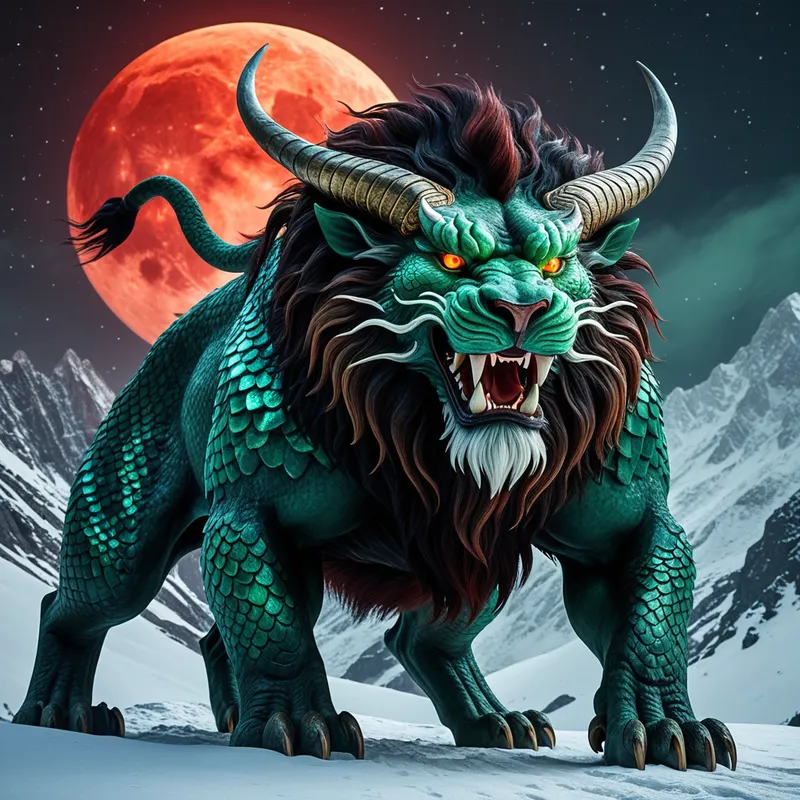
In the deep, forgotten winters, when the world held its breath beneath a sky of iron, the terror came. It was not born of wind or snow, but of the silence between heartbeats. Its name was Nian, a creature of the mountains and the deep dark, a shape woven from the nightmares of the first people. Its body was a storm of scales like cold jade, its head a lion’s with the horns of a bull, and its eyes were pits of smoldering coals. It moved with the sound of cracking stone.
Each year, as the old life withered and the new had not yet stirred, Nian would descend. It came not for hunger of the flesh, but for the spirit. It fed on fear, on quiet despair, on the loneliness of the long night. Villages would huddle behind their gates, hearing only the thunder of its approach and the shattering of their homes. It devoured grain, livestock, and—the elders whispered with trembling voices—it would take the wandering, the lonely, the ones whose hope had grown thin. For a night, chaos was king, and the people were but leaves before its wrath.
One such winter, as despair threatened to become the permanent resident of a mountain village, an old wanderer with eyes like polished river stones appeared at the gate. He saw the terror in their eyes and the ruins of winters past. "You fight a shadow with shadows," he said, his voice quiet yet clear. "You cower from its nature, but have you learned its truth?"
That night, as the dread hour approached, the old man did not hide. He took dried bamboo and cast it into the hearth’s heart. The green stalks did not burn quietly; they erupted with a series of deafening cracks and pops, a sound like the sky splitting. He hung sheets of vermilion paper at every door and window. Then he stood, clad in a robe of the same defiant red, before his dwelling.
Nian came. The ground shook. Its hot breath fogged the icy air. But as it neared the old man’s hut, it halted. The violent cracks of the bamboo assaulted its senses. The blinding, furious red of the paper and robe burned its eyes. The beast, a creature of silent darkness and stealthy fear, recoiled. It let out a roar of confusion and pain, and turned away, fleeing back to its mountain abyss, vanquished not by spear or sword, but by light, sound, and color.
When dawn broke, the villagers emerged to find their world intact. They poured into the streets, wearing red, beating drums, and lighting firecrackers, their joy a roaring counterpoint to the previous silence. They visited each other, sharing food and well-wishes, their community reforged in the crucible of shared triumph. They had learned the alchemy of turning terror into celebration.
Cultural Origins & Context
The myth of Nian is inextricably woven into the fabric of the Spring Festival. Its origins are folkloric, passed down orally through generations long before being recorded in texts. It functioned as an etiological myth—a story explaining the origins of core cultural rituals. The terrifying, annual visitation of the beast provided a narrative reason for the explosive, colorful, and communal practices that define Chinese New Year: the wearing of red clothing, the hanging of red decorations and couplets, the deafening discharge of firecrackers, and the vital tradition of family reunion feasts.
This was not a tale told by priests in temples, but by grandparents by the hearth. Its societal function was profound. It transformed a potentially terrifying time—the dead of winter, the turn of an uncertain year—into a ritual of collective empowerment. The myth taught that the community itself, armed with specific, symbolic actions, held the power to banish chaos and ensure renewal. It encoded survival wisdom into celebratory tradition, making the psychological act of confronting the unknown a shared, and even joyous, cultural duty.
Symbolic Architecture
At its heart, Nian is not merely a monster, but the embodied Shadow of the year and the psyche. It represents all that is chaotic, unknown, and destructive in the cyclical nature of time and existence. It is the culmination of old regrets, unresolved fears, and the psychic "old growth" that must be cleared for new life.
The beast does not come from outside the world, but from the untamed wilderness within the turning of the year itself.
The hero of the story is notably not a warrior, but an old sage. His victory is one of knowledge, not force. He discovers Nian’s vulnerabilities: a fear of loud noise, bright light (fire), and the color red. These are not arbitrary. Red, in Chinese symbology, is the color of life, blood, luck, and vibrant yang energy—the direct antithesis of Nian’s dark, cold, yin nature. Fire and noise represent the active, assertive, and disruptive human spirit breaking the silence of stagnation and fear. The victory is an act of symbolic inversion, using the very principles of life and consciousness to repel the unconscious, devouring force.
The Dreamer's Resonance
When this mythic pattern stirs in the modern dreamer, it often signals a confrontation with a personal "Nian." This might manifest as a dream of a looming, monstrous presence (often shadowy or indistinct) approaching one’s home or psyche, or a recurring dream set in a time of ending or transition filled with dread.
Somatically, this can correlate with feelings of anxiety as a "background hum," a tightening in the gut, or a sense of impending doom without a clear source. Psychologically, the dreamer is at the precipice of a necessary "yearly" cycle within their own life—perhaps the end of a relationship, career phase, or outdated self-concept. The monstrous presence is the accumulated weight of all they have avoided, the fear of the void that change brings. The dream is the psyche’s way of announcing that the time for hiding is over; the shadow is at the gate and must be faced with conscious, ritualized action.
Alchemical Translation
The individuation process modeled by the Nian myth is a masterclass in psychic alchemy. It outlines the transformation of primal, undifferentiated fear into conscious, structured vitality.
First, we must name the beast. The villagers knew their enemy was "Nian." In our psyche, this is the act of consciousness: identifying the amorphous anxiety as a specific pattern—fear of failure, terror of abandonment, the chaos of unresolved grief.
Second, we must learn its nature. The old sage did not attack blindly; he observed and discovered Nian’s symbolic weaknesses. Psychologically, this is shadow-work: understanding that our deepest fears are often vulnerable to their opposites. A fear of invisibility (a Nian of neglect) is vulnerable to the "red" of self-assertion and public recognition. A fear of chaos is vulnerable to the "loud noise" of imposing new structure and routine.
The transmutation occurs not by destroying the shadow, but by rendering its environment—the silent, dark, isolated psyche—uninhabitable.
Finally, we perform the ritual. We consciously "wear the red" and "light the firecracker." This translates to taking the precise, often culturally or personally symbolic actions that directly counter the fear. It is the act of calling a friend when feeling isolated (breaking silence), pursuing a creative project when feeling stagnant (adding color), or celebrating small wins when feeling overwhelmed by large fears (creating joyful noise). The culmination is the communal feast—integrating the victorious, renewed self back into the world of relationship and shared meaning. The beast is not killed; it is banished by the active, colorful, noisy, and connected state of an individuating psyche, making room for the new year of the self to begin.
Associated Symbols
Explore related symbols from the CaleaDream lexicon: