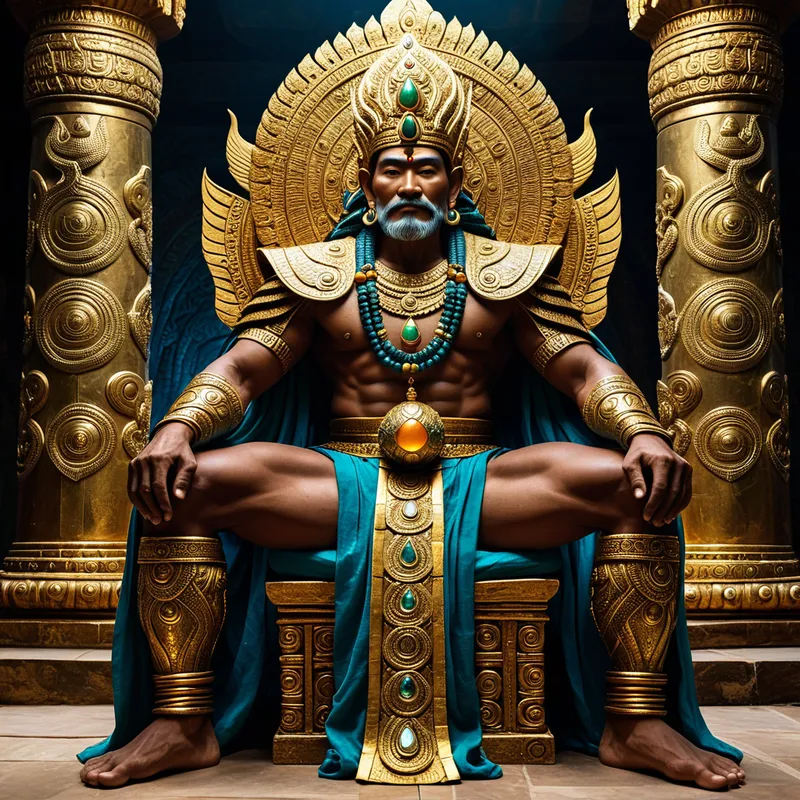
Nāga Myth Meaning & Symbolism
Serpentine deities of earth and water, guardians of esoteric treasures, embodying the raw, transformative power of the unconscious and its integration into consciousness.
The Tale of Nāga
Beneath the roots of the world, where the soil remembers the first rain and stone dreams of being mountain, they dwell. Not in darkness, but in a twilight richer than any sunlit realm. Here, in Patala, the earth’s jeweled womb, the Nāgas coil. Their bodies are rivers of muscle and scale, their hoods canopies of living gemstone. They are the keepers of the deep waters, the secret veins of the planet, and the treasures that the surface world has forgotten it lost.
Listen now to the tale of the Churning.
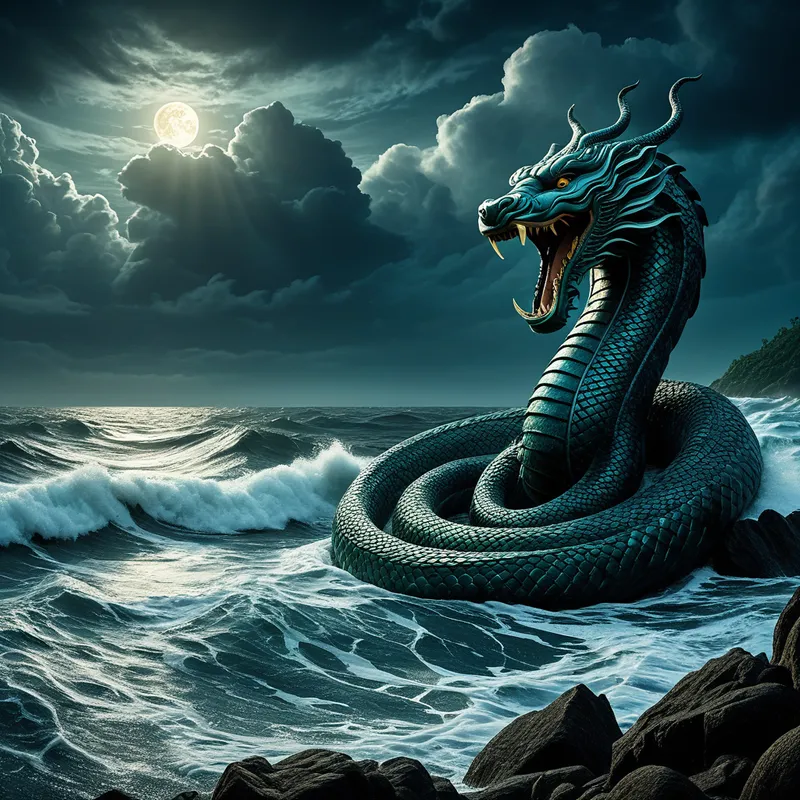
In a time when gods and titans wore their power like naked flame, the world had grown weary and thin. The nectar of immortality, Amrita, was lost to the primordial depths. To retrieve it, a pact was struck between the devas and the asuras—a temporary, trembling truce. Their tool was the mountain, Mandara. Their churn-rope was the king of the Nāgas, the mighty Vasuki.
They came to him, these lords of light and shadow, to his aqueous court. “Great One,” they said, their voices echoing in the cavernous hall, “the world needs its heart-medicine. Lend us your strength, your divine form, to bind the mountain and stir the ocean of milk.”
Vasuki regarded them, his eyes pools of ancient patience. He knew the cost. To be the instrument of creation is to bear its friction. Yet, for the sake of all worlds, he consented. They coiled him around the great peak, gods at his tail, demons at his head. The churning began—a cosmic groaning, a tectonic sigh. The mountain ground upon the back of the world-turtle, Kurma. Vasuki’s immense body grew taut, his scales scraping against rock, his breath becoming the hot, pained wind of the endeavor.
From the foaming, churned depths, wonders and horrors emerged. The celestial cow, the wish-fulfilling tree, the moon. Then, a searing, black smoke—Halahala, a venom so potent it threatened to unravel creation itself. In the ensuing panic, it was the great god Shiva who drank the poison, holding it in his throat, turning blue with the contained fury of the abyss, becoming Neelakantha.
And finally, from the exhausted, glittering foam, rose Dhanvantari with the pot of Amrita. The truce shattered, a great struggle ensued, but the nectar was secured for the gods, ensuring the continuity of cosmic order. Vasuki, released, returned to the depths, his body a testament to the agony and the necessity of the work. He bore the scars of the world’s rebirth, the eternal Nāga, who by his suffering participation midwifed both poison and nectar into being.
Cultural Origins & Context
The Nāga mythos is not a single story but a vast, fluid tradition woven through the spiritual fabric of the Indian subcontinent and Southeast Asia. Originating in the pre-Vedic indigenous traditions that venerated serpent spirits as deities of water, fertility, and the underworld, the Nāgas were seamlessly absorbed into the evolving Hindu and later Buddhist cosmologies. They are the genii loci of rivers, lakes, and springs; to cut a forest or dam a river was to risk the wrath of the local Nāga.
These stories were passed down by village elders, temple priests, and traveling bards, and were immortalized in epics like the Mahabharata and Ramayana, the Puranas, and in the Jataka tales of the Buddha’s past lives. Their societal function was multifaceted: they explained natural phenomena (droughts were a Nāga’s displeasure), enforced ecological ethics, and served as potent symbols of spiritual protection and occult knowledge. In Buddhism, particularly in Myanmar, Thailand, and Cambodia, Nāgas are revered as protectors of the Dharma and are often depicted sheltering the meditating Buddha.
Symbolic Architecture
The Nāga is the archetypal symbol of the unconscious in its raw, primal, and ambivalent power. It dwells below—beneath the surface of the conscious mind, in the watery depths of the psyche where instincts, forgotten memories, and creative potentials reside.
The serpent does not think; it knows. Its wisdom is the wisdom of the earth-body, the instinctual intelligence that precedes and undergirds all cognition.
Its dual nature is paramount. The Nāga is a guardian of treasures (psychic wholeness, spiritual insight) and a bearer of deadly venom (unprocessed trauma, destructive compulsions). It is both the life-giving water of the deep spring and the choking flood. In the churning of the ocean, Vasuki embodies the necessary tension of individuation—the painful but creative friction between opposites (devas and asuras, conscious and unconscious) that brings forth both the poison of shadow and the nectar of transformation.
The Nāga’s form, often half-human, half-serpent, symbolizes this very integration. It is the bridge between the chthonic (earthly/instinctual) and the celestial (spiritual/conscious), refusing to be wholly one or the other. To encounter the Nāga is to encounter the non-human intelligence within the human, the ancient, coiled power that must be recognized, respected, and ultimately integrated, not slain.
The Dreamer's Resonance
When the Nāga glides into the modern dreamscape, it signals a profound engagement with the foundational layers of the Self. This is not a dream of abstract ideas, but of somatic, earthy reality.
Dreaming of a serene, majestic Nāga offering a jewel often coincides with a period of accessing deep, innate wisdom or creative inspiration—a treasure from the unconscious is being made available. Conversely, being pursued or threatened by a Nāga may point to a rising tide of repressed emotion, instinctual rage, or a primal fear that is “poisoning” one’s current life situation. A dream of a coiled Nāga at the base of one’s spine or in the cellar of a house directly invokes the Kundalini metaphor, hinting at a powerful, potentially disruptive, awakening of psychic energy.
The somatic resonance is key. The dreamer may wake with a tightness in the gut, a feeling of being “grounded” or, oppositely, of deep anxiety. The Nāga dream is a body-dream; it calls for attention not just to the mind’s content, but to the instincts, the gut feelings, the raw life-force that moves beneath the surface of persona.

Alchemical Translation
The myth of the Nāga provides a precise alchemical map for psychic transmutation. The process is not one of conquering the serpent, but of engaging with it, of undergoing the “churning” it facilitates.
First, one must descend to Patala—to consciously turn attention inward, away from the surface identifications of ego, and into the murky, fertile depths of the personal and collective unconscious. This is an act of courage, a willingness to meet what is “below.”
Then, one must embrace the tension. Like Vasuki stretched between gods and demons, the psyche must hold the tension of opposites: love and rage, creativity and destruction, spirit and matter. This friction is the prima materia of transformation. It is agonizing, as any honest inner work is, and it generates a psychic “heat” that brings contents to the surface.
The poison emerges first. The Halahala of the psyche—the bitter resentment, the ancient shame, the corrosive envy—must be acknowledged. The alchemical act here is to do as Shiva did: to “drink” it, to contain this toxic shadow without being destroyed by it, to hold it in consciousness until its transformative potential is revealed.
Only after facing and containing the poison does the nectar of Amrita become accessible. This is the integrated state, the Self. It is the healing insight, the durable peace, the creative vitality that arises when the power of the Nāga (the unconscious) is not fought, but invited into a sacred partnership with the conscious mind. The individual becomes, like the Nāga itself, a bridge—a being in whom the deep, coiled wisdom of the earth and the illuminating awareness of the spirit are united, guarding the ultimate treasure: a whole and authentic existence.
Associated Symbols
Explore related symbols from the CaleaDream lexicon: