
Netzach Victory Myth Meaning & Symbolism
The eternal victory of divine endurance over primordial dissolution, a cosmic rhythm of collapse and renewal within the Kabbalistic Tree of Life.
The Tale of Netzach Victory
Listen, and hear the rhythm beneath the world. Before time was counted, in the palace of Sefirot, there dwelt Netzach. He was the verdant king, the lord of perpetuity, whose crown was woven from the stubborn vines of recurrence and whose throne was the turning wheel of the stars. His realm was the first breath after struggle, the echo of a song that refuses to die. His light was not the blinding flash of inception, but the enduring, stubborn glow of a hearth that will not be extinguished.
Yet from the depths, from the place before the Tohu</ab- br title="Chaos, formlessness">Bohu, a whispering tide arose. It was not a beast with claws, but a force of unraveling—the Sitra Achra's sigh of dissolution. It sought not to conquer, but to erode. It was the silence that swallows the last note of the psalm, the entropy that turns victory to dust, the despair that asks, "What is the point of striving, if all ends in stillness?"
This tide, grey and formless as forgotten mist, lapped at the shores of Netzach's diamond realm. Where it touched, the vibrant patterns of his dominion began to soften, to blur. The rhythms of his celestial music grew faint. The very will to continue, the drive that turns potential into act, began to seep away into a great, yawning indifference. This was the true battle: not against a foe to be slain, but against the creeping doubt that undermines all foundations, the cosmic fatigue that threatens eternal recurrence.
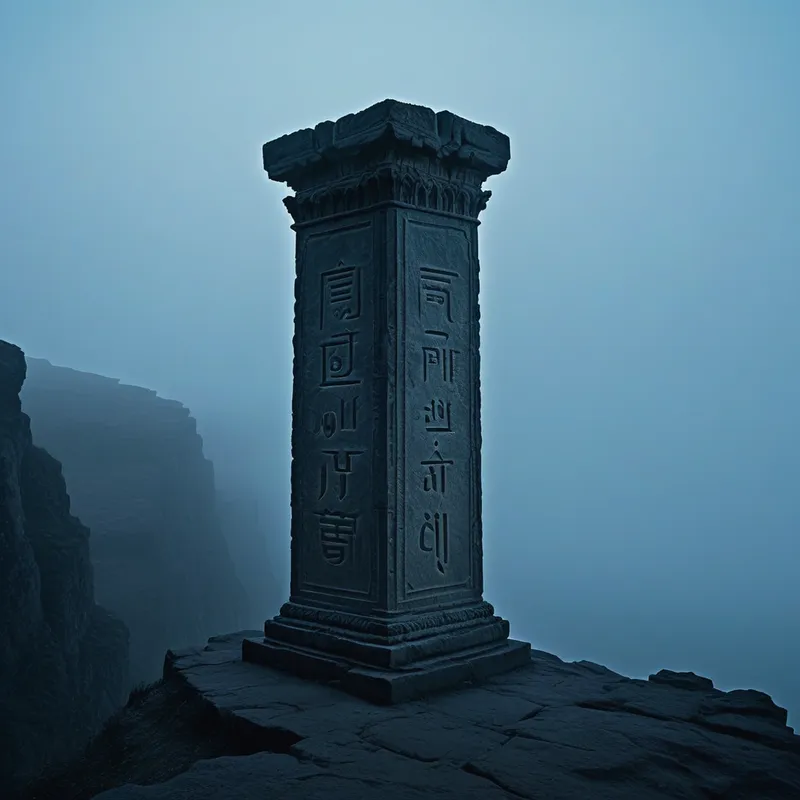
Netzach did not draw a sword, for no blade cuts apathy. Instead, he planted his feet upon the shore of becoming. He became the pillar in the stream. He began the old song again, from the beginning, as the mist sought to drown the words. He rekindled the hearth as the chill sought to claim the embers. He did not fight the tide—he outlasted it. He embodied the principle that the wave breaks, and the shore remains. The formless force would swell, seeking to dissolve his very definition into the primordial soup, and Netzach would respond not with counter-force, but with reiteration. He would re-assert the pattern, re-sing the melody, re-establish the rhythm, not once, but infinitely.
The conflict was an eternal recurrence of its own: assertion, erosion, re-assertion. It was the cosmos breathing. And in each cycle, Netzach did not merely defend. He integrated. From the formless tide, he captured the essence of cessation, not as an enemy, but as the necessary rest between notes, the silence that gives meaning to sound. He transmuted the threat of finality into the rhythm of renewal. His victory was not a conquest that ended, but a stance that persisted. It was the moment the tide, finding no purchase, receded—not defeated, but acknowledged as part of the great, breathing dance of being. And the light of Netzach, the light of endurance, burned not brighter, but deeper, having made the void itself a part of its song.
Cultural Origins & Context
The myth of Netzach Victory is not a narrative found in a single sacred text, but is woven into the very fabric of Kabbalah, particularly as systematized in the medieval Zohar and the later Lurianic tradition. It is a myth of metaphysics, told not by bards around a fire, but by mystics in dimly lit study halls, parsing the architecture of the divine.
The "story" is an exegesis of the Tree of Life. Netzach, the seventh Sefirah, sits on the pillar of Chesed, opposite Hod on the pillar of Gevurah. Its societal function was deeply psychological and cosmological. For Kabbalists, the balance of the Sefirot was not just a divine concern but the blueprint for the human soul and the stability of the world. The myth of Netzach's enduring struggle was a map for navigating personal despair, communal collapse, and the constant threat of spiritual entropy. It taught that victory is not a singular event, but a mode of existence—a committed, recurring "yes" to the process of life in the face of the void.
Symbolic Architecture
At its core, Netzach Victory symbolizes the psychological principle of Eros in its most profound sense: the connective, life-affirming, pattern-sustaining drive. It is the will to persist, the instinct to continue the species, the artistic impulse to create beauty that outlasts the moment, and the emotional resilience to love again after loss.
Victory is not the absence of struggle, but the quality of presence within it—the eternal recurrence of choice in favor of form, relationship, and meaning.
Netzach represents the part of the psyche that says, "And yet, I continue." Its opponent, the formless tide, is the pull of Thanatos, not as violent destruction, but as passive dissolution, nihilism, and the depression that asks "why bother?" The myth beautifully illustrates that these two forces are not at war in a linear sense, but are engaged in a dynamic, eternal tension. Netzach's "victory" is the maintenance of this tension itself. It is the ego's necessary, recurring triumph over the lure of oceanic undifferentiation—the choice to remain a coherent self, a standing pillar in the river of time.

The Dreamer's Resonance
When this myth stirs in the modern dreamscape, it rarely appears as a green king on a shore. It manifests as the dream of tirelessly pushing a boulder up a hill, only to find it at the bottom again—but feeling a strange, grim determination to begin once more. It is the dream of trying to hold a disintegrating sandcastle together as the tide comes in, not with panic, but with focused will. It is the somatic sensation of profound fatigue coupled with an undeniable, deep-seated pulse that refuses to let the body fully collapse.
The dreamer undergoing this process is at a critical juncture of endurance versus surrender. They are facing a life pattern—a relationship, a creative project, a career, a healing journey—that feels besieged by forces of stagnation, doubt, or meaningless repetition. The psyche is working through the Netzach archetype, teaching the dreamer that the victory lies not in a final, cathartic battle, but in the daily, often wearying, recommitment to the process. The "tide" in the dream is their own shadow of apathy, despair, or the seductive call to give up the struggle for coherence. The dream is an initiation into cyclical, rather than linear, triumph.

Alchemical Translation
For the individual on the path of individuation, the myth of Netzach Victory models the alchemy of transforming existential fatigue into authentic endurance. The prima materia is the soul's exhaustion, the "cosmic tiredness" that comes from life's repetitions and setbacks.
The alchemical process begins with Recognizing the Tide: identifying the specific forms of dissolution in one's life—addictions, cynicism, escapist fantasies, relational withdrawal. This is the nigredo, the blackening. Then comes the work of Netzach: Conscious Reiteration. This is not blind perseverance, but the intentional, daily re-choosing of one's values, re-engagement with one's commitments, and re-creation of one's meaningful patterns. It is the albedo, the whitening, where the soul learns to work with cycles rather than against them.
The ultimate transmutation is realizing the "foe" is not to be defeated, but to be danced with. The void of meaninglessness becomes the silent ground upon which the figure of meaning is drawn, again and again.
The gold produced is not a static state of "happiness," but a resilient identity. It is the attainment of a self that can withstand its own periods of fragmentation and doubt, not because it is rigid, but because it has mastered the rhythm of dissolution and re-formation. The individual becomes like Netzach: a sovereign of their own recurring nature, finding victory not in an end to the struggle, but in the dignified, eternal posture of engagement within it.
Associated Symbols
Explore related symbols from the CaleaDream lexicon:
- Netzach — The central symbol of enduring victory itself, representing the eternal, rhythmic assertion of life and form against the silent pull of dissolution and chaos.
- Ocean — The formless, primordial tide of dissolution and the unconscious, against which the defined structure of Netzach must eternally stand.
- Rhythm — The core expression of Netzach's power; the recurring pulse, pattern, and cycle that outlasts any single note or event, turning struggle into a sustainable dance.
- Pillar — The symbol of Netzach's unwavering stance and endurance; the ego's capacity to remain coherent and upright amidst the flowing forces of change and entropy.
- Fate — Understood not as predestination, but as the acceptance and mastery of one's recurring patterns and life cycles, which is the essence of Netzach's dominion.
- Victory — Redefined from a singular conquest to a perpetual state of engaged persistence, the quality of continuing to choose life and connection.
- Eternity — Not as static foreverness, but as the experience of timeless recurrence within time, the "always-again" that characterizes Netzach's struggle and triumph.
- Dance — The active, graceful embodiment of Netzach's principle; the harmonious engagement with cyclical forces rather than a rigid battle against them.
- Heart — The seat of enduring passion, feeling, and the will to connect that persists through disappointment and weariness, fueled by Netzach's energy.
- Light — Specifically, the enduring, stubborn glow that refuses to be quenched, representing consciousness and identity persisting through periods of inner darkness.
- Chaos — The necessary counterpart to Netzach's order; the raw, unformed potential and threat of dissolution that provides the context for all meaningful victory.
- Renewal — The fruit of Netzach's victory; the constant refreshment and re-beginning that follows each acknowledged ending, ensuring life continues its cycles.