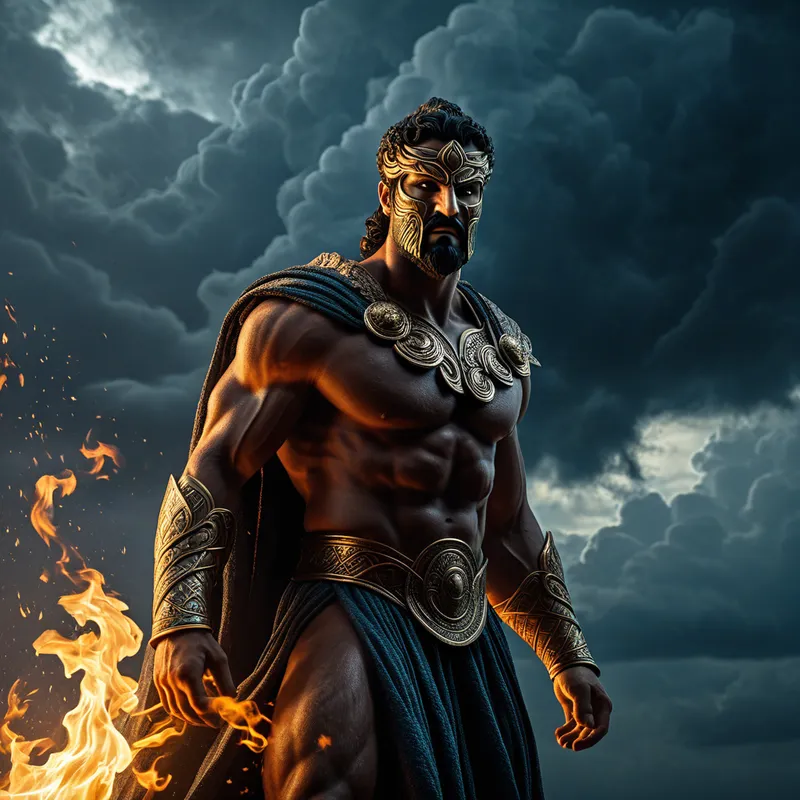
Nessus' Robe Myth Meaning & Symbolism
Heracles is killed by a poisoned robe, a gift of love from his wife, unknowingly crafted from the venom of the centaur he slew.
The Tale of Nessus' Robe
Hear now the tale not of a glorious death in battle, but of an ending that crept in, disguised as love’s own garment. The hero Heracles, his Twelve Labors complete, had won his bride, the fair Deianira. Yet peace for such a man is a fleeting shadow. Journeying home, they came to the wide, rushing river Euenos. Here lurked Nessus, a centaur of foul repute, who offered to carry the lady across the treacherous waters.
Heracles, mighty and trusting, swam ahead. But in mid-stream, Nessus’s beastly nature awoke. Clutching Deianira, he spurred his equine flanks to flee, his intent a violent theft. A roar echoed across the water. Heracles turned, and his famous wrath, hotter than any forge, ignited. He fitted an arrow to his bow, one tipped with the black, hydra-venomed blood from his second labor. The shaft flew true, piercing the centaur’s back, the poison burning like acid in his veins.
As his life fled into the river mud, Nessus conceived a vengeance more subtle than any claw or fang. Gasping, he called Deianira to his side. “Lady,” he whispered, a false remorse in his eyes, “see what my lust has wrought. Take this… a token of my final penitence.” From his fatal wound, he gathered his own blood, now mingled with the Hydra’s venom, into a vial. “Keep it,” he hissed. “Should the hero’s love ever grow cold, anoint his robe with this. It is a charm of old power, a surety to bind his heart to yours forever.” Deianira, shaken and pitying, took the poisoned gift, a seed of future ruin.
Years passed. Heracles, ever the warrior, sacked the city of Oechalia and took the princess Iole as a captive. Word reached Deianira of this new, younger beauty. Fear, cold and serpentine, coiled in her heart. Remembering the centaur’s promise, she saw her salvation. She took a magnificent robe, woven for her husband’s glory, and soaked it in Nessus’s preserved blood. She gave it to a messenger, instructing him to carry it to Heracles so he might wear it for a sacrifice to the gods, a garment of love to rekindle his devotion.
Heracles, on a promontory overlooking the sea, received the gift. He donned the robe, a smile for his wife’s thoughtfulness on his lips. But as the sun’s heat touched the fabric, a dreadful alchemy began. The Hydra’s venom, dormant in the centaur’s blood, awoke. It fused with the hero’s own divine vitality, creating an agony beyond any monster’s blow. The robe, once soft linen, became a second skin of molten lead, searing and binding. He tore at it, but it clung, the poison eating into his flesh like fire. In his torment, he uprooted trees and shattered altars, but the pain was within, a corruption he could not outrun. Understanding at last the trap—the gift that was a weapon, the love that was a poison—he built his own funeral pyre on Mount Oeta. As the flames took him, his mortal part was consumed, and his divine essence, purified of the mortal poison, ascended to Olympus. The robe had not saved a love; it had burned away the hero’s mortal shell, a final, cruel labor administered not by a god, but by the shadow of his own past violence.

Cultural Origins & Context
This myth, a cornerstone of the Heracles cycle, finds its most complete and poignant telling in the tragedy Women of Trachis by Sophocles. It represents a mature phase of Greek mythological thought, moving beyond simple tales of monster-slaying to explore tragic irony, the complexity of human motivation, and the inescapable web of moira. Performed in the civic-religious context of the City Dionysia, the story served as a profound cautionary tale for the Athenian polis.
It functioned on multiple levels: as a warning about the unintended consequences of heroic violence (the poisoned arrow returns), as an exploration of the destructive power of zelos and fear in marriage, and as a theological narrative explaining the apotheosis—the deification—of Heracles. The myth taught that even the greatest strength is vulnerable to deceit, that the gifts of enemies are never pure, and that the path to divinity often passes through unbearable, transformative suffering. It was passed down not just as entertainment, but as a cultural meditation on fate, trust, and the poisonous potential of secrets held in the heart of the home.
Symbolic Architecture
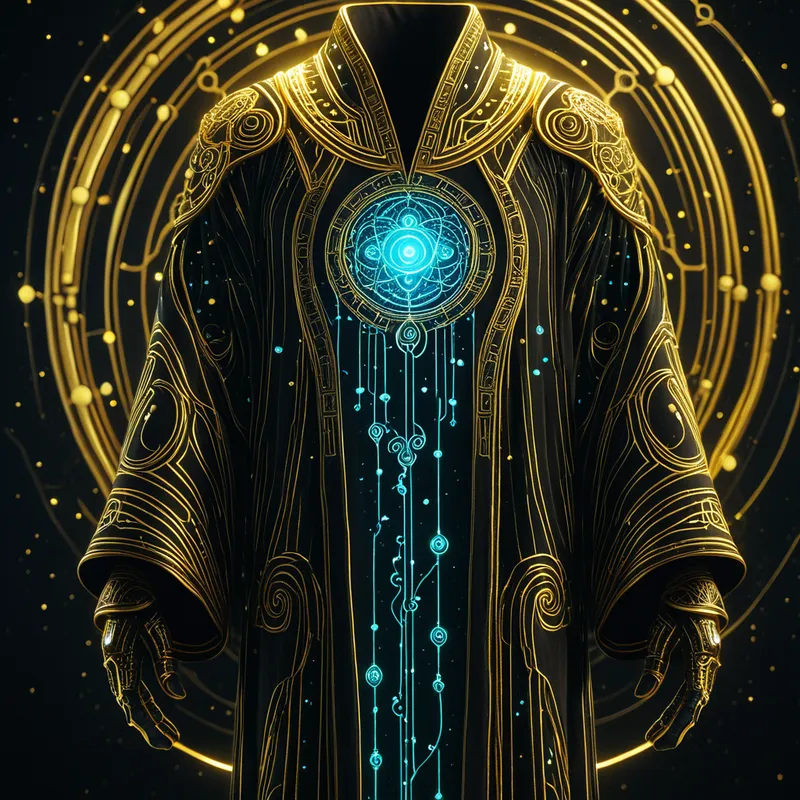
The myth’s power lies in its dense symbolic architecture. Nessus’ Robe is the ultimate pharmakon—a Greek term meaning both poison and cure. It is a gift that kills, a love token that tortures, a garment of honor that becomes an instrument of agonizing death.
The greatest poison often arrives wrapped in the beautiful package of a promised solution.
Heracles represents the Solar Consciousness—the hero who conquers the external world but remains tragically naive to the internal, relational world. His might is physical; his weakness, psychological. Deianira embodies the Anima—the inner feminine principle—in a state of fear and possession. Her act is not one of malice, but of desperate, misguided self-preservation, showing how love, when infected by insecurity, can become manipulative and destructive. Nessus is the Shadow—the bestial, vengeful aspect Heracles thought he had slain with his arrow. The Shadow does not die; it metastasizes, passing its venom into the hands of the Anima, who then, unknowingly, applies it to the Hero himself. The robe symbolizes the complex, often toxic persona—the social skin or role (husband, hero) that can become a prison, fused to the self by the unprocessed venom of past actions and hidden fears.
The Dreamer's Resonance
When this myth stirs in the modern psyche, it manifests in dreams of insidious contamination or betrayal by what should be safe. To dream of a beautiful garment that burns or binds is to encounter the Nessus’ Robe complex. The dreamer may be undergoing a somatic process where a past trauma (the “poisoned arrow”) or a repressed resentment (the “centaur’s blood”) has been secretly integrated into their way of relating or presenting themselves to the world.
Psychologically, this is the process of a “gift” or a strategy that once seemed like salvation—a relationship, a career path, a self-image—turning toxic. The dreamer feels trapped in a role that is now causing immense suffering, but they cannot simply “take it off,” for it feels fused to their identity. The agony Heracles feels is the somatic truth of the psyche screaming that an adaptation has become a prison. The dream signals that a profound, fiery dissolution of an old way of being is necessary, often initiated by the very “solution” one trusted to maintain the status quo.

Alchemical Translation
The alchemical journey modeled here is the nigredo leading to a forced albedo. Heracles’s labors were the great opus of conquering the outer chaos. But the final, most crucial labor is interior: the confrontation with the poison that has been woven into the fabric of his own life.
Individuation demands not only slaying the monster, but enduring the venom that leaks from its wound into your own story.
For the modern individual, the “robe” is any complex—be it of the caregiver, the achiever, the loyal partner—that has been anointed with the venom of inauthenticity, fear of abandonment, or unprocessed rage. The wearing of it is the performance of this complex. The burning is the inevitable psychological crisis when the persona becomes unsustainable. The alchemical fire of Mount Oeta is not a failure, but the horrific, necessary means of separatio—separating the immortal core of the Self from the mortal, poisoned garment of the conditioned ego.
The triumph is not in surviving the robe, but in being compelled by its agony to build one’s own pyre—to consciously participate in the end of an old identity. The ascent to Olympus is the recognition that true strength is forged not in victory, but in the willingness to be utterly consumed by the transformative fire of one’s own deepest, most painful truths. The myth thus maps the path from heroic doing to a sacred undergoing, where the greatest foe is finally recognized as the poisoned gift we ourselves agreed to wear.
Associated Symbols
Explore related symbols from the CaleaDream lexicon: