Nergal and Ereshkigal Myth Meaning & Symbolism
A god of war descends to the underworld, confronts its queen, and through a dance of power and vulnerability, forges a union that balances the cosmos.
The Tale of Nergal and Ereshkigal
Hear now the tale of the descent, of the meeting of fire and absolute night. In the high places, where the Anunnaki feasted, a slight was born from an absence. A great banquet was called in the Celestial Abode, and messengers were sent to every corner of the cosmos. To the Kur, to its deepest chamber, Ganzir, they went to summon Ereshkigal, the Great Lady of the Earth. But she of the Great Below could not ascend; her nature bound her to the dust and the silence. "Send a messenger to receive my portion," she commanded.
And so Namtar, her vizier, the decreer of fate, climbed to the shining halls. As he entered, all the gods rose from their seats in respect for the power he represented—all but one. Nergal, son of Enlil, burning with the fury of the desert sun and the slaughter of battle, remained seated. He did not bow. This insult, a spark in the dry tinder of cosmic order, was carried back to the depths. Ereshkigal’s wrath shook the foundations of the world. "Send that god to me," she demanded, "that I may kill him."
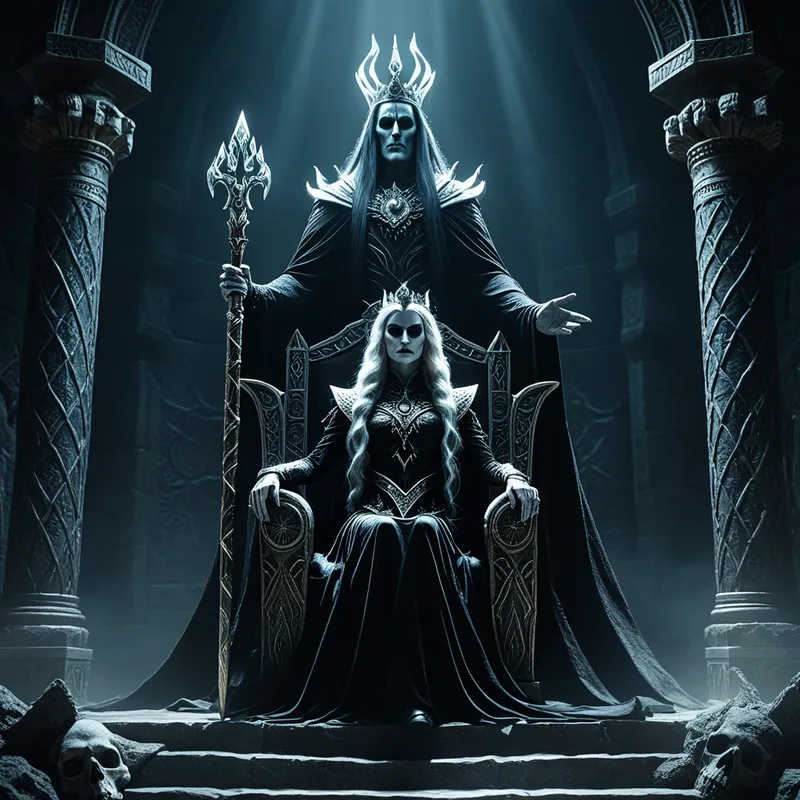
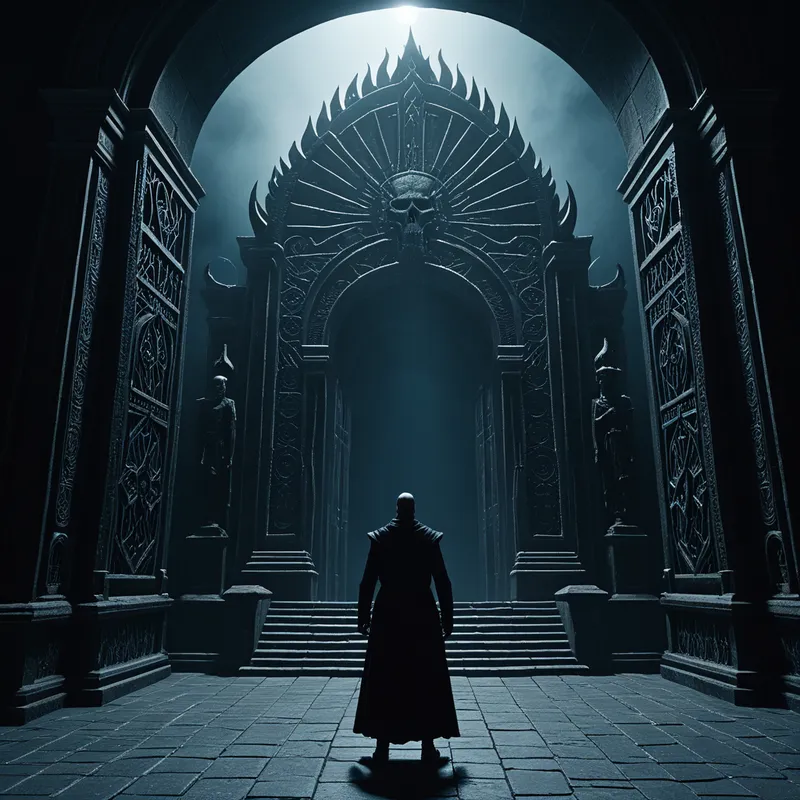
The high gods, fearing her terrible power, commanded Nergal to descend. They gave him a throne, a warning, and a fate. Down, down through the seven gates of the Kur he went, stripped at each portal of a piece of his divine raiment, until he stood naked in the ultimate darkness before the Queen of the Dead. She sat upon her throne of lapis lazuli, clothed in majesty and loneliness, a power as absolute as the grave. She commanded Namtar to seize him, to drag him to his death. But Nergal, the unleashed force, was ready. He sprang from the threshold, a storm of violence. He seized Ereshkigal by her hair, dragged her from the throne, and raised his axe to sever her head from her shoulders.
In that suspended moment, at the brink of annihilation, their eyes met. She cried out, not in fear, but in a raw, unmediated need. "Be my husband, and I will be your wife! I will place you on the throne of the vast underworld, and put the tablet of wisdom in your hand!" The axe did not fall. The fury transmuted. For six days, they lay together upon the royal couch, a union of scorching plague and cold eternity.
Then, Nergal fled. He returned to the upper world, as if waking from a fever dream. But the underworld had claimed its due. A sickness fell upon him, a longing for the darkness he had conquered and embraced. Meanwhile, in Ganzir, Ereshkigal writhed in a grief that echoed through all the levels of being. She sent Namtar again to the heavens, wailing her loss. The gods, hearing her torment, knew the balance was broken. They asked Nergal: would he return?
He chose the descent a second time. But this was no forced march; this was a sovereign return. He went not to destroy, but to claim. He passed through the seven gates again, and entered her chamber not as an executioner, but as a king. He took his seat beside her on the throne of the dead. And there, in the heart of the silent land, the fierce god and the terrible queen ruled together, their union the hidden pivot between life and death, rage and order, the searing sun and the eternal night.
Cultural Origins & Context
This myth, found in fragments across Akkadian and Babylonian tablets from the late second millennium BCE, has deep roots in Sumerian cosmology. It was not mere entertainment but a sacred narrative explaining the structure of reality. The story functioned as a theological anchor, legitimizing the cult centers of both deities—Nergal’s association with cities like Kutha and Ereshkigal’s unchallenged rule in the Kur.
It was likely recited in ritual contexts, perhaps by āšipu priests, to invoke the powers of these formidable deities or to symbolically navigate transitions of state, such as mourning or confronting pestilence. The myth codifies the Mesopotamian understanding of the cosmos as a delicate balance of opposing powers. The "upper" gods of sky, order, and fertility needed a relationship with the "lower" powers of chaos, death, and the unseen. Ereshkigal’s initial exclusion from the heavenly banquet reflects the profound separation between these realms, a separation that the story ultimately heals through a violent, passionate integration.
Symbolic Architecture
At its core, this is a myth of the necessary and terrifying marriage of opposites. Nergal represents the active, aggressive, outward-destroying principle: solar fury, martial rage, and the plague that culls life. Ereshkigal embodies the passive, absorbing, inward-receiving principle: the absolute stillness of the earth, the finality of death, and the lonely sovereignty of the repressed.
The throne of the underworld is not won by avoidance, but by a direct confrontation with the very power that threatens to annihilate the ego.
Nergal’s first descent is one of hubris and enforced punishment, ending in an act of potential genocide (killing the Queen of Death herself). His second, chosen descent is the key. It represents the conscious ego’s decision to return to and integrate the shadow aspect it first encountered with brute force. The seven gates are the stages of this initiation, stripping away the persona until one stands psychologically naked. The union on the throne signifies the achievement of a new, more complete form of power—one that holds both creative/destructive energy (Nergal) and the authority over endings/the unconscious (Ereshkigal).
The Dreamer's Resonance
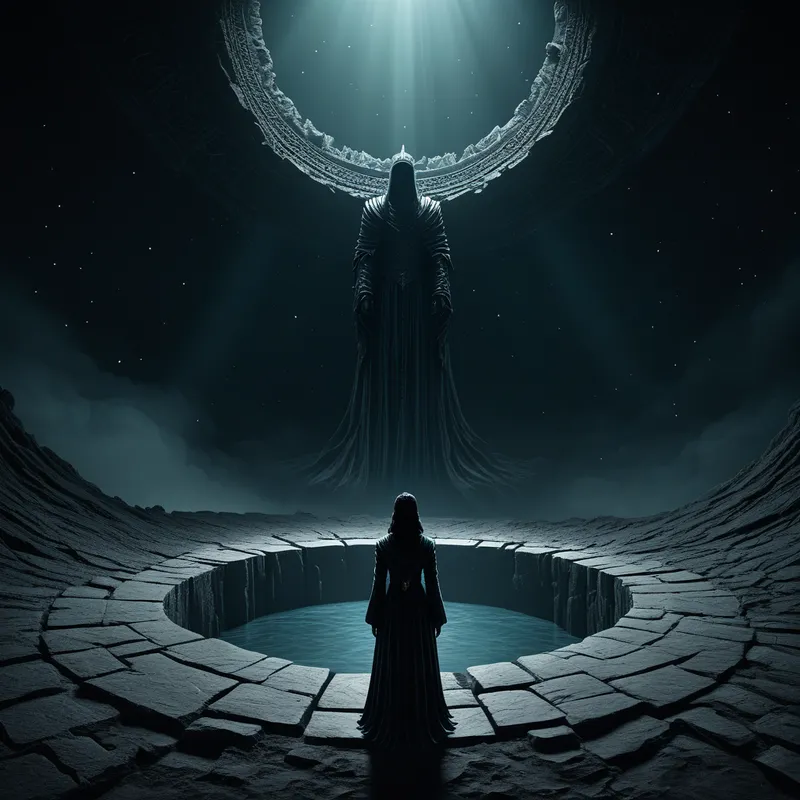
When this myth stirs in the modern psyche, it often manifests as dreams of profound, intimidating descent: finding a hidden basement that descends endlessly, being pulled into a whirlpool or sinkhole, or standing before a formidable, dark figure who demands something. The somatic feeling is one of gravity, dread, and immense pull.
This dream pattern signals a critical phase of individuation where a powerful, neglected, or "unacceptable" complex—often related to rage, primal sexuality, deep grief, or a will to power—is rising from the personal or collective unconscious (the underworld) and demanding recognition. The dreamer is Nergal at the first gate, being commanded to face what they have insulted by ignoring. The psychological process is one of moving from resisting this "dark queen" of the psyche to engaging with it, not to destroy it, but to hear its terms. The resolution in the dream, if integration is underway, may be finding a seat in the darkness, or an unexpected alliance with the feared figure.
Alchemical Translation
The alchemical journey mirrored here is the Nigredo leading to a sacred marriage, the Coniunctio. Our conscious identity (Nergal) is initially inflated, refusing to bow to the reality of limitation, decay, and the powerful emotions we’ve banished (the insult to Namtar). Life, or the Self, then forces a descent into depression, illness, or crisis (the command to go to the underworld).
The psyche’s most feared ruler cannot be deposed; she must be wed. Sovereignty is only achieved by sharing the throne with one's own depths.
The first confrontation is often a psychic inflation of shadow combat: trying to kill our depression, violently suppress our anger, or rationally argue away our grief. This fails. The turning point is Ereshkigal’s offer—the shadow’s proposal. It says: "If you stop trying to destroy me, I will give you authority over this entire realm. I will give you the tablet of wisdom." The wisdom is the knowledge of the whole self. The modern individual’s "alchemical translation" is the conscious decision to return—to willingly engage with that depression, that rage, that grief—not as an enemy, but as a source of terrifying power and ultimate legitimacy. The throne you share is your own full, authentic being, ruling over the entirety of your experience, light and dark.
Associated Symbols
Explore related symbols from the CaleaDream lexicon:
- Door — The seven gates of the underworld represent successive thresholds of initiation, each requiring a surrender of egoic protection to pass deeper into the unconscious.
- Descent — The core action of the myth, symbolizing the necessary psychological journey into the repressed, forgotten, or feared aspects of the self.
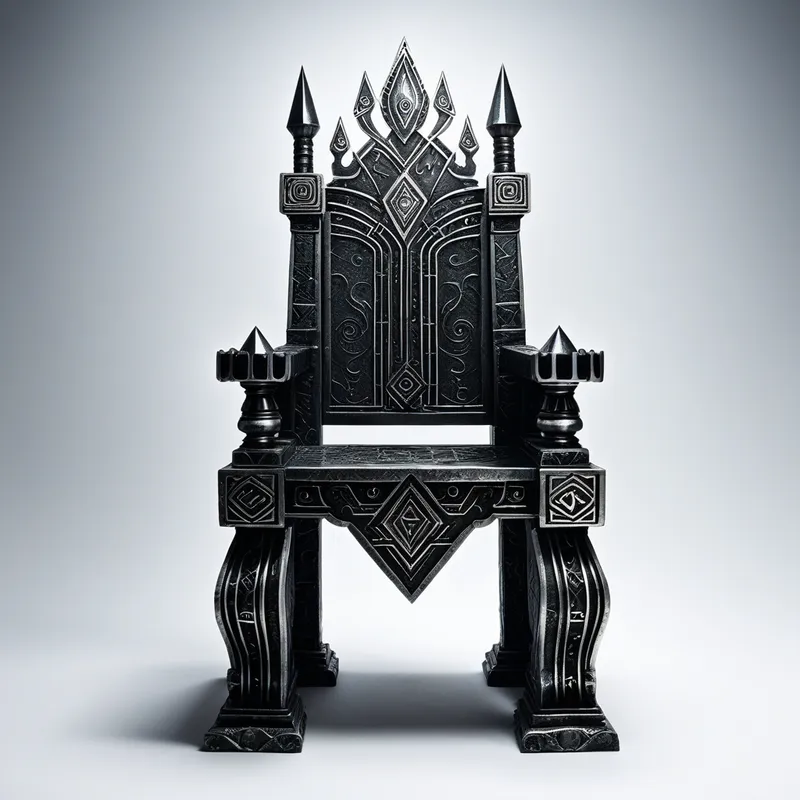
- Throne — The seat of power in the underworld; claiming it alongside Ereshkigal represents achieving sovereignty through the integration of shadow, not through its suppression.
- Shadow — Ereshkigal embodies the ultimate Shadow—the Queen of all that is denied, feared, and yet holds immense latent power and authority.
- Rage — Nergal’s primary energy, the fiery, destructive force that must be brought into relationship with the cold stillness of the deep psyche to be transformed.
- Death — Not merely physical death, but the principle of endings, dissolution, and the fertile void from which new psychological structures are born.
- Union — The sacred marriage of Nergal and Ereshkigal symbolizes the coniunctio oppositorum, the alchemical fusion of conscious and unconscious, aggression and receptivity.
- Sovereignty — The ultimate prize of the myth; a rulership earned not by conquest alone, but by the courageous partnership with one's own depths.
- Gate — Each of the seven portals strips away a layer of persona, forcing a confrontation with increasingly raw and fundamental aspects of being.
- Tablet — The tablet of wisdom offered to Nergal represents the deep, often non-rational knowledge and authority that comes from integrating the shadow.
- Sumerian Tablet — The physical medium of the myth, connecting the symbolic narrative to the tangible, ancient wisdom tradition that sought to map the human relationship with cosmic forces.