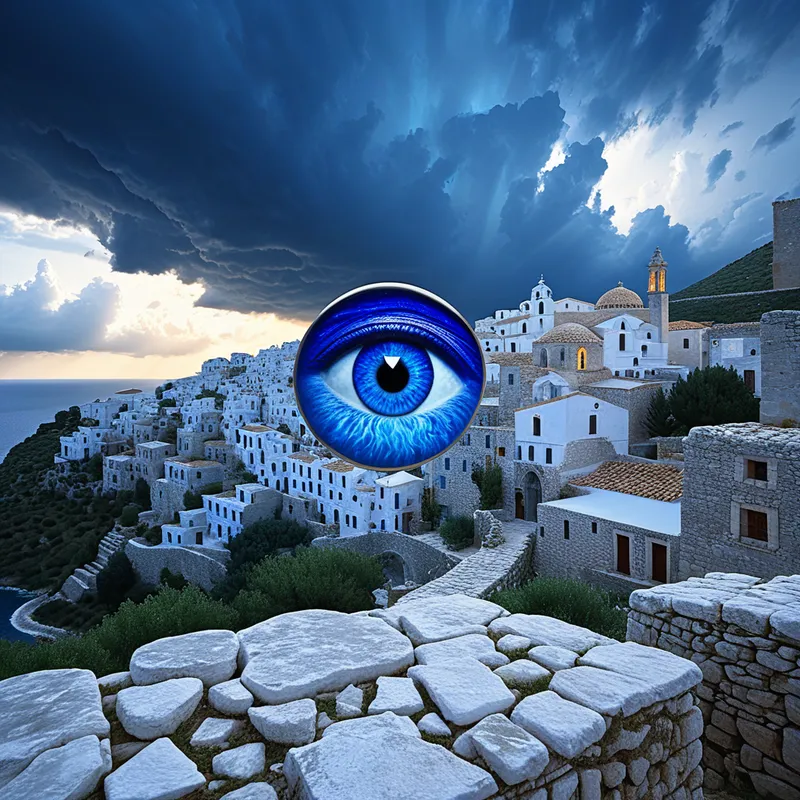
Nazar Myth Meaning & Symbolism
A myth of the all-seeing eye, born from divine grief, that protects humanity by absorbing the world's malice and transmuting it into inert glass.
The Tale of Nazar
Listen, and let the salt-wind carry you back. Before the first city was built of sun-bleached stone, when the world was young and raw with feeling, the gods walked the shores of the Middle Sea. Among them was a being of pure perception, a deity known as the Witness. It had no form but sight; its essence was to observe the dance of creation without desire, without judgment.
But a day came when the Witness gazed upon the first human grief. A mother wept over her stillborn child, and her sorrow was not a simple thing. It was a complex, twisting helix of love, despair, and a sharp, unspoken spike of envy for those whose children lived. This envy was a poison, a malignant wish that others might share her pain. The Witness, who had only ever known the pure forms of things, was pierced. For the first time, it felt. And what it felt was the searing, corrosive touch of this directed malice—what would come to be called the Nazar itself.
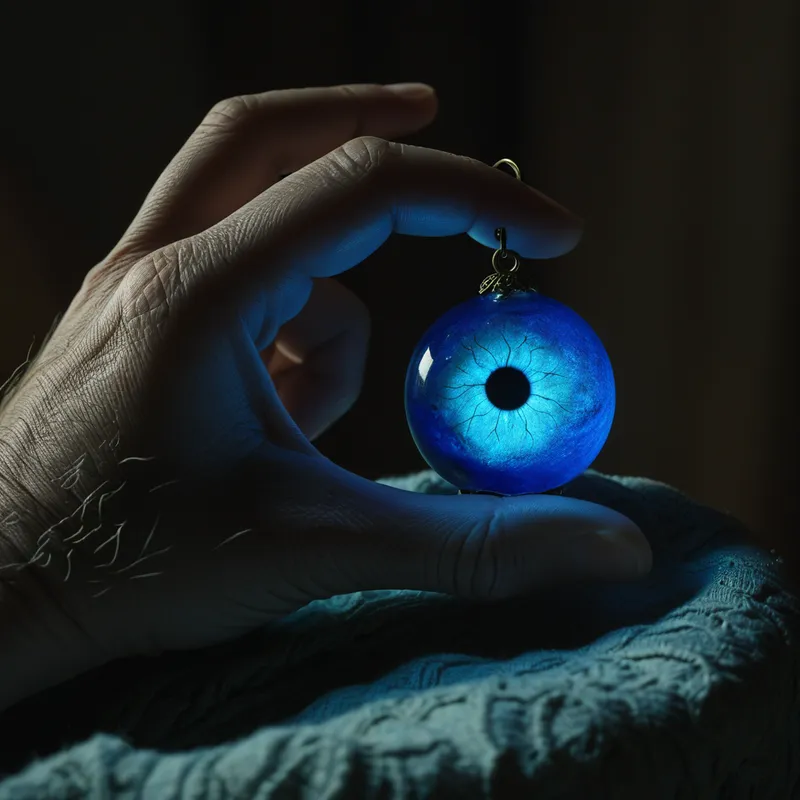
The deity recoiled, not in anger, but in a profound, cosmic ache. Its perfect, detached vision was shattered. From the tears of its divine empathy, mingled with the essence of that first human envy, a physical form began to coalesce. It wept a single, enormous tear that did not fall to earth but hung in the air. As it cooled in the sea-breeze, it solidified into a perfect, concentric circle of the deepest, most tranquil blue anyone had ever seen—the color of the sea at its most profound depth, the color of the sky just before twilight. At its center, a circle of lighter blue formed, and within that, a point of purest black, like a pupil. It was an eye, but not one that looked out. It was an eye that looked in, that absorbed.
This floating eye, the first Nazar Boncuğu, began to pulse with a soft, cool light. It drifted over the grieving mother. And as it did, the dark, knotted feeling of her envy was drawn out of her heart, not as a theft, but as a release. The malicious energy flowed into the blue glass, where it swirled for a moment like ink in water before being frozen, trapped, and rendered inert. The mother’s grief remained, pure now and bearable, but the poison was gone. The eye had taken the Nazar upon itself. The deity, its essence now forever changed into this protective form, scattered its substance. Fragments of that first, great blue eye fell across the lands, becoming the countless talismans that would hang in doorways, rest on cradles, and be worn close to the skin—a silent, eternal guardian born from the pain of seeing too truly.
Cultural Origins & Context
The myth of the Nazar is not housed in a single, canonical text but is woven into the very fabric of daily life across the Mediterranean basin, from Turkey and Greece to the Levant and North Africa. It is a folk tradition, passed down through generations of mothers, artisans, and sailors. The story was told not in grand temples, but in hushed tones at a child’s bedside, in the workshops of glassblowers on the island of Murano or in the ancient streets of Istanbul, and among fishermen who would fix a blue eye to the prows of their boats.
Its societal function is profoundly pragmatic and psychological. In close-knit, communal societies where prosperity and misfortune were highly visible, the unspoken rules of social harmony were paramount. Envy, even unconscious envy, was recognized as a potent, destabilizing force. The myth and the talisman provided a culturally sanctioned "circuit breaker" for this anxiety. It externalized the vague fear of malice into a concrete symbol that could be managed and neutralized. It allowed people to celebrate their good fortune (a beautiful child, a new home, a bountiful harvest) while proactively deflecting the potential "evil eye" of others, thus maintaining social cohesion without direct accusation. The myth taught that protection is not about aggression, but about absorption and transformation.
Symbolic Architecture
At its core, the Nazar myth is a profound allegory for the psychology of perception and protection. The Witness represents pure, undifferentiated consciousness. Its shattering is the inevitable human fall into empathy and, consequently, into the awareness of shadow—the dark, complex emotions in ourselves and others.
The true Nazar is not the talisman of glass, but the human capacity to recognize the shadow in a glance and choose not to reflect it, but to receive it.
The evil eye, or Nazar, symbolizes projected envy—the unconscious, psychic toxicity we cast onto others out of our own lack, and which we fear is cast upon us. The Nazar Boncuğu (the blue bead) is the symbol of a conscious, containing psyche. Its concentric circles mirror the layers of the self. The deep blue is the vast, containing unconscious; the light blue, the conscious mind; the black center, the unknowable core of the Self. It models a psychic immune system: it does not destroy the invasive "virus" of malicious intent, but encapsulates it, rendering it powerless through acknowledgment and containment. The myth tells us that the ultimate protection is a kind of spiritual stamina—the strength to look directly at the "evil eye" of the world's shadow and, through understanding, disarm it.

The Dreamer's Resonance
When the Nazar appears in modern dreams, it seldom comes as a simple amulet. It manifests as the dreamer’s own relationship to being seen and to seeing. One might dream of an eye that follows them, not with judgment, but with a heavy, absorbing gaze. This often coincides with periods of personal success or vulnerability—a new relationship, a promotion, a creative unveiling—where the dreamer feels exposed to the envy or criticism (real or imagined) of others. Somatic sensations might include a feeling of being "pierced" in the chest or a strange, cool sensation on the skin, as if being washed in blue light.
Psychologically, this dream signals an active process of ego-boundary work. The dream-ego is grappling with the anxiety of social visibility and the projection of its own shadow. The Nazar’s appearance suggests the unconscious is activating a protective, containing function. The dream is an internal ritual: the psyche is attempting to transmute the fear of external malice (which is often a mirror of one’s own unacknowledged envy or self-sabotage) into a structured, manageable form. It asks the dreamer: What are you afraid will be seen? And what poison are you, perhaps, unconsciously casting with your own gaze?

Alchemical Translation
The myth of the Nazar is a perfect map for the alchemical stage of Nigredo, the confrontation with the black shadow, and its transmutation into the integrated Self. The journey begins with the Witness’s naive, unified state (the Unus Mundus). The "fall" into empathy is the necessary separatio, the division that makes consciousness possible, but at the cost of experiencing conflict and poison.
Individuation requires the courage to become the talisman—to allow the corrosive elements of the personal and collective shadow to be absorbed into the vessel of a stronger consciousness, where they lose their destructive power.
The individual’s task, modeled by the deity’s sacrifice, is to build a psychic Nazar Boncuğu. This is the development of a conscious attitude that can receive negative projections—from others and from one’s own inner critic—without being identified with them or reflexively projecting them back. It is the practice of containment. One learns to say, "I see this envy, this fear, this malice. I acknowledge its existence. I will not let it define me or dictate my actions." In this container, the leaden poison of the shadow is "frozen," examined, and through understanding, its energy is neutralized. It becomes inert glass—a part of one’s history, but no longer active. The triumph is not the eradication of the shadow, but the achievement of a consciousness wide enough and calm enough to hold it without being destroyed by it. One becomes, like the scattered deity, a localized point of protection—first for oneself, and by extension, for the immediate world one inhabits.
Associated Symbols
Explore related symbols from the CaleaDream lexicon: