Navaratna Myth Meaning & Symbolism
The myth of the Navaratna, nine celestial gems born from cosmic conflict, representing the integration of divine forces into a unified, protective whole.
The Tale of Navaratna
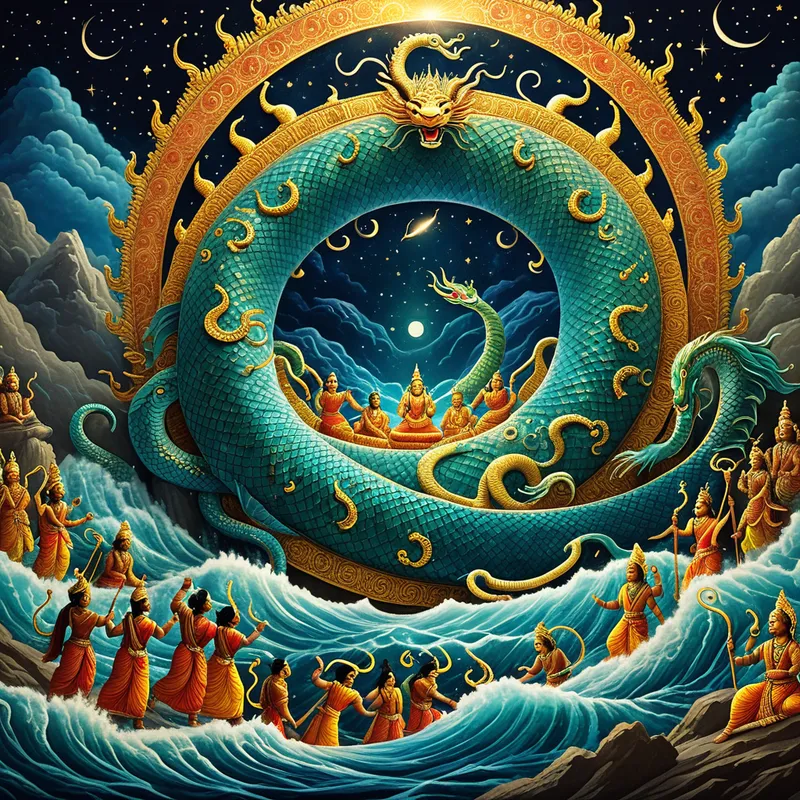
In the time before time, when the universe was a single, unbroken ocean of potential, a great weariness fell upon the gods. They were mighty, yet they were mortal. The shadow of death, a gift from the sage Durvasa's curse, clung to them like a pall. In their celestial halls, a council of despair was held. Indra, his thunderbolt dim, turned to Vishnu, who rests upon the serpent of eternity.
Vishnu spoke, his voice the sound of deep waters. "The cure for your mortality lies not in heaven, but in the depths. You must churn the ocean of milk, the Kshirasagara. From its depths will arise amrita. But you cannot do this alone. You must enlist your eternal opposites, the asuras. Promise them a share. Use their strength, for the task is for all beings."
And so began the grandest endeavor. The cosmic mountain, Mandara, was uprooted to be the churning rod. The king of serpents, Vasuki, consented to be the rope. The gods took the serpent's tail; the asuras, his fearsome head. They began to pull, back and forth, a cosmic tug-of-war. The mountain spun, grinding against the back of Kurma, the great tortoise who dove beneath to provide a foundation.
The ocean roared. It frothed and seethed, not with water, but with the essence of all creation. First, it yielded a terrible poison, Halahala, so potent it threatened to dissolve all worlds. In desperation, they called to Shiva, the ascetic. He gathered the venom and drank it, holding it in his throat, which turned blue, earning him the name Neelakantha. The crisis passed.
Then, the treasures began to rise.
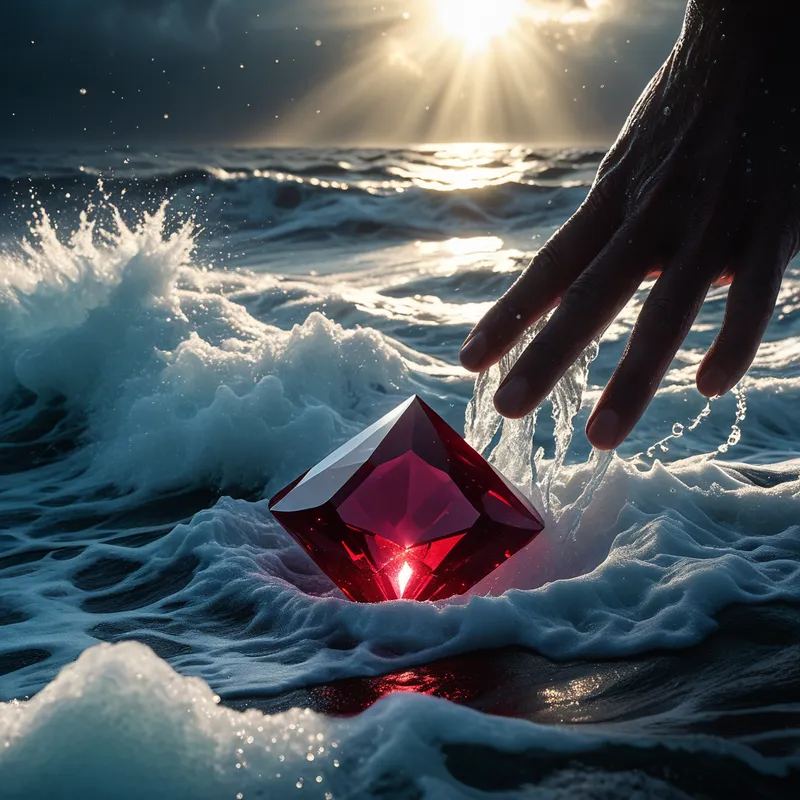
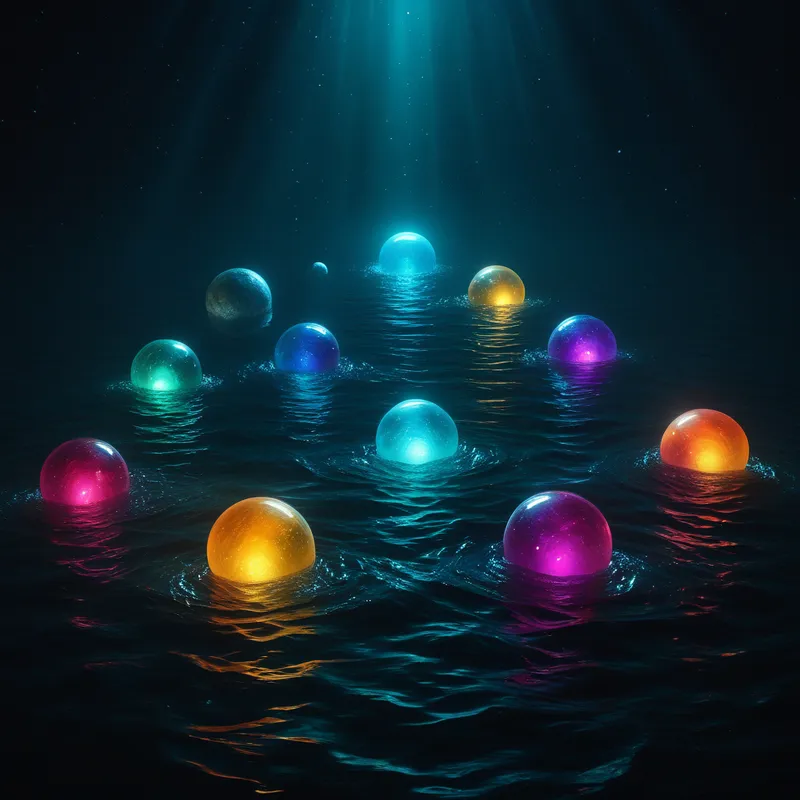
Not one, but many. The wish-fulfilling cow, Kamadhenu. The white elephant, Airavata. The goddess of wine. And then, emerging like solidified starlight, came the gems. Nine of them. They were not mere stones; they were crystallized aspects of the cosmos itself. The ruby, hot with the essence of the Sun. The pearl, cool with the touch of the Moon. The red coral, born of Mars's fiery breath. The emerald, Mercury's swift intelligence. The yellow sapphire of Jupiter's wisdom. The diamond of Venus's lucid beauty. The blue sapphire of Saturn's solemn discipline. The hessonite garnet of the shadowy Rahu. The cat's eye chrysoberyl of the mysterious Ketu.
They glowed with an inner fire, a complete set, a celestial family pulled from chaos. They were claimed, distributed, set into crowns and scepters. But their true purpose was revealed only later. When worn together, in a specific, harmonious arrangement, they did more than adorn. They created a field, a microcosm of the churned ocean itself—a stable, resonant matrix that balanced the very forces that had birthed them. They were the Navaratna, the jewels of cosmic order, born from collaboration with the adversary, forged in the tension between poison and nectar.
Cultural Origins & Context
The myth of the Navaratna is inextricably woven into the grand narrative of the Samudra Manthan, a foundational episode found in the Puranas, particularly the Vishnu Purana and the Shiva Purana. It was not merely a story for entertainment but a cosmological map and a societal allegory. Passed down by storytellers, sutas, and priests, it functioned on multiple levels.
For the royal and priestly classes, it legitimized power. The gems became associated with planetary deities (Navagraha), and a properly arranged Navaratna was believed to harmonize celestial influences, protecting the wearer (often a king) and, by extension, the kingdom. It was a tool of statecraft, a symbolic engine for maintaining dharma. For the common person, the myth explained the origin of precious objects and reinforced a core Hindu philosophical principle: that the greatest treasures—and the greatest perils—emerge from engaging with the totality of existence, light and dark, god and demon, not from avoiding it.
Symbolic Architecture
The Navaratna is not a random collection of valuables. It is a symbolic blueprint for a complete psyche. The churning ocean is the unconscious, the vast, unformed potential within every individual. The gods and demons represent the eternal internal conflict between our aspirational, ordering tendencies (the gods, or devas) and our primal, desirous, shadowy drives (the demons, or asuras).
Individuation does not come from the victory of light over dark, but from the conscious tension between them, which produces something new.
The mountain is the axis of the Self, the central pillar of consciousness around which this inner work must revolve. The serpent is the vital, kundalini-like energy that makes the work possible. The poison that emerges first is the shadow material, the repressed trauma, rage, and fear that must be confronted and contained (as Shiva contains it) before any "nectar" can be accessed.
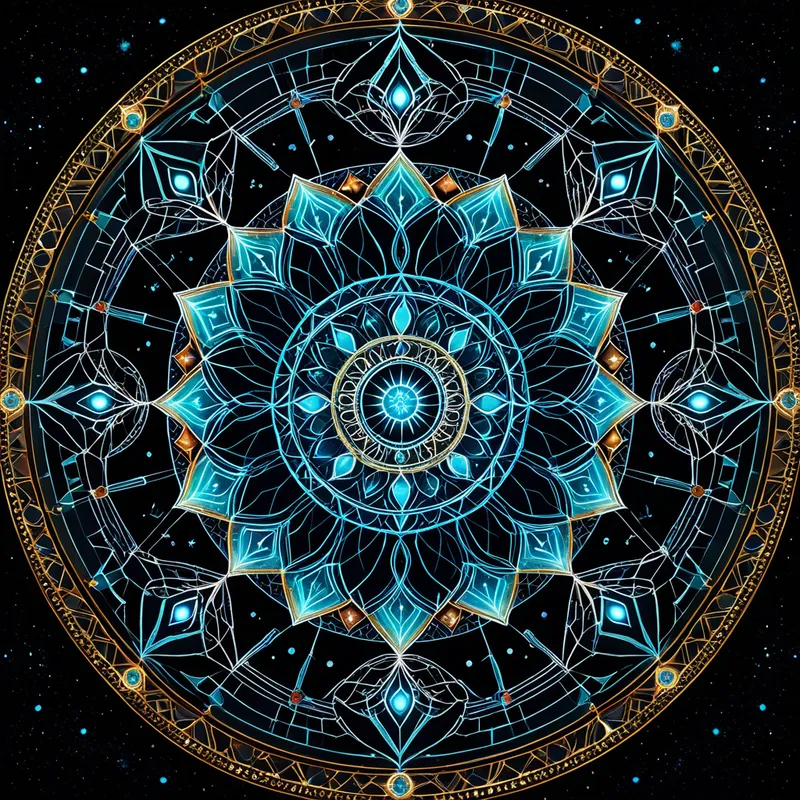
The gems are the crystallized, integrated aspects of the Self that result from this profound inner work. Each gem represents a core psychological function or archetypal influence: the will (Sun/ruby), the emotions (Moon/pearl), passion and action (Mars/coral), intellect (Mercury/emerald), wisdom and meaning (Jupiter/sapphire), love and values (Venus/diamond), discipline and structure (Saturn/blue sapphire), the compulsive desires of the past (Rahu/garnet), and the liberating, mystical insights that come from releasing them (Ketu/cat's eye). Together, they form a mandala of the whole personality.
The Dreamer's Resonance
When the pattern of the Navaratna appears in modern dreams, it rarely manifests as literal jewels. The dreamer may find themselves in a situation of immense, chaotic pressure—a churning job, a turbulent relationship, an internal crisis. They may see nine of something: nine lights in a tunnel, nine doors in a hallway, nine figures in a council, or nine distinct emotions warring within.
The somatic experience is one of being pulled in opposite directions, of a necessary but exhausting effort. This is the psyche initiating its own Samudra Manthan. The dream is signaling that a process of deep integration is underway. The appearance of a "poison" (a nightmare, a shocking image, a feeling of toxicity) is not a sign of failure, but a critical first product of the churn. The dreamer is being asked to "drink" and hold this poison—to consciously acknowledge their shadow—without being destroyed by it. The longing felt in the dream is for the "nectar," the sense of wholeness and immortality (ego-transcendence) that comes after the gems of integrated selfhood are assembled.
Alchemical Translation
For the modern individual, the myth of the Navaratna is a precise allegory for the alchemical process of individuation. We begin in a state of undifferentiated potential, often feeling subject to forces beyond our control (the curse of mortality). The first step is the recognition that our salvation lies not in fleeing our demons, but in engaging them. We must enlist our shadow—our anger, our greed, our laziness, our fear—and put it to work. We use its energy as the necessary counter-force to our spiritual aspirations.
The churning is the hard, repetitive, often painful work of therapy, introspection, creative struggle, or any disciplined practice that stirs up the contents of the unconscious. The first yield is always the poison: the repressed memories, the defensive projections, the neuroses. This is the nigredo, the blackening of alchemy. We must find our inner Shiva, the transcendent witness consciousness, to contain and neutralize this toxicity.
The gems are the enduring, valuable structures of the personality that are forged in the fire of self-confrontation. They are not given; they are earned.
Then, and only then, do the treasures emerge. Each integrated complex, each healed wound, each accepted aspect of ourselves becomes a "gem"—a stable, valuable part of our character. The yellow sapphire of earned wisdom replaces blind dogma. The diamond of authentic love replaces needy attachment. The final act is not to hoard these gems separately, but to arrange them into a cohesive whole—a Navaratna. This is the creation of a conscious personality, a Self that can withstand the pressures of life because it contains and balances all its own inherent contradictions. The individual becomes a living mandala, a microcosm of the churned cosmos, radiating not a single light, but the harmonious, multifaceted brilliance of a fully realized being.
Associated Symbols
Explore related symbols from the CaleaDream lexicon: