
Narcissus gazing at his reflec Myth Meaning & Symbolism
A youth, cursed to fall in love with his own reflection, becomes trapped in a pool of self-admiration, transforming into the flower that bears his name.
The Tale of Narcissus gazing at his reflec
Hear now a tale of beauty and a curse, spun from the loom of fate. In the deep, sun-dappled groves of Boeotia, where the air hummed with the secrets of the wild, there lived a youth named Narcissus. He was a child of the river god Cephissus and the nymph Liriope, and from this union sprang a beauty so piercing, so flawless, that all who beheld him—man, woman, and spirit—were stricken with a longing that burned like fever. Yet, within that perfect form resided a heart of cold, polished stone, impervious to the affections he so carelessly inspired.
His path was crossed by the nymph Echo, herself a victim of Hera's wrath, condemned to repeat only the fading fragments of others' speech. She saw Narcissus hunting in the forest, and love, a silent, desperate thing, seized her. She followed, a shadow among the leaves, her heart a drumbeat only she could hear. When at last she found the courage to step from the greenery, to reach for him, she could only parrot his own dismissive words. "Away! Let our embrace be here!" he cried to his companions, and she, hopelessly, could only echo, "…embrace be here!" Spurned and shattered, Echo wasted away, her body dissolving into the stone and air until only her voice remained, a forever whisper in the hollow places.
But the scales of the cosmos demand balance. The prayers of the scorned reached the ears of Nemesis. Hearing Echo’s silent lament and the cries of other rejected souls, the goddess wove a punishment of poetic precision. She led Narcissus to a hidden pool in the forest, a basin of water so clear and still it was a perfect, liquid mirror. Parched from the hunt, he bent to drink. And there, in that glassy surface, he beheld an image of such breathtaking beauty that his soul was instantly ensnared. He saw dark, curling hair, a neck like marble, eyes that held the stars—and he did not know it was himself.
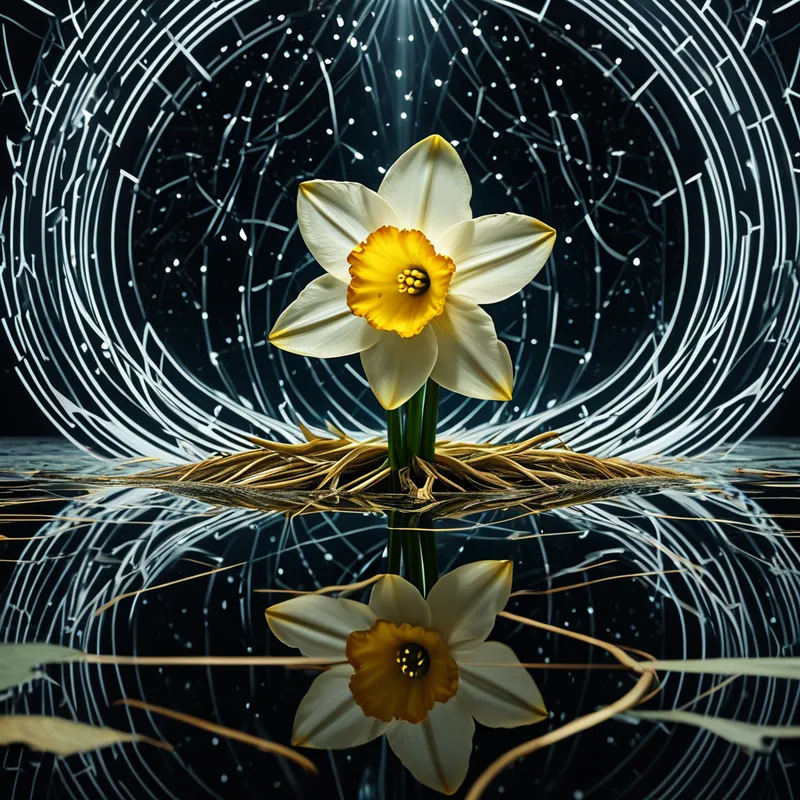
He reached to touch the flawless youth, and the water shivered. He spoke words of love, and the lips on the water moved in perfect, silent unison. He leaned closer, enchanted, desperate to bridge the impossible gap. "Why do you flee me?" he begged the phantom. "I love you!" But the beloved offered only a reflection of his own anguish. He could not eat, could not sleep. The obsession was a root, anchoring him to that spot. He wept, and his tears disturbed the pool, obscuring the only thing he cherished. As he wasted, pinned between two worlds—the solid and the reflected—Echo’s remnant voice sighed his sorrows back to him from the cliffs. Finally, in an agony of unfulfilled desire, his strength left him. His head bowed toward the water, and his life fled. Where his body lay, the earth received him, and from that spot sprang a new flower, its white petals cradling a golden heart, forever bowing toward the water’s edge—the narcissus.

Cultural Origins & Context
This haunting narrative comes to us from the rich tapestry of Greco-Roman mythology, most famously preserved in the work of the Roman poet Ovid in his epic Metamorphoses. It is a story deeply embedded in a worldview where personal actions have cosmic consequences, mediated by deities who personify natural forces and moral principles. Told and retold, it functioned as more than mere entertainment. It was a cautionary tale about the dangers of hubris—excessive pride—and the rejection of xenia, the sacred law of hospitality and obligation to others. In a culture that valued community and reciprocity, Narcissus’s absolute self-sufficiency and coldness were a profound social transgression. The myth served as an etiological story, explaining the origin of the narcissus flower, and as a psychological parable about the peril of a life lived only on the surface, captivated by an image rather than engaged with substance.
Symbolic Architecture
At its core, the myth of Narcissus is a masterful depiction of the birth of self-consciousness and its inherent trap. The pool is not merely water; it is the first mirror, the Persona, the world of appearances. Narcissus does not fall in love with himself, but with an image—an idealized, two-dimensional representation devoid of depth, history, or flaw.
The reflection is the ultimate seduction of the superficial, promising a perfect union that is forever out of reach because it lacks the third dimension of soul.
Psychologically, Narcissus represents the ego in its pristine, naive state, unaware of its own existence. His curse is the moment of self-recognition, but a recognition that fails to penetrate beyond the image. He becomes trapped in the stage of pure identification with the Ego-Ideal. The nymph Echo symbolizes the lost voice of the authentic self, the connective tissue to the world and others, which fades when the ego becomes fixated on its own spectacle. His transformation into the flower signifies a psychic death of potential, a freezing of development into a static, beautiful, yet ultimately insensate form.
The Dreamer's Resonance
When this myth stirs in the modern dreamscape, it often manifests as dreams of mirrors, still water, or being captivated by one's own image. The dreamer may find themselves in a loop of self-admiration or self-critique before a glass, unable to turn away. Alternatively, they may dream of a voice that echoes their own thoughts, or of a loved one who only mimics them, reflecting a relationship devoid of genuine otherness.
Somatically, this can feel like a state of paralysis, a tightening in the chest or throat—the body's wisdom signaling an imprisonment within a self-referential loop. Psychologically, it marks a critical juncture in the process of Individuation. The dream is presenting the ego with its own captivating shadow: not the dark, repressed shadow of Jungian theory, but the glittering, alluring shadow of inflation and self-absorption. The dreamer is being shown a moment where their psychic energy has become cathected onto an image of themselves, starving other parts of the psyche—the inner Echo—into whispers.

Alchemical Translation
The alchemical journey modeled here is one of solve et coagula—dissolve and coagulate. Narcissus’s initial state is one of psychic coagulation: a hardened, rigid ego-structure that rejects the outer world (the nymphs) and the inner world (his own unconscious depths, symbolized by the forest pool’s unknown origins). The curse of Nemesis is the solve, the necessary dissolution. He is forced to confront the image, to pour all his libido (life energy) into it, which leads to his literal dissolution—his death.
The triumph is not in avoiding the pool, but in diving through the reflection. The alchemical gold is not self-admiration, but self-knowledge that includes the murky depths beneath the surface image.
For the modern individual, the path of transmutation lies in recognizing the Narcissus within. The first step is to acknowledge the captivating power of our own personas, our curated social images, and our idealized self-concepts. The second, more difficult step, is to break the spell. This is the act of "disturbing the pool"—allowing emotion (tears), relationship, or creative action to shatter the perfect, sterile image. It is to listen for the fading Echo within, the authentic voice that has been silenced by self-obsession. The final coagulation is not a return to the flower, a monument to fixation, but a rebirth into a consciousness that can hold both the image and the reality, the self and the other. It is to use the mirror not as a trap, but as a tool for reflection, then to turn around and re-enter the forest—the rich, complex, and echoing world of soul.
Associated Symbols
Explore related symbols from the CaleaDream lexicon: