The Alchemy of the Mirror: Dreaming of Vanity
The Somatic Echo
It begins not as a thought, but as a sensation: a subtle, cold pressure behind the eyes, a tightening in the jaw as if holding a smile too long. The skin feels like a costume, a millimeter too tight, humming with the static of a thousand unseen gazes. There is a hollowness in the solar plexus, a cavity where the echo of applause should resonate, but instead, there is only the faint, metallic taste of a stage left empty. This is the body’s prelude to the dream of vanity—a visceral awareness of the gap between the curated surface and the unlit interior. It is the somatic signature of a self divided, where the energy meant for being is siphoned into the perpetual labor of seeming.
The Dreamer's Log
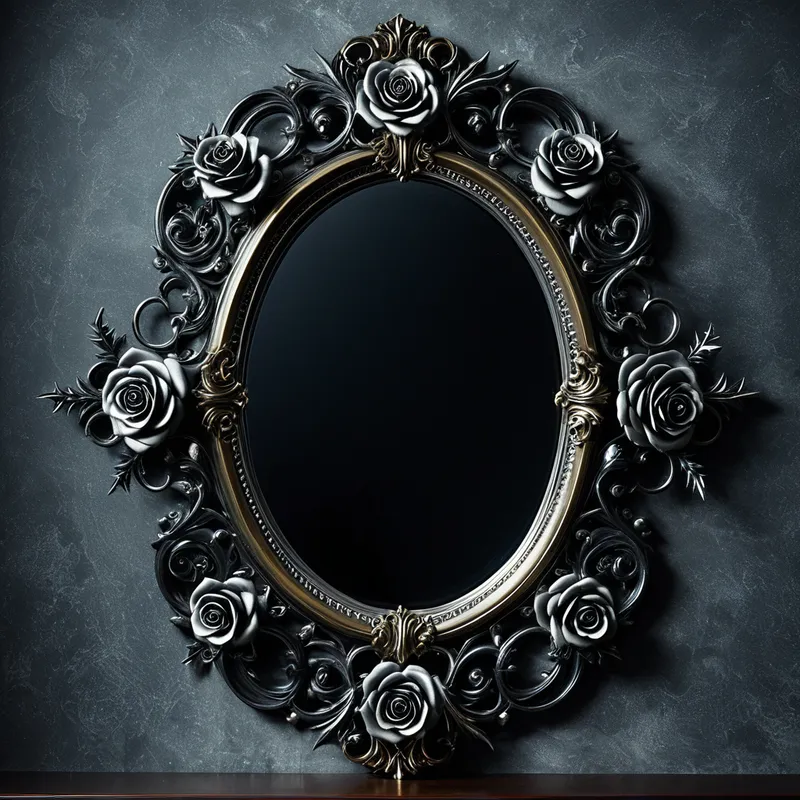
In the dream, I am late for my own premiere, rushing through a labyrinth of backstage corridors. I finally find my dressing room, but the mirror is a vortex. My reflection is perfect, immaculate, yet utterly still—a mannequin wearing my face. When I try to speak, the reflection’s mouth moves out of sync. I reach out to touch the glass, and my fingertips meet not cold surface, but a permeable film. I watch, horrified and fascinated, as my hand sinks into the reflection’s chest, feeling not organs, but a dense, warm, and pulsing darkness.
This is not a nightmare of ugliness, but of perfect, lifeless image. The alchemical interpretation: The dreamer’s conscious identity has become a static artifact, and the soul now demands a perilous descent through the mirror to reclaim the living, shadowed substance within.

The False Lead
Do not mistake this for a simple dream of insecurity or low self-esteem. That is its crude opposite. Vanity, in its profound dream form, is not a lack of self-love, but a misplaced love—a deep, often brilliant investment in a constructed self. It is not about feeling worthless, but about anchoring your worth to a reflection that cannot breathe, age, or truly connect. The terror here is not of being unseen, but of being seen only for the surface, and thus, in a fundamental way, never being seen at all. It is the grief of the curator who has mistaken the museum for the wild.
Psychological Architecture
To dream of vanity is to be summoned to the most intimate construction site: the architecture of the Self. Here, shadow work is not about battling monsters in a basement, but about auditing the blueprints of the penthouse. The individuation process demands a dismantling of the persona—not as an enemy, but as an overzealous contractor who built a beautiful, airtight fortress and called it a home. The windows are mirrors, the doors only open inward, and the echo is deafening.
The work is to first acknowledge the genius of this construction. It was likely built for excellent reasons: protection, acceptance, survival. Then, with the tenderness of a restorer discovering original fresco beneath whitewash, you must begin the careful, terrifying process of creating an opening. A crack in the perfect plaster where authentic feeling, unapproved thought, or “unbecoming” desire can seep through. This is not demolition; it is a sacred renovation where the ego, the master builder, learns to collaborate with the soul, the wild tenant it tried to evict.
Mythic Resonance
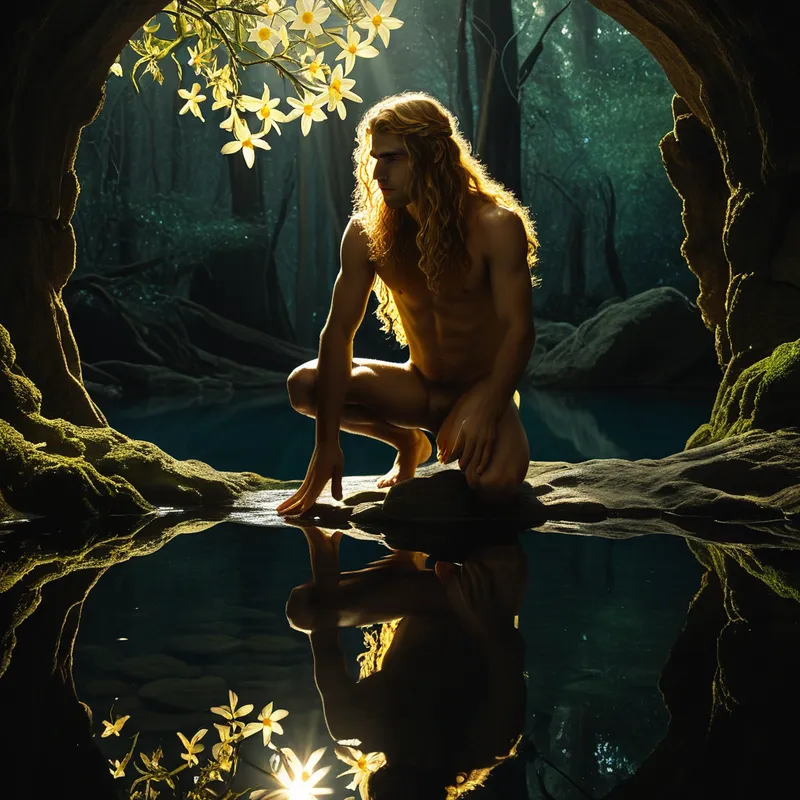
This is the territory of Narcissus, but the common telling misses the point. He did not fall in love with himself. He fell in love with an image—a flawless, water-smooth reflection that could not love him back. The tragedy was not his self-absorption, but his fatal confusion between the living man and the inert picture. The myth whispers the core truth: to be enamored with the reflection is to starve the source. Similarly, in the tale of Dorian Gray, the portrait in the attic is not just a record of sin, but the embodied shadow of vanity—the hidden cost of maintaining eternal, surface perfection. The portrait swells with the authentic, decaying, lived experience that the living man has refused to integrate.
Symbolic Nodes
- Distorting Mirrors: Reflecting a grotesque, perfect, or shifting image. The tool of truth becomes an instrument of illusion.
- Crumbling Makeup/Masks: The applied facade losing integrity, revealing something raw or unexpected beneath.
- Empty Stages & Auditoriums: The performance continues for an absent audience, highlighting the automation of the persona.
- Mannequins & Wax Figures: Perfect form devoid of consciousness, the self as a display object.
- Gilded Cages/Opulent Prisons: Environments of beautiful confinement, where the self is both the jewel and the jailer.
- Polished Surfaces that Become Liquid: The solid boundary of the image destabilizes, inviting (or threatening) a merge.
Archetypal Resonance
The dream of vanity is the domain of The Shadow Ruler.
The core energy of the Ruler is sovereignty, order, and conscious creation of a kingdom. In its shadow, this archetype curdles into the tyrant and control-freak, where the kingdom shrinks to the fragile territory of one’s own image. The somatic echo—the tightness, the hollow performance—is the body living under this inner tyranny, where every gesture is legislated, every emotion assessed for its diplomatic value. The alchemical potential lies in the Ruler’s true purpose: not to control, but to govern with wisdom. The transmutation occurs when this archetic energy turns from policing the borders of the persona to consciously, compassionately integrating the diverse and often rebellious territories of the full psyche, establishing a sovereignty based on authentic authority, not just control.
The Alchemical Process
The alchemy of vanity requires the heat of conscious embarrassment and the pressure of radical self-honesty. The prima materia is the glittering dust of the constructed image. The process begins with the mortificatio—not a death of the self, but a death of the identification with the image. This is the humbling, often painful moment when the reflection cracks, when the performance falters, when the applause rings hollow. It feels like failure, but it is the necessary corrosion of the false gold.
In this heat, the soul-stuff—the shadowed emotions, the uncurated desires, the “unacceptable” truths—which had been exiled to maintain the image, begins to rise. The solutio (dissolution) is the terrifying, liberating experience of feeling those banned parts of yourself seep back into awareness. The final coagulatio is not a return to a new, better image. It is the crystallization of a presence. You are no longer the statue on the pedestal, nor the artist chiseling it. You become the entire gallery—the space, the art, the observer, and the quiet, enduring truth that holds it all.

The Integration Protocol
Question 1: Where in my life do I feel the exhausting pressure of "maintaining the image," and what fragile truth is that image protecting? Question 2: If my perfect reflection in the dream-mirror could speak one sentence of absolute, unadorned truth to me, what would it say? Question 3: What forgotten or disowned part of myself would be most scandalized by, and most essential to, the person I project to the world?
Action 1 (The Cracked Mirror Gaze): For one minute each morning, stand before a mirror. Do not assess, adjust, or critique. Simply meet your own gaze and silently repeat, "You are here. This is the animal that lives." Feel the shift from object to subject. Action 2 (Unglossed Pages): Set a timer for 10 minutes. Write in a stream-of-consciousness, but with a rule: you must only write about feelings, observations, or memories you consider "unimpressive," "messy," or "not your best." Do not craft a narrative. Let the prose be plain. This is an exercise in existing without curation. Action 3 (Ritual of the Unseen): Go to a natural setting—a park, a backyard, a forest trail. Find a small, "imperfect" natural object: a crooked stick, a scarred leaf, a misshapen stone. Sit with it. Acknowledge its existence without any need for it to be beautiful, useful, or symbolic. Then, extend that same silent acknowledgment to yourself, sitting there, simply being.
Final Validation
To encounter vanity in the dreamscape is to confront one of the most sophisticated and seductive defenses the psyche can devise. It is a testament to your own creative power—a power that has been used, until now, to build a magnificent prison. The difficulty, the hollow ache, the terror of the crumbling mask—these are not signs of failure, but of a profound intelligence within you beginning to rebel against its own masterpiece. It is the soul refusing to be a portrait in the attic any longer. The integration is not about becoming humble instead of vain; it is about becoming real instead of reflected. It is the moment you turn from the mirror, not in disappointment, but in completion, because you have finally remembered you are the light that makes the reflection possible.