
Narcissus at the pool - the or Myth Meaning & Symbolism
A youth, captivated by his own reflection in a pool, becomes the archetype of self-absorption, trapped between the world and its shimmering echo.
The Tale of Narcissus at the pool - the or
Hear now a tale spun from light and water, a whisper from the groves where the world grows quiet. It begins not with a bang, but with a prophecy, cold and clear as mountain ice. The seer Tiresias, when asked if the infant Narcissus would live to a ripe old age, gave a riddle for an answer: “He will, if he never knows himself.”
The air in the sacred grove of Artemis is still, heavy with the scent of damp earth and crushed hyacinth. Here, by a pool of water so pure it seems not to hold the sky but to be a piece of it fallen to earth, the youth Narcissus rests. He is fleeing—fleeing the heat of the day, the chatter of his companions, and most of all, the desperate, echoing love of the nymph Echo, whose voice, cursed by Hera, can now only repeat the last words of others. He has spurned her, as he has spurned all suitors, for none can match the ideal that lives, unseen, within his own heart.
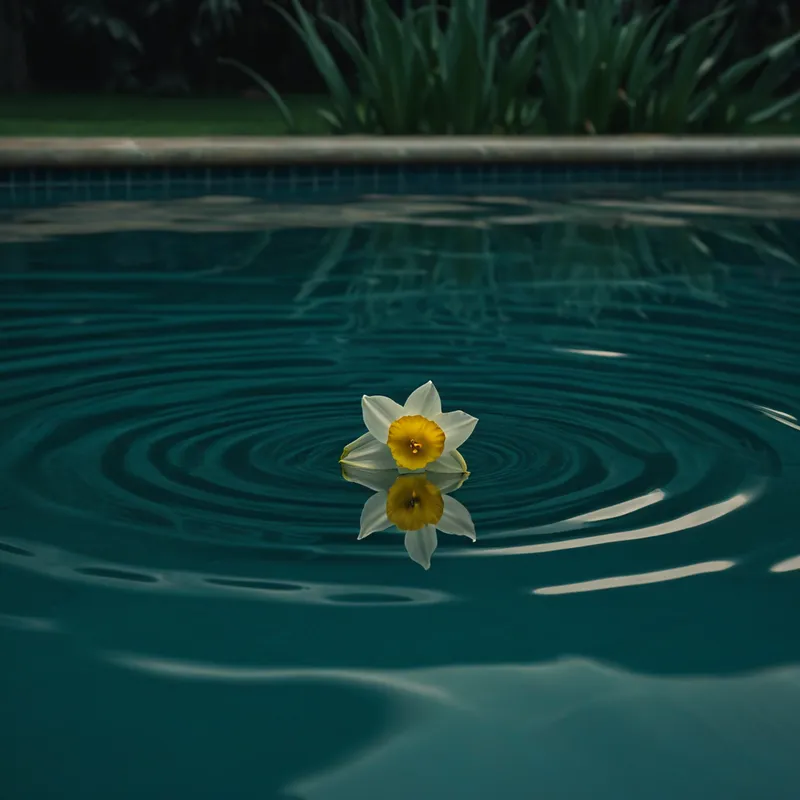
He kneels at the water’s edge to drink. As he bends, a face of breathtaking beauty looks back at him. Not a ripple mars the surface. The eyes are deep pools of fascination, the lips parted in silent admiration. He does not know it is his own. He sees only the perfect eidos, the flawless object of his lifelong, unconscious search. He reaches out—the image reaches back. He speaks words of love—it mouths them in perfect, soundless unison. He is enchanted, trapped in a dialogue of one.
Days melt into nights. He does not eat, does not drink from the water that torments him. He tries to embrace the figure, but it shatters into a thousand liquid fragments at his touch, only to reform, more beautiful and distant than before. The realization dawns, not as an intellectual knowing, but as a slow, consuming fire in the soul: This is me. This is what I am. The object of his limitless desire is the very subject from which that desire springs. It is an uncrossable boundary. The love is real, the beloved is a phantom. In a final, agonized moment of clarity, he weeps. “I am he,” he whispers to his reflection. His tear falls, disturbing the perfect surface, blurring the beloved face forever. His strength ebbs, flowing out of him and into the ground, and where his body finally rests, a new flower springs forth—a white bloom with a blood-red center, nodding perpetually towards the water, named for him: the narcissus.
Cultural Origins & Context
This haunting story comes to us from the Greco-Roman world, most famously preserved in the epic Latin poem Metamorphoses by the Roman poet Ovid. It is a myth deeply embedded in a culture that prized beauty, athleticism, and public honor, yet was equally preoccupied with concepts of fate, hubris, and the often-cruel interventions of the gods. Myths like these were not mere entertainment; they were the foundational narratives that explained the origins of natural phenomena (like the echo or the flower) and explored the boundaries of human psychology.
Told by bards and written by poets, the tale served as a cautionary narrative about the dangers of excessive self-regard (hubris) and the tragic consequences of failing to engage with the world beyond oneself. It functioned as a societal mirror, reflecting anxieties about identity, the nature of love, and the peril of becoming ensnared by appearances in a culture where public image was paramount.
Symbolic Architecture
The myth of Narcissus is a masterclass in symbolic paradox. The pool is the world’s first mirror, representing not just a physical surface, but the reflective medium of consciousness itself—the mind’s ability to turn back upon itself.
The reflection is not the self; it is the self made object, a portrait painted on the fluid canvas of perception. To fall in love with it is to confuse the map for the territory.
Narcissus represents the ego in its pristine, unintegrated state. He is not evil, but incomplete. His fatal flaw is not vanity in a simple sense, but a profound mis-identification. He mistakes the image—the persona, the social self, the ideal ego—for the totality of his being. The nymph Echo symbolizes the neglected outer world, the call of relationship and genuine connection that fades into mere repetition when met with a closed heart. The transformation into the flower signifies a frozen state, a beautiful but static existence, forever bending inward, caught between growth and introspection.

The Dreamer's Resonance
When this myth stirs in the modern dreamscape, it often manifests as dreams of mirrors, still water, or encountering a captivating yet distant double. You may dream of speaking to someone who only mimics your words, or of trying to grasp something in a reflection that always eludes your touch. Somaticly, this can feel like a tightening in the chest, a paralysis, or a profound sense of longing with no clear object.
Psychologically, such dreams signal a critical moment of self-confrontation. The dreamer is likely at a point where their sense of identity is being sourced primarily from external validation, a curated social image, or an internalized ideal that is disconnected from their authentic feelings and instincts. The dream is the psyche’s attempt to show the paralysis this creates—the energy (libido) that should flow outward into life and relationship is turned back upon itself, creating a feedback loop of stagnation and enervation. It is a call to ask: What am I truly reflecting on? Am I in love with an idea of myself, or am I engaging with the messy, real, and echoing world?

Alchemical Translation
The alchemical journey implied by this myth is the transmutation of self-absorption into self-knowledge. The base metal is the naive ego, captivated by its own glittering surface. The pool is the vas or vessel of the opus, the contained space where this difficult introspection must occur.
The first, and most brutal, stage is nigredo—the dark night of the soul that Narcissus experiences when he realizes the truth. His despair is not the end, but the necessary death of an illusion. To follow this myth path towards individuation is not to destroy the capacity for self-reflection, but to shatter the identification with the mere image.
The goal is not to stop looking at the pool, but to see through its surface—to discern the dark, unknown depths beneath the reflected sky, and to eventually dive in.
The alchemical gold is the realization that the true Self is not the flawless image on the water, but the entire system: the seer, the water, the reflection, and the mysterious depths that hold them all. It is to integrate the narcissistic wound—the shock of our own limitation and separation—into a more compassionate, grounded, and relational existence. The flower that grows is then not a symbol of frozen self-love, but of a new, delicate awareness that knows its origin in both beauty and tragedy, and can now turn its face, however cautiously, toward the sun and the world beyond the pool’s edge.
Associated Symbols
Explore related symbols from the CaleaDream lexicon: