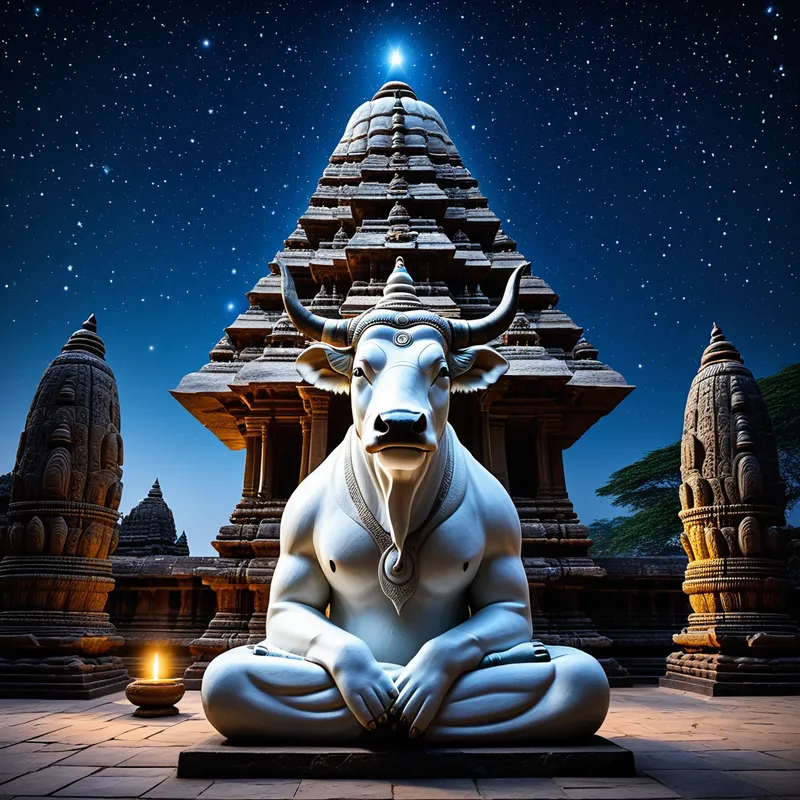
Nandi Myth Meaning & Symbolism
The story of a sage transformed into the divine bull, becoming the eternal guardian, vehicle, and foremost devotee of the god Shiva.
The Tale of Nandi
In the age when the mountains were young and the gods walked closer to the earth, there lived a sage named Shilada. His heart was a vessel of such fierce austerity and longing that it burned with a single desire: a son who would be immortal, divine, untouched by the common fate of mortals. For years, he performed penances so severe that the very elements held their breath. He stood in the heart of a sacred forest, his body a mere scaffold for his unwavering will, his prayers rising like smoke to the heavens.
His tapas, his fiery discipline, finally pierced the veils of the worlds. The atmosphere shimmered, and the great god Shiva manifested before him, his presence both terrifying and sublime. “Your devotion has moved me, Shilada,” the god’s voice echoed, a sound like distant thunder and flowing water. “You shall have a son. He will be immortal. He will be a portion of my own essence.”
In time, a child was born from a furrow of earth blessed by Shiva—a boy of radiant strength and serene demeanor. He was named Nandi, “he who brings joy.” The boy grew not as mortals do, but like a sacred idea taking form. His body became a testament of power, his spirit a lake of profound calm. He learned all the scriptures, mastered all the arts, yet his eyes always sought the horizon, as if listening for a call only he could hear.
One day, as Nandi wandered the foothills of the holy mountain Kailash, he felt a pull—a deep, resonant frequency that vibrated in his very bones. He followed it to a grove where Shiva sat in deep meditation, the cosmos turning quietly within his still form. Parvati, the goddess, was by his side. Without a word, without a thought of his own illustrious birth, Nandi assumed a posture of eternal service. He took his place before the god, becoming a living statue of vigilance and devotion.
So profound was his posture, so complete his surrender, that Shiva opened his eyes. In Nandi’s steadfast gaze, the god saw not a servant, but the perfect devotee—the very embodiment of faithful waiting. A smile touched Shiva’s lips, a rare dawn breaking on a timeless face. “From this day,” Shiva declared, his voice weaving destiny, “you shall be my vahana, my carrier. You shall be the guardian of all that is mine. Where I am, you shall be. Whoever seeks me must first encounter your gaze.”
In that moment, Nandi’s human form was transfigured. He became the great white bull, his horns like crescent moons, his hump a mountain of strength, his eyes holding the patience of eternity. He was installed as the foremost bhakta and the eternal gatekeeper. And so he sits, even now, in every temple courtyard, facing the inner sanctum. He is the one who waits, who watches, who listens for the footsteps of the sincere soul, ready to grant passage to the presence of the Lord of Transformation.

Cultural Origins & Context
The myth of Nandi finds its roots deep in the Vedic and Puranic layers of Hindu tradition. While bulls were symbols of virility and rain in the early Vedic period, Nandi’s specific identity as Shiva’s attendant crystallized in the Puranas, texts designed to make philosophical truths accessible through story and symbol. The tale is most prominently told in the Shiva Purana and the Linga Purana.
This myth was not merely recited; it was enacted and embodied. Temple architecture from at least the 7th century CE onwards formalized Nandi’s role, mandating a pavilion for his image directly opposite the main shrine (garbhagriha). Through this, the myth moved from scripture into stone, into the daily lived experience of devotees. Every pilgrim’s journey to Shiva begins with an encounter with Nandi—whispering prayers into his ear, believed to be carried directly to the god. The myth thus functions as a societal blueprint for devotion (bhakti), modeling the ideal of selfless service (seva) and the hierarchical yet intimate relationship between the divine and the devotee. It was passed down by storytellers (pauranikas) and temple priests, making the cosmic gatekeeper a familiar, approachable figure in the communal spiritual imagination.
Symbolic Architecture
Nandi is a symbol of immense psychological and cosmological density. He is not merely an animal or a servant; he is an archetypal threshold entity.
The true guardian does not block the path but tests the quality of the soul who wishes to walk it.
First, he represents transformed instinct. The bull, a universal symbol of raw animal power, fertility, and untamed energy, is here completely sublimated. His strength is not for conquest but for bearing the weight of the divine; his virality is channeled into unwavering focus. He symbolizes the mastery of the primal, physical self in service of a higher consciousness.
Second, he is the embodiment of attentive devotion. His eternal posture—seated, alert, gazing directly at the sanctum—is the very picture of meditative focus. He is the devotee who has stilled the restless mind, who waits without desire for reward, whose entire being is oriented toward the object of its reverence. He is the bridge between the human realm of seeking and the divine realm of being.
Finally, and most crucially, Nandi is the Gatekeeper. He sits at the liminal space between the profane and the sacred, the conscious and the unconscious, the individual ego and the transcendental Self (Atman). One does not bypass Nandi to reach Shiva; one must meet his gaze. He discerns the readiness of the seeker.
The Dreamer's Resonance
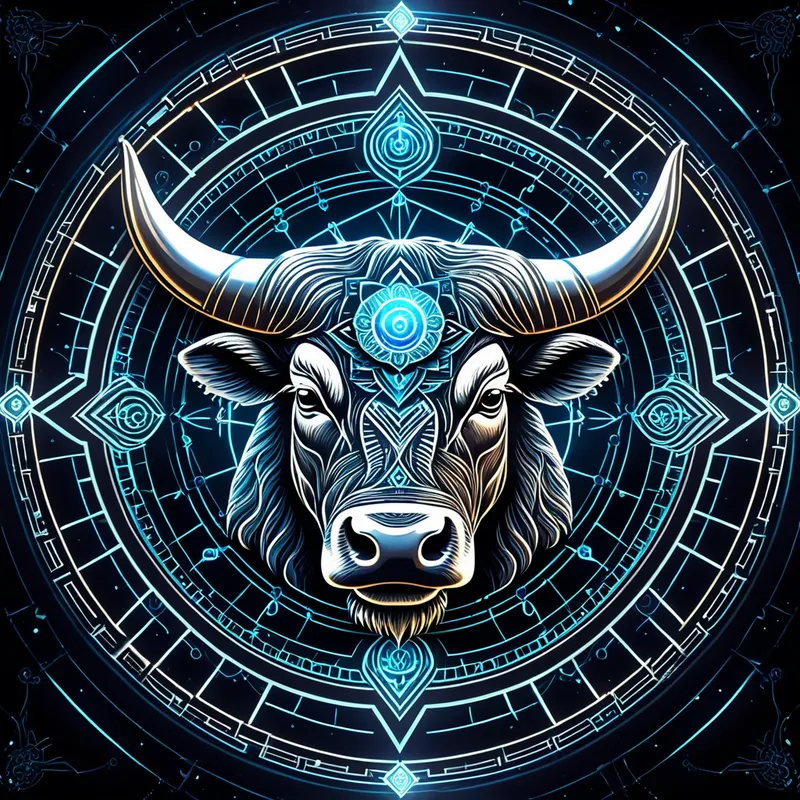
When the figure of a bull or a steadfast guardian appears in modern dreams, it often signals a profound somatic and psychological process related to thresholds. This is not the charging bull of unchecked anger, but the seated, monumental bull of Nandi.
Somatically, the dreamer may experience a feeling of grounded pressure—a weight in the legs or pelvis, a sense of being “rooted” or unable to move frivolously. This is the body resonating with the bull’s earthy, patient strength. Psychologically, the dream emerges at life’s thresholds: before a major commitment, at the beginning of a spiritual quest, or when confronting a deep, unconscious truth. The Nandi-figure in the dream assesses readiness. Its silent gaze asks the dreamer: Are you sincere? Have you mastered your baser impulses enough to proceed? Is your devotion to this new phase of life true, or is it born of fleeting desire? The dream is an encounter with the psyche’s own inner gatekeeper, the part of us that protects our deepest core from casual or harmful intrusion.

Alchemical Translation
The alchemical journey modeled by Nandi’s myth is one of transmutation through devoted orientation. The modern individual’s “Shiva” is not an external deity, but the central, transformative core of the psyche—the Self that orchestrates individuation.
The first and most crucial work is not to find the god, but to become the vehicle worthy of carrying it.
The process begins with the “Shilada phase”—a period of intense, often painful, focused longing for wholeness (the “immortal son”). This is the discipline of analysis, introspection, and confronting one’s shadows. The birth of “Nandi-as-child” is the emergence of a new psychic structure: a nascent consciousness of the Self, strong and promising.
The critical alchemical operation is the voluntary assumption of the gatekeeper’s role. This is the ego’s conscious decision to no longer reign supreme, but to orient itself entirely in service of the deeper Self. The ego’s raw power (the bull-nature) is not destroyed; it is repositioned. It becomes the strength to maintain focus, to bear the unsettling revelations of the unconscious, and to guard the sacred inner space from the trivial distractions of the persona.
The final transmutation is becoming the vahana, the vehicle. The individuated ego does not become the Self; it carries its presence into the world. It provides the grounded, earthly means through which the transcendent can be experienced and expressed. One becomes a living conduit. To sit before one’s own inner sanctum with the patience of Nandi is to achieve the ultimate alchemy: where waiting is itself the arrival, and vigilant service is perfect freedom.
Associated Symbols
Explore related symbols from the CaleaDream lexicon: