Nanahuatl the Humble Sun Myth Meaning & Symbolism
A diseased god's ultimate sacrifice ignites the Fifth Sun, revealing that true radiance is forged in humility and self-immolation.
The Tale of Nanahuatl the Humble Sun
Listen. The world was dark, and the gods were afraid.
The Fourth Sun had perished, drowned in a great flood. The heavens were a void, a silent, star-strewn cloak over a motionless earth. In the sacred city of Teotihuacan, the gods gathered in despair. A new sun was needed to set the cosmos in motion, to give life and time and purpose. But a sun requires a heart, a furnace, a being of such immense power that it could burn forever in the sky.
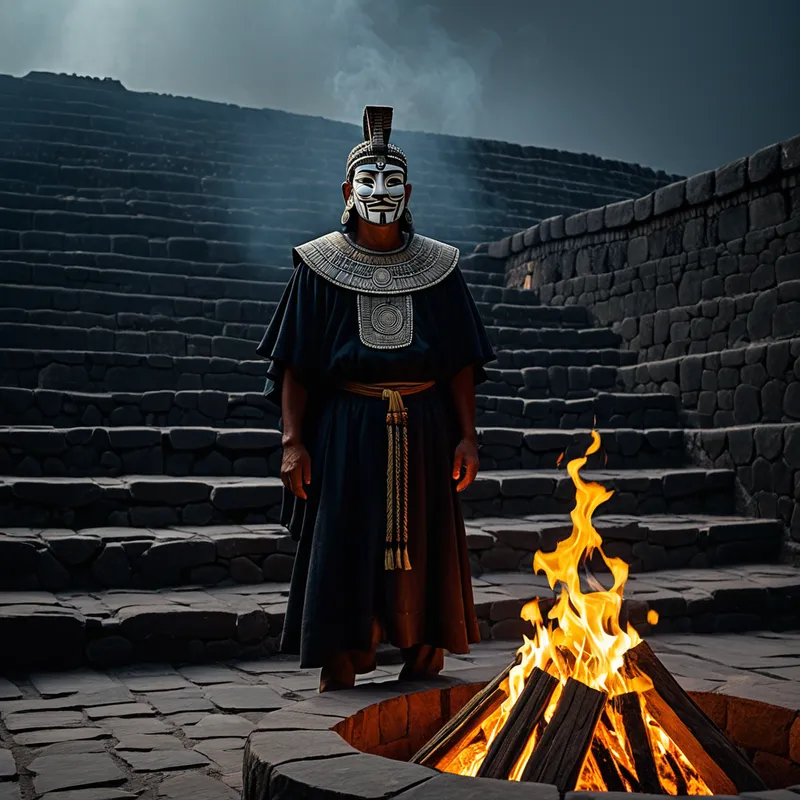
The council was called. A great, divine fire was kindled in the very heart of the plaza, a pyre that roared with primordial heat. “Who among us,” the gods asked, “will leap into this fire? Who will become the sun and give light to the new age?”
Two stepped forward.
The first was Tecuciztecatl. He was resplendent, adorned with rich quetzal feathers and gleaming jade. His pride was a visible aura. He offered precious corals and quills of gold. He was certain of his destiny, certain he was worthy of the ultimate honor.
The second was Nanahuatl. He did not step forward with pride, but with resolve. He was poor, covered in weeping sores and pustules. His offerings were not jewels, but bundles of simple reeds, his own blood drawn from scabs, and the pus from his wounds. The other gods looked upon him with pity, or disdain. He was humility incarnate, the one who carried the world’s afflictions on his skin.
The ritual began. For four nights, the gods fasted and did penance. Tecuciztecatl built his own lavish altar. Nanahuatl built his from simple grass. When the moment of immolation arrived, the gods called to Tecuciztecatl. “Now! Leap into the sacred fire!”
Tecuciztecatl approached the blazing abyss. The heat was unbearable, a wall of annihilation. His courage, built on pride, shattered. He recoiled. He tried four times, and four times he faltered, retreating from the terrifying brilliance.
Then the gods turned to Nanahuatl. “Now it is your turn.”
Without hesitation, without a glance back, Nanahuatl gathered himself. He did not strut; he simply closed his eyes, and with a final, humble acceptance of his fate, he flung himself into the very heart of the flames. The fire consumed him utterly—his diseased flesh, his humble reeds, his very essence.
Witnessing this ultimate act of courage, shame ignited a spark in Tecuciztecatl. In a frantic attempt to reclaim honor, he too finally leaped into the pyre. But he was second.
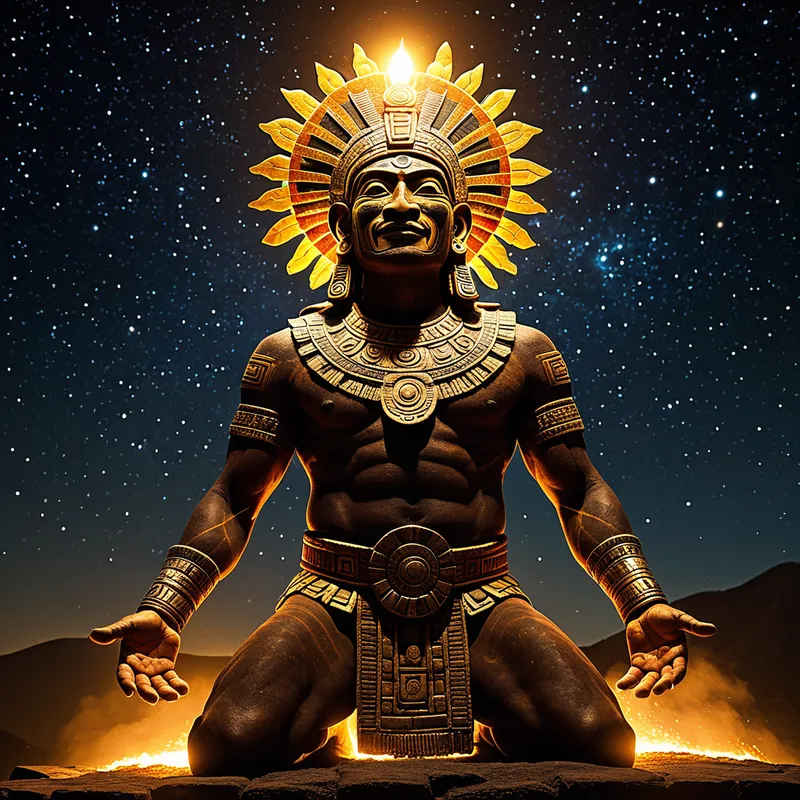
In the heavens, a miracle unfolded. From the ashes of the fire, Nanahuatl began to rise. Transfigured, he ascended into the sky as the brilliant, life-giving Tonatiuh. He was the sun, his humble wounds transformed into radiant light. A moment later, Tecuciztecatl rose after him, becoming the moon. But his light was pale, a reflection, a reminder of his hesitation.
Yet the sun hung motionless. Nanahuatl, now the sun, demanded payment. “If I am to move, to labor across the sky, I must be fed. You demanded my life. Now you must give yours.” And so, to set the cosmos in motion, the gods offered their own hearts and blood in a final, terrible sacrifice. The Humble Sun began his journey, and the age of the Fifth Sun was born, an age sustained by sacred debt and the courage of the unlikeliest of gods.
Cultural Origins & Context
This foundational myth, central to Mexica cosmology, is recorded in texts like the Florentine Codex. It was not merely a story of origins but the ideological bedrock of the Aztec world. The myth explained the nature of their universe—one born from and sustained by sacrifice (tequitl). It was recited by priests (tlamacazqui) and taught to nobles in the calmecac, instilling the core societal values: humility before duty, the supreme value of courageous action over proud status, and the understanding that life itself was a sacred energy (tonalli) paid for by death.
The setting at Teotihuacan, a city already ancient and revered by the Aztecs, grounded the myth in a real, awe-inspiring landscape. The myth functioned as a divine mandate for the practice of human sacrifice, which was seen not as cruelty but as a necessary repayment of the debt owed to Nanahuatl and the other gods who sacrificed themselves to create and sustain the world. The sun needed nourishment to continue its journey and stave off a final, eternal darkness.
Symbolic Architecture
At its core, the myth is a profound allegory of transformation through self-surrender. Nanahuatl represents the despised, wounded, and marginalized aspect of existence—the part deemed unworthy of glory. His pustules are not merely disease; they are the visible manifestation of the world’s suffering, the “shadow” material of the psyche.
The most radiant light is not born from perfection, but from the willing immolation of the wounded self.
His leap is the ultimate act of acceptance. He does not try to heal his wounds before the fire; he offers the wounds as the fuel. This inverts all conventional hierarchies of value. The proud ego (Tecuciztecatl) hesitates, for it seeks to preserve itself. The humble self, identified with its own brokenness, has nothing to lose and thus can make the total commitment. The fire is the alchemical crucible, the point of no return where old identity is annihilated so a new, transcendent function (the Sun, consciousness itself) can be born. The moon, as a pale follower, becomes the eternal symbol of the ego’s belated and derivative enlightenment.
The Dreamer's Resonance
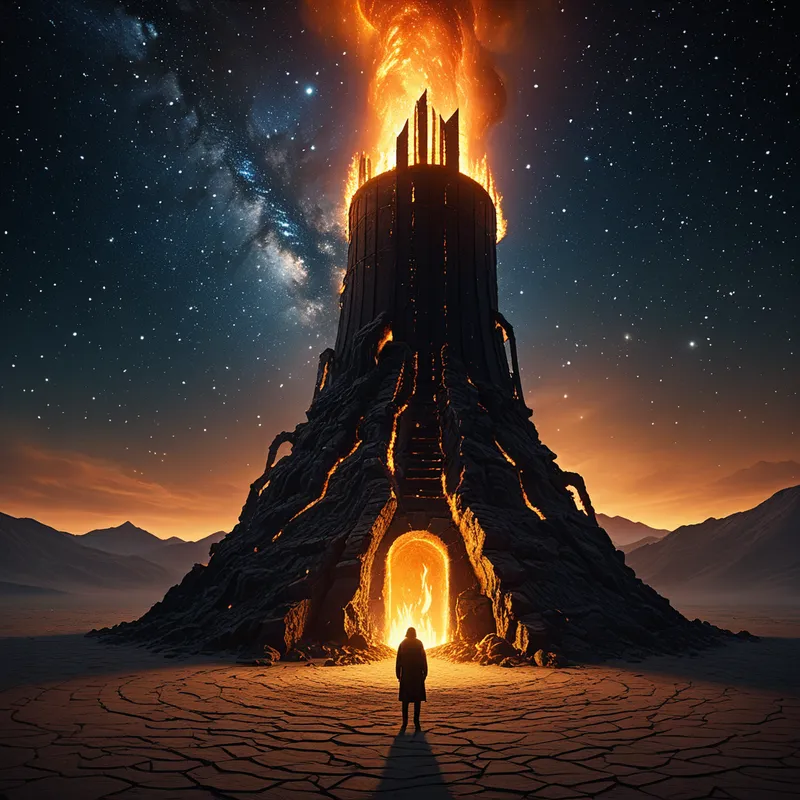
When this myth stirs in the modern unconscious, it often manifests in dreams of profound, terrifying transformation. One might dream of being covered in a shameful, visible affliction (sores, dirt, rags) while standing before a council of judging, powerful figures. Or the dreamer may find themselves at the edge of a vast furnace, volcano, or incinerator, knowing they must jump to save something precious, paralyzed by a Tecuciztecatl-like fear.
Somatically, this can correlate with feelings of intense shame, of being fundamentally flawed or “not enough.” The psychological process is the confrontation with the “shadow self”—the parts of our identity we have diseased, impoverished, and hidden. The dream is presenting the fiery choice: to continue hiding in the shame of the wounds, or to offer the entirety of the wounded self to a process of radical change. The hesitation in the dream is the ego’s last stand. The leap, if taken, often precedes a waking-life period of significant psychological death and rebirth.
Alchemical Translation
For the individual on the path of individuation, Nanahuatl’s journey is the archetypal map for psychic transmutation. The first stage is Recognizing the Humble God Within—identifying not with our polished achievements (the quetzal feathers), but with our inner Nanahuatl: our secret shames, chronic insecurities, and emotional “pustules.” These are not obstacles to wholeness; they are the prima materia, the raw substance.
The second stage is The Offering at the Pyre. This is the conscious, voluntary act of bringing that wounded material into the fire of awareness and acceptance. It is the therapy session, the heartfelt confession, the moment of brutal self-honesty where we stop hiding our poverty of spirit. We offer our reeds and pus—our imperfect truths.
Individuation demands the sacrifice of the person you were, to become the consciousness you are meant to be.
The third stage is The Immolation and Ascent. This is the non-negotiable death of the old self-concept. The “poor me” narrative, the identity built on wounding, must be consumed. What rises is not the healed version of the old self, but something entirely new: a conscious, solar principle. This is the birth of the Self, which illuminates the entire inner landscape. Finally, the myth warns that this new consciousness requires Sustenance—the ongoing “sacrifice” of egoic attachments (petty fears, prideful narratives) to keep the inner sun moving, to prevent psychic stagnation. We must continually feed the light we have become with the honesty we have learned.
Associated Symbols
Explore related symbols from the CaleaDream lexicon:
- Sun — The ultimate symbol of consciousness, life, and transcendent identity born from sacrifice; it represents the realized Self after the ego’s immolation.
- Sacrifice — The core mechanism of the myth; the voluntary giving of the self (or a part of the self) to a greater purpose, which is the only engine of true transformation.
- Fire — The alchemical crucible and agent of transmutation; it represents the transformative ordeal that annihilates the old form to release the essential energy within.
- Wound — The visible manifestation of Nanahuatl’s humility and suffering; it symbolizes the raw, unintegrated, and painful parts of the psyche that contain the seed of transformation.
- Humility — The defining quality of Nanahuatl; it is not weakness but the clear-eyed acceptance of one’s true state, which is the prerequisite for genuine courage.
- Rebirth — The fundamental outcome of the myth; the emergence of a new, higher-order existence (the Sun) from the ashes of a total self-surrender.
- Light — The product of the sacrificial combustion; it represents enlightenment, awareness, and the guiding principle that emerges from confronting darkness.
- Hero — Nanahuatl embodies this archetype not through martial strength, but through the ultimate courage of self-sacrifice for the renewal of the world.
- Shadow — Nanahuatl, in his diseased state, represents the personified shadow—the despised aspects that must be acknowledged and offered up for wholeness.
- Heart — The demanded sustenance for the sun; it symbolizes the essence of life, vitality, and the ongoing cost of maintaining consciousness and cosmic order.
- Moon — The symbol of the hesitant ego; a reflective, derivative light that follows the true source, representing incompletion and belated action.
- Pride — Embodied by Tecuciztecatl; the obstacle to transformation, as it seeks to preserve the self-image and cannot make the total commitment required.