Nana Buluku the Primordial Creator Myth Meaning & Symbolism
The story of the androgynous cosmic womb whose self-division birthed the universe and the divine twins who order reality.
The Tale of Nana Buluku the Primordial Creator
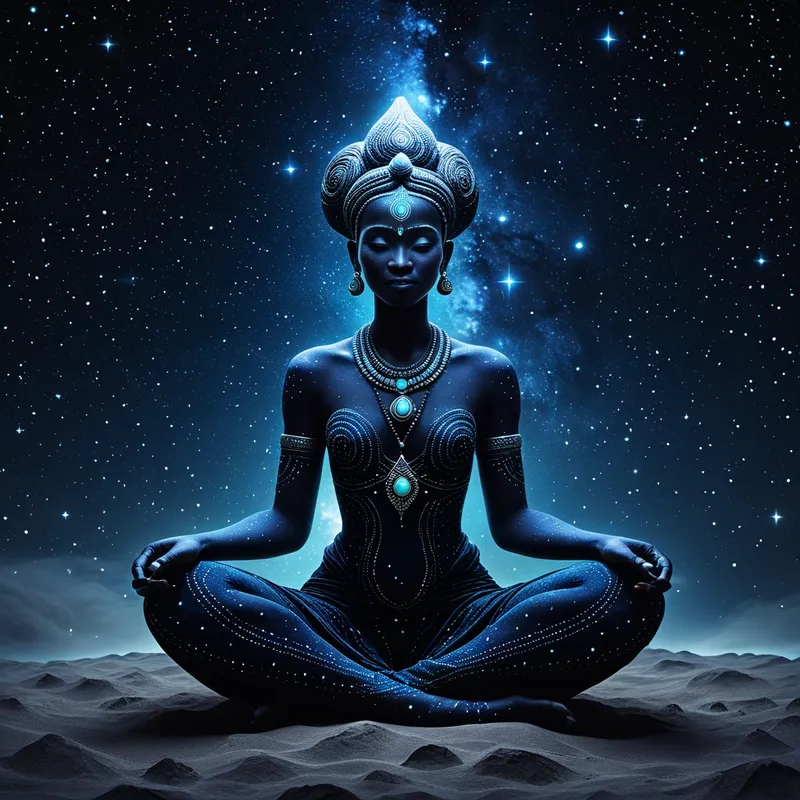
In the beginning, there was no beginning. There was no sky to arch, no earth to hold, no water to flow. There was only the great, silent hum of potential. And within that hum, within that boundless, formless dark, was Nana Buluku.
Nana Buluku was the All, and the All was Nana Buluku. Not old, for there was no time. Not vast, for there was no space to measure. Simply… Is-ness. A profound, complete unity, containing within itself the blueprint for every star, every grain of sand, every beat of every heart that would ever be. This unity was a perfect, self-sustaining circle, a cosmic womb that was also the seed.
But within the stillness of perfection, a thought stirred—not a thought of lack, but of expression. The One contemplated the possibility of Two. The silence imagined echo. The unity dreamed of relationship. And from this dreaming arose a tension, a sacred longing for manifestation.
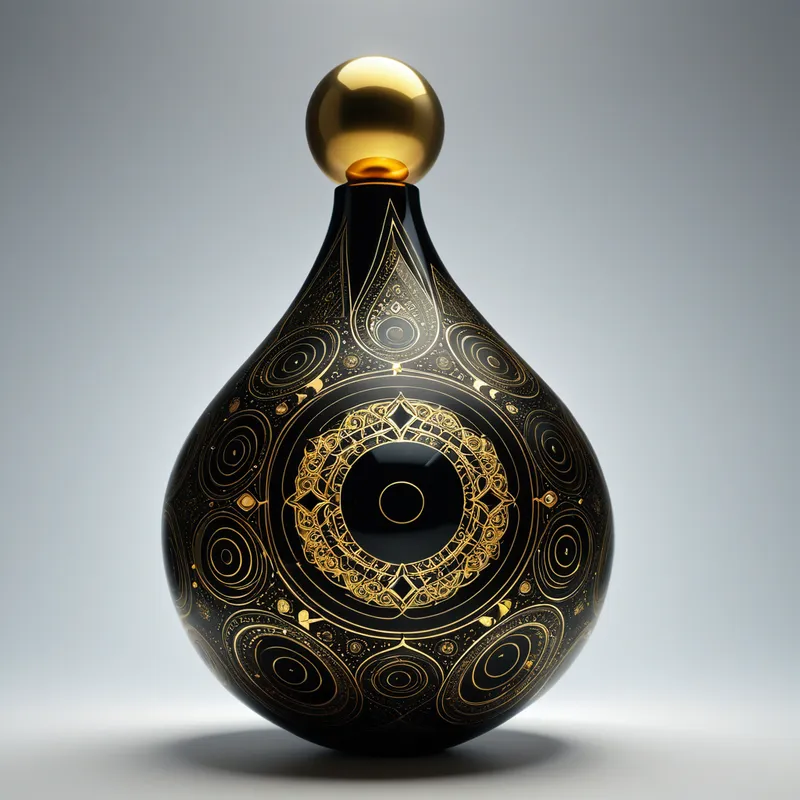
So Nana Buluku, the primordial container, performed the first and ultimate act of creation: division from within. From the core of their boundless being, they brought forth a vessel—a cosmic calabash. This was not a pot made by hands, but the very first shape of possibility itself. Into this calabash, Nana Buluku poured the essence of all-that-could-be: the swirling mists of proto-matter, the whispers of laws yet unwritten, the song of life yet unsung.
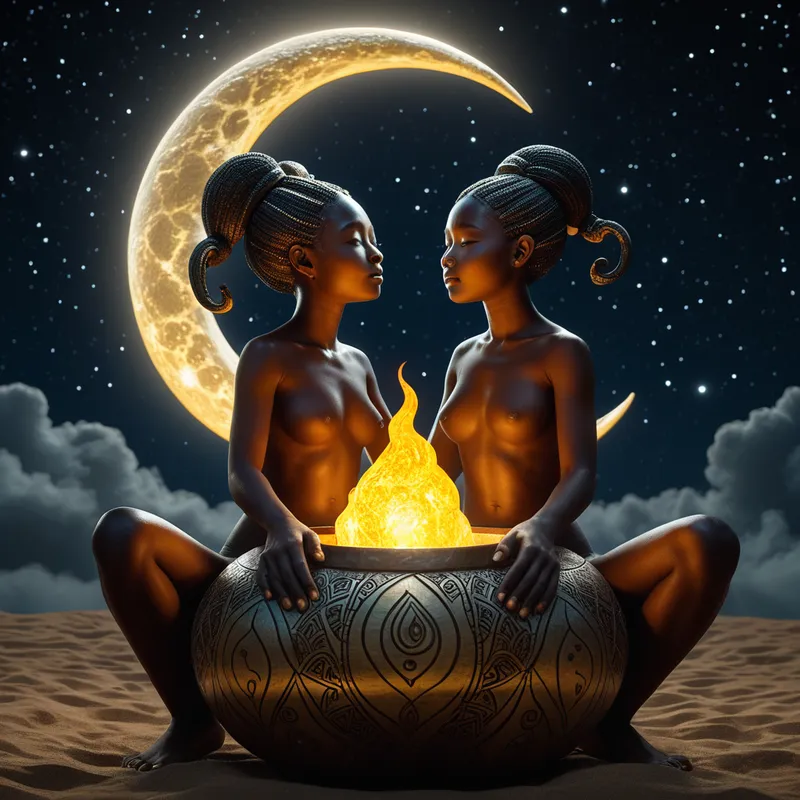
Then, with a will that was both gentle and irrevocable, Nana Buluku divided their own unity. From the calabash, from the very substance of the creator, emerged two radiant beings, twins born of a single source. First came Mawu, whose body was the soft, cool light of the moon, whose breath was the gentle night breeze. Then came Lisa, whose form blazed with the fierce, warming fire of the sun, whose gaze brought forth the sharp contours of day.
They were separate, yet forever connected, two halves of a broken whole, orbiting one another in the void. To Mawu, Nana Buluku gave dominion over the night, over rest, over the deep waters and the mysteries of growth. To Lisa, they gave dominion over the day, over action, over the fiery sky and the laws of order. Together, Mawu and Lisa reached into the calabash of their origin and began to spin the contents into being: they stretched out the sky, they packed the earth, they set the waters to flowing, and they peopled the world with spirits, animals, and finally, humanity.
Having set the universe in motion through its children, Nana Buluku receded. Not gone, but profoundly withdrawn, becoming the foundational silence beneath all noise, the unity that makes duality possible, the great-grandparent of existence who rests, complete, as the world turns under the watchful eyes of the sun and the moon.
Cultural Origins & Context
The myth of Nana Buluku originates primarily among the Fon people of Dahomey (modern-day Benin, Togo, and southwestern Nigeria), with strong resonances among the neighboring Ewe and other Gbe-speaking peoples. This is not a myth confined to parchment; it is a living cosmology breathed through oral tradition. It was and is recited by diviners, elders, and storytellers during rituals, festivals, and rites of passage.
Its societal function is foundational. It is not merely an explanation of origins but a charter for reality. It establishes the sacred order (Fa) that governs everything. By explaining the world as born from a primordial unity that intentionally divided to create complementary opposites (male/female, night/day, earth/sky), the myth provides a template for balance, reciprocity, and social harmony. It legitimizes the dual sovereignty found in traditional structures and teaches that all apparent opposites are, at their root, children of the same source.
Symbolic Architecture
The myth presents a profound symbolic map of consciousness itself. Nana Buluku represents the state of the unconscious before the birth of the ego—a state of undifferentiated wholeness where all potentials coexist without conflict. This is the psychic condition of the infant, and the deep, sought-after state of mystical union.
The first act of consciousness is not to add something, but to divide something: to separate self from other, subject from object, I from Thou.
The calabash is the archetypal vessel. It symbolizes the bounded space (the cosmos, the psyche) where the unmanifest becomes manifest. It is the crucible of creation. The act of Nana Buluku’s self-division is the primordial act of discrimination, the necessary "fall" into duality that makes experience possible. Mawu and Lisa are not just deities; they are the archetypal principles of the yin and the yang that structure perceived reality. Their ongoing dance is the dynamic tension that generates life, time, and thought.
The Dreamer's Resonance
When this myth stirs in the modern dreamscape, it often signals a profound process of psychic (re)organization. Dreaming of a vast, silent void or a containing, all-encompassing darkness may point to a regression to the Nana Buluku state—a necessary dissolution of ego boundaries to heal or reconstitute the psyche.
Dreams of twins, of complementary pairs (two suns, two moons, a balanced scale), or of a sacred vessel cracking open speak to the emergence of new conscious attitudes. The dreamer may be integrating long-opposed parts of themselves—logic and intuition, strength and compassion, activity and rest. The somatic experience can be one of deep, oceanic calm giving way to the energizing tension of a new polarity being born. It is the dream of the psyche preparing to give birth to a more complex, more capable Self.
Alchemical Translation
For the individual, the myth of Nana Buluku models the entire arc of individuation. We all begin in a state of unconscious unity with the world (the maternal/parental cosmos). The journey to adulthood is the first great division: the creation of the ego (Lisa, the conscious, solar principle) from the unconscious (Mawu, the lunar, relational matrix).
The goal is not to return to the undifferentiated womb, but to consciously remember the unity that precedes and makes possible our fruitful divisions.
The alchemical work, however, lies in the later stages. After a life often spent identified with one pole (the striving sun or the accommodating moon), the task is to consciously re-member the twins. This is the coniunctio oppositorum—the sacred marriage within. One must discover the Lisa within one's Mawu-like qualities, and the Mawu within one's Lisa-like drives. By holding these inner opposites in conscious tension, the individual recreates the calabash on a personal level: they become a vessel that can contain the whole of their being. In doing so, they do not become Nana Buluku, but they touch that primordial ground of being within themselves, achieving a hard-won wholeness that honors both unity and diversity, silence and song.
Associated Symbols
Explore related symbols from the CaleaDream lexicon:
- Creator — The ultimate source and first cause, representing the archetypal force of bringing something from nothing, the primal will to manifest.
- Primordial Chaos — The formless, potential-filled state before creation, symbolized by the silent hum of Nana Buluku's existence prior to division.
- Circle — The symbol of Nana Buluku's original, perfect unity, wholeness, and self-containment, from which all duality emerges.
- Calabash — The sacred vessel that contains the universe, representing the womb, the cosmos, and the bounded space where potential takes form.
- Moon — The celestial body of Mawu, symbolizing the feminine, receptive, cool, intuitive, and mysterious aspects of creation.
- Sun — The celestial body of Lisa, symbolizing the masculine, active, hot, logical, and ordering aspects of creation.
- Twins — Mawu and Lisa as the divine pair, representing the fundamental duality (male/female, night/day) that structures reality and creates dynamic balance.
- Water — The element associated with Mawu, the night, and the primordial waters of creation contained within the cosmic calabash.
- Fire — The element associated with Lisa, the sun, and the active, shaping energy that forges the world from potential.
- Order — The divine law (Fa) established by the complementary rule of Mawu and Lisa, representing the cosmic and psychic structure born from unity.
- Mother — The nurturing, generative aspect of the cosmos embodied by Mawu and the original containing nature of Nana Buluku.
- Father — The authorizing, shaping aspect of the cosmos embodied by Lisa, who brings definition and law.