Namorrodor the Night Spirit Myth Meaning & Symbolism
A terrifying spirit from the Kimberley, Namorrodor hunts the living at night, embodying the primal fear that must be faced to restore cosmic and psychic order.
The Tale of Namorrodor the Night Spirit
Listen. In the time when the world was soft, when the Dreaming still breathed close to the earth, there walked a terror in the night. Not from the east, where the sun is born, nor from the south where the cold winds sleep. This terror came from the west, from the place of the setting sun and the gathering dark. Its name was Namorrodor.
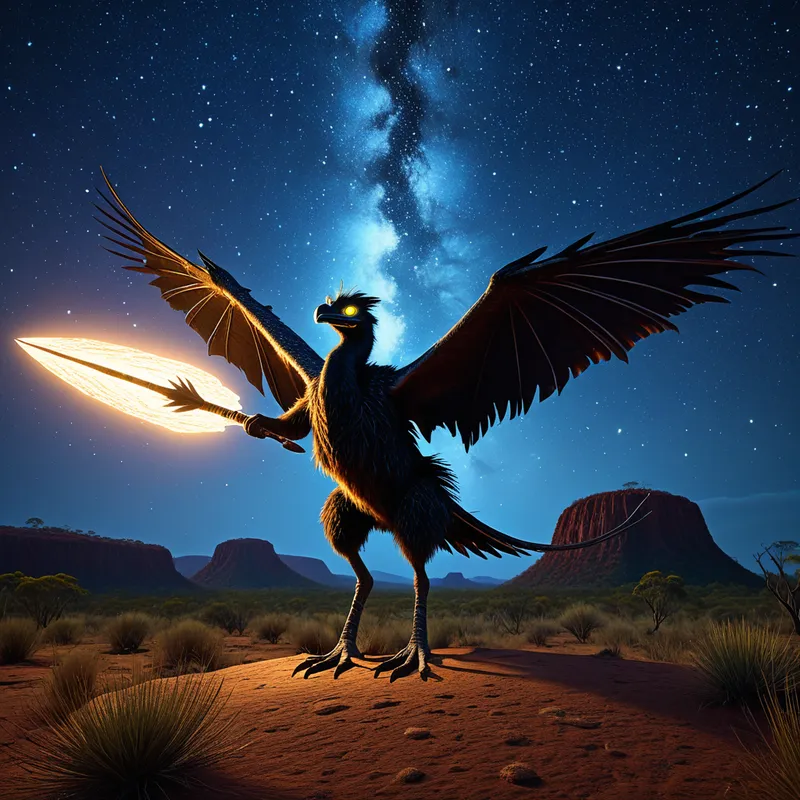
He was a spirit of the between-places, a shape that defied the day. His body was like the great flightless emu, but twisted, striding on monstrous legs. From his shoulders sprang the vast, leathern wings of the bat, blotting out the star-paths. His head was a horror—a long, spear-tipped beak that could pierce a man’s heart, and eyes that burned with a cold, hungry light. He lived in the hollows of ancient, gnarled trees, in the deep crevices of stone country, places the sunlight never touched.
When the last ember of twilight died and true night fell, Namorrodor would stir. He would unfold from his lair and take to the black sky, a silent shadow against the Milky Way. His hunt began not for meat, but for the very breath of life. He sought the living, the warm and the breathing, those who strayed from the safety of the campfire and the sacred law. His cry was not a sound for ears alone; it was a vibration in the bone, a chill that started in the soul—a long, piercing shriek that froze the blood.
The people knew. They banked their fires high. They kept their children close. They sang the old songs that tied them to their country, for the law was a shield. But sometimes, a hunter, proud or lost, would wander too far. Sometimes, a traveler would be caught between camps as darkness fell. For them, the world shrank to the pounding of their own heart, the scrape of a twig in the dark, and then… the shape against the stars. Namorrodor would descend, a vortex of night and fear. His spear-beak struck swift and true, not to feed, but to kill. To extinguish the light of a life and leave a cold shell for the dawn to find.
This was the balance of that ancient time: the nourishing sun of Wuriupranili, the life-giving waters of the Rainbow Serpent, and the ever-present threat of Namorrodor, the necessary shadow. He was the consequence of chaos, the price of forgetting the way. The myth does not tell of a hero who slew him, for he cannot be slain. It tells of vigilance, of community, of holding fast to the fire and the law. Namorrodor is the night itself—a power that must be respected, contained by ritual and remembrance, lest it consume the world.
Cultural Origins & Context
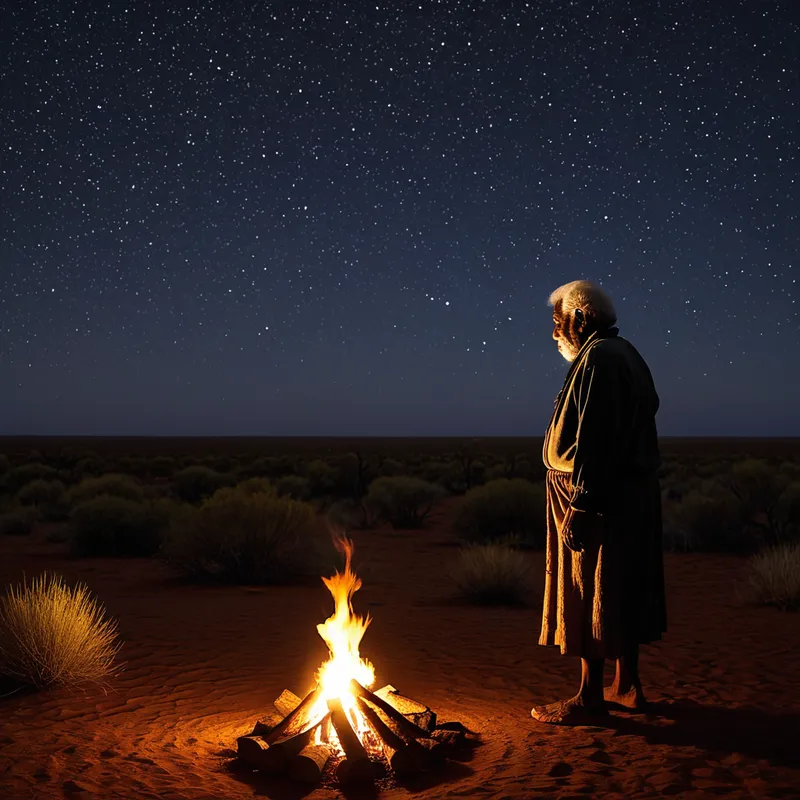
The myth of Namorrodor originates from the Aboriginal peoples of the Kimberley region in north-western Australia, a land of ancient, rugged beauty. It belongs to the vast, interwoven tapestry of the Dreaming or Alcheringa. Unlike European fairy tales told for entertainment, this story is a vital piece of living law. It was and is transmitted orally by elders, not as a simple spooky story, but as profound instruction.
Its primary function was pedagogical and sociological. For the young, it was a potent, memorable lesson in safety and obedience: stay close to camp after dark, respect the boundaries of your country, heed the wisdom of your elders. On a deeper level, it reinforced the sacred order of the cosmos. The world is not benign; it contains inherent dangers that are kept at bay only through adherence to ritual, kinship obligations, and correct relationship with country. Namorrodor represents the chaos that exists beyond the perimeter of maintained cultural and spiritual order. The story was likely told at specific times, perhaps as dusk fell, making the lesson immediate and visceral, binding the community together against the symbolic and very real dangers of the night.
Symbolic Architecture
Namorrodor is the archetypal Shadow made manifest. He is not evil in a moralistic sense, but a primal, amoral force of negation. He exists outside the hearth, the tribe, the known world. Symbolically, he represents every unintegrated fear, every consequence of breaking taboo, and the ultimate, impersonal reality of death that underpins life.
The Night Spirit is the psychological truth that what we refuse to acknowledge in ourselves will eventually hunt us in the dark of our own unconscious.
His form is a terrifying amalgamation: the earth-bound emu and the nocturnal bat. This symbolizes a perversion of natural order—a creature that belongs to neither realm fully, and is thus monstrous in both. His spear-beak is phallic and deadly, a symbol of violent, penetrating insight that kills rather than enlightens. He does not eat his victims; he simply ends them. This speaks to a fear not of consumption, but of annihilation, of being rendered spiritually null, disconnected from the continuum of life and lore.
The Dreamer's Resonance
When the pattern of Namorrodor stirs in the modern psyche, it often manifests in dreams of being stalked by a formless, terrifying presence. The dreamer may be alone in a vast, dark landscape, hearing a haunting cry, or feel an overwhelming dread of something approaching just outside their field of vision. This is not merely a replay of anxiety; it is a somatic encounter with the personal and collective shadow.
The psychological process underway is one of confrontation with a repressed content—a guilt, a shame, a rage, or a profound fear—that has grown large in the darkness of neglect. The chilling cry of Namorrodor is the sound of that content demanding recognition. The dream is an initiatory space where the ego, like the hunter alone in the bush, must face what it has been fleeing. The terror is real, but within the dream-logic, it is also the necessary catalyst. To integrate the shadow is not to befriend the monster, but to stop running, to turn and see its shape, and in doing so, reclaim the psychic territory it has occupied.
Alchemical Translation
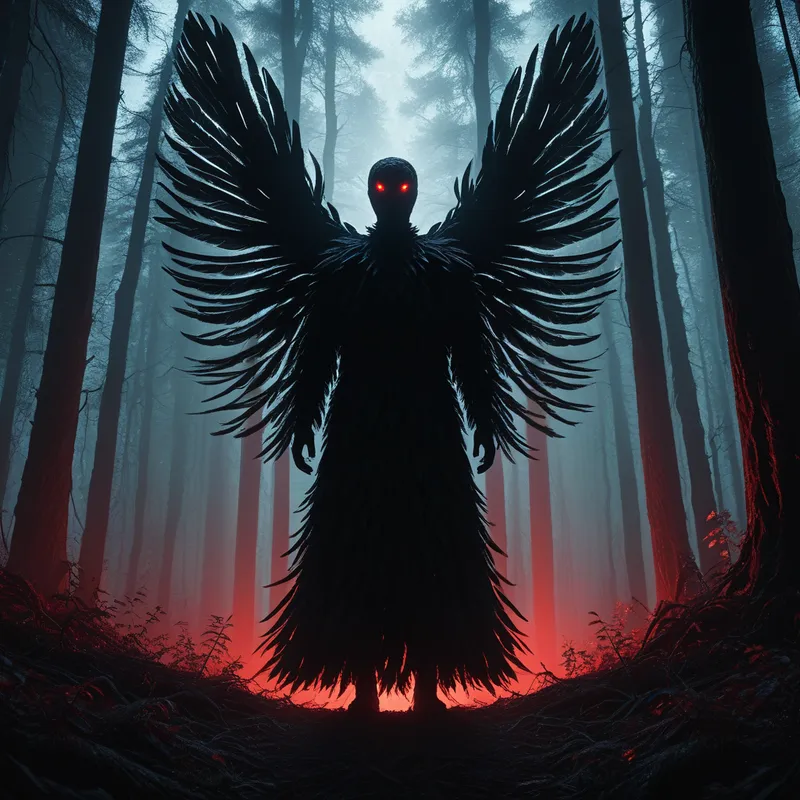
The myth models the alchemical stage of nigredo, the blackening, the descent into the darkest material of the soul. For the modern individual on the path of individuation, the journey is not to find and kill Namorrodor, but to perform the cultural function of the elders: to build the sacred fire of consciousness and establish the lawful boundaries of the self.
The triumph is not in the hero's victory over the beast, but in the community's sustained ritual of remembrance that keeps the terror at bay—translated inwardly as the ego's consistent, conscious relationship with the unconscious.
The "campfire" is the light of sustained self-reflection, therapy, art, or spiritual practice. The "songs" are the personal myths and values we live by. The "law" is the integrity of our own being. Namorrodor attacks when one is "between camps"—in a state of psychic disorientation, alienation from one's values, or spiritual neglect. The alchemical work is to heed the warning cry of anxiety or depression, to return to one's inner fire, and to face the dark with the tools of consciousness. In this confrontation, the annihilating force is transmuted. It becomes a known quantity, a respected power whose territory we learn to navigate, not a sovereign that rules us through fear. The night remains, but we learn to carry our own light within it.
Associated Symbols
Explore related symbols from the CaleaDream lexicon:
- Night — The primary domain of Namorrodor, representing the unconscious, the unknown, and the field where repressed contents become active and threatening.
- Fear — The essential emotion evoked by the Night Spirit, symbolizing the raw, somatic response to the shadow and the catalyst for psychological awakening or paralysis.
- Shadow — Namorrodor is the mythic personification of the Jungian Shadow, the totality of the unknown or rejected aspects of the personality that dwell in psychic darkness.
- Spirit — Namorrodor exists as a malevolent spirit, reflecting the belief in non-corporeal forces that interact with the human world, embodying specific principles or dangers.
- Death — The Spirit’s ultimate action and purpose, representing not just physical cessation but the psychic death of ignorance, or the threat of annihilation for the unintegrated self.
- Journey — The nocturnal wanderings of both the Spirit and its potential victims mirror the perilous inner journey into the unconscious territories of the self.
- Order — The cultural laws and rituals that protect the community from Namorrodor symbolize the psychic order and conscious structure needed to contain chaos.
- Dream — As a being of the Dreaming, Namorrodor operates in the mythic dimension that is the source of all law and story, parallel to the personal dreaming where our shadows manifest.
- Root — Namorrodor’s connection to ancient trees and stone country signifies his emergence from the deepest, most archaic layers of the psyche and the cultural landscape.
- Original — The Spirit belongs to the original time of the Dreaming, representing a primordial, foundational pattern of fear and confrontation that is built into the human experience.