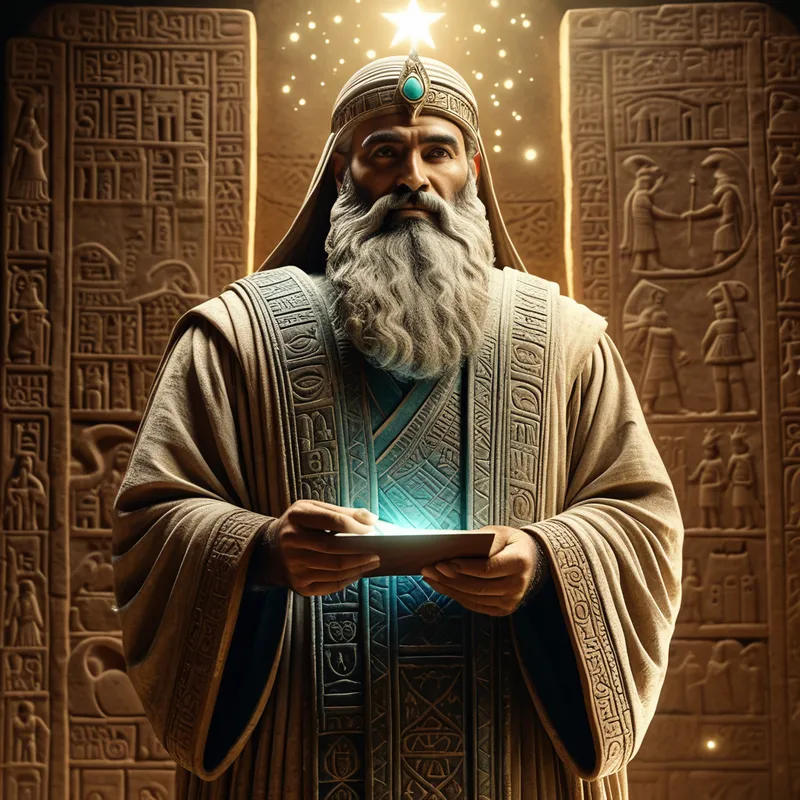
Nabu Myth Meaning & Symbolism
The story of Nabu, divine scribe, who inscribes the fates and grants humanity the power to write its own destiny through wisdom and sacred knowledge.
The Tale of Nabu
Listen. Before the clamor of empires, in the breath between the twin rivers, there was a silence that awaited a word. In the high halls of Esharra, where the air hummed with the power of decrees yet unspoken, a son was born not of battle-cry, but of a thought. His name was Nabu.
He did not enter the world with a thunderclap, but with the soft, decisive scratch of a stylus tip finding clay. While his father, the great Marduk, shaped the mountains and channeled the waters, Nabu’s realm was the tablet of the world itself. His playground was the <abbr title="The Mesopotamian "Tablet of Destinies," a divine artifact granting authority over the cosmic order.">Tuppi Shimati, the sacred ledger where the fates of gods and mortals were recorded. His fingers, long and precise, knew the weight of the destiny-stylus. His eyes did not see armies or harvests, but the intricate, wedge-shaped poetry of cause and effect being etched into the fabric of reality.
Each year, as the season turned, a great procession stirred in the holy city of Borsippa. The air, thick with the scent of cedar incense and baking earth, grew charged. The statue of Nabu was placed upon his ceremonial barge, and the journey began—a slow, solemn voyage up the canal to Babylon. The people lined the banks, not cheering, but watching in hushed reverence. They were not witnessing a parade, but a celestial mechanism clicking into place. Nabu was traveling to the Esagila, the axis of the world.
Inside the innermost sanctuary, away from all mortal eyes, father and son met. Marduk, the king, sat upon the dais of the world. Nabu, the scribe, stood before him with his tablet. This was the moment of renewal. The old year, its deeds and destinies fully inscribed, was a completed scroll. The new year was a blank, damp slab of celestial clay. And as the cosmic balance hung in the stillness, Nabu would lift his stylus. He would not merely write what was to be; he would inscribe what must be to maintain Ma’at, the divine order. The scratch of the stylus was the sound of time itself beginning anew. With each wedge pressed into the tablet, a king’s reign was secured, a river’s path was set, a child’s first breath was allotted. He wrote the law of stars and the fate of worms. And when the tablet was complete, placed before Marduk for his seal, the universe exhaled and moved forward, bound by the graceful, unassailable logic of the written word.
Cultural Origins & Context
The worship of Nabu flourished most powerfully during the first millennium BCE, particularly within the Neo-Assyrian and Neo-Babylonian empires. While his origins may be older and possibly West Semitic, he was comprehensively integrated into the Babylonian pantheon as the firstborn son and vizier of Marduk, the national god. This was not merely a familial detail but a profound theological and political statement. Babylon’s supremacy was mirrored in the heavens: Marduk was the sovereign, and Nabu, as his scribe and minister, was the executor of his divine will.
His primary cult center was the Ezida temple in Borsippa, a city so closely associated with him it was often called "his beloved city." The annual Akitu festival, where his statue journeyed to Babylon, was the heartbeat of the imperial religious calendar. This ritual re-enacted the mythic moment of destiny’s decree, reinforcing the king’s legitimacy (as the recipient of a favorable destiny) and the stability of the cosmos.
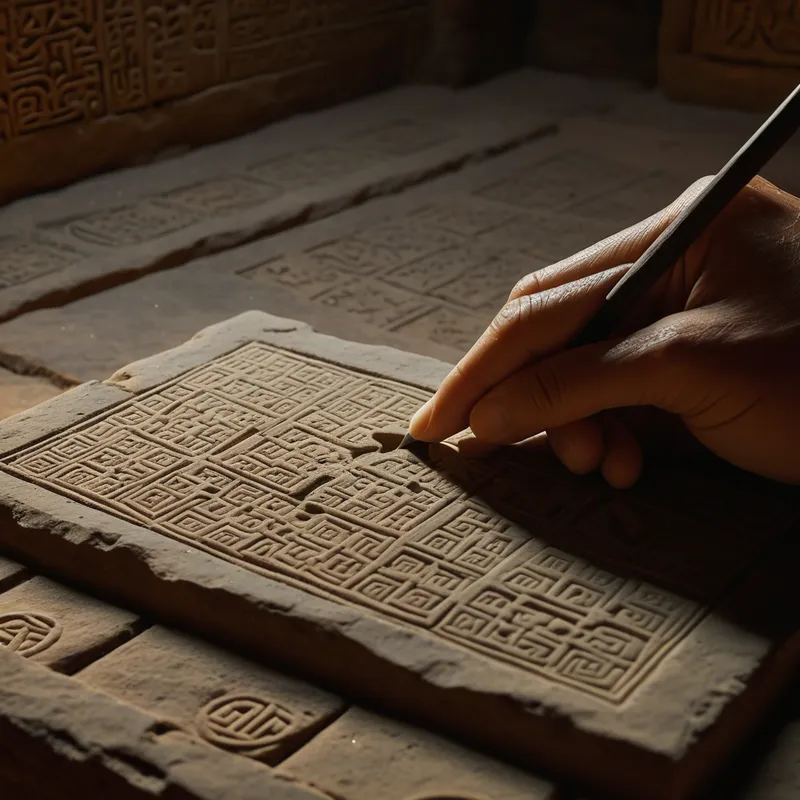
Nabu was the patron of the tupšarru, the scribes. In a civilization built on administration, law, literature, and astronomy—all recorded in cuneiform on clay tablets—the scribe was the essential linchpin. To invoke Nabu was to invoke the very principle that lifted human society from chaos to order: the recorded word. His myth was not just told in stories; it was performed in every act of writing, in every school where young students painstakingly copied signs, and in every temple archive where the records of the gods and the kingdom were kept.
Symbolic Architecture
Nabu represents the archetypal principle of the Logos—not merely as "word," but as the structured, intelligible pattern that underlies reality. He is the divine intellect that translates chaotic potential into coherent form. His symbols—the stylus and the clay tablet—are tools of incarnation. The stylus is the active, masculine principle of will and distinction; the tablet is the receptive, feminine principle of substance and possibility. Together, they birth destiny.
To inscribe is to make the invisible visible, to give boundary to the boundless. The act of writing is an act of creation, and thus, of limitation—which is the prerequisite for existence.
He is not the source of raw power (that is Marduk’s domain), but the channel through which power is directed and made manifest according to a plan. Psychologically, Nabu symbolizes the conscious ego in its highest function: not as the tyrannical ruler of the psyche, but as the faithful scribe of the Self. His task is to listen to the deeper, often inchoate directives from the central authority (the unconscious Self, or Marduk) and to carefully, accurately record them into the "tablet" of one’s lived experience and conscious understanding.
The <abbr title="The Mesopotamian "Tablet of Destinies," a divine artifact granting authority over the cosmic order.">Tuppi Shimati is thus the ultimate symbol of cosmic and personal law. It is not a prison of predestination, but a living document. The annual renewal signifies that fate is not static; it is a story being written in installments, responsive to the actions and worth of the world and the individual.
The Dreamer's Resonance
When the archetype of Nabu stirs in the modern unconscious, it often manifests in dreams of writing, lists, codes, or sacred books. One might dream of frantically trying to inscribe a message on a melting tablet, of discovering a journal with one’s own life story written in an unknown language, or of being handed a stylus of immense weight and significance.
These dreams point to a critical psychological process: the ego’s struggle to articulate the Self. The dreamer is at a threshold where unconscious contents—intuitions, callings, fragments of a deeper identity—are pressing for recognition and formulation. The anxiety of the "melting tablet" reflects the fear that this nascent self-knowledge will be lost before it can be made conscious. The "unknown language" signifies the foreign, archetypal nature of the material emerging from the depths.
Somatically, this can feel like a pressure in the head or hands, a compulsion to literally write or create, or a sense of mental "fullness" that seeks release. The psyche is in its scribal phase, attempting to take dictation from the inner sovereign. The process is one of focused attention and patient translation, moving from the somatic and imaginal into the realm of clear, communicable form.

Alchemical Translation
The alchemical journey modeled by Nabu is the transmutation of raw experience into conscious wisdom. It is the opus of the sage. The prima materia—the chaotic flood of life events, emotions, and unconscious drives—is the formless clay. The disciplined, observing mind is the stylus.
The first stage is Mortificatio: the humbling of the ego. One must cease trying to be the author (Marduk) and accept the role of the scribe. This means surrendering the illusion of total control and instead developing the capacity to listen, to observe, to record without immediate judgment.
The second stage is Coniunctio: the sacred marriage of the stylus (conscious intellect) and the tablet (the soul’s substance). This is the act of committed practice—journaling, therapy, artistic creation, or any discipline where inner truth is given outer form. Each honest inscription is a fusion.
The goal is not to write a perfect, immutable fate. It is to become so skilled in the art of inscription that you can participate in the annual renewal of your own soul, editing the old text and beginning the new with wiser hands.
The final stage is the creation of your own <abbr title="The Mesopotamian "Tablet of Destinies," a divine artifact granting authority over the cosmic order.">Tuppi Shimati. This is the living document of your individuation—not a rigid life plan, but a dynamic, personal code of meaning. It is the accumulated wisdom, the "tablet" of values, insights, and hard-won truths that guides your choices. You become, like Nabu, the steward of your destiny. You hold the stylus. The clay is your life. And the authority to inscribe comes from the deep, silent consultation with the divine within.
Associated Symbols
Explore related symbols from the CaleaDream lexicon: