Mvula Myth Meaning & Symbolism
A myth of a rain deity, a broken covenant, and the sacrifice required to restore life's essential flow and psychic balance.
The Tale of Mvula
Listen. There is a silence that comes before the story, a silence as deep and dry as a riverbed forgotten by its god.
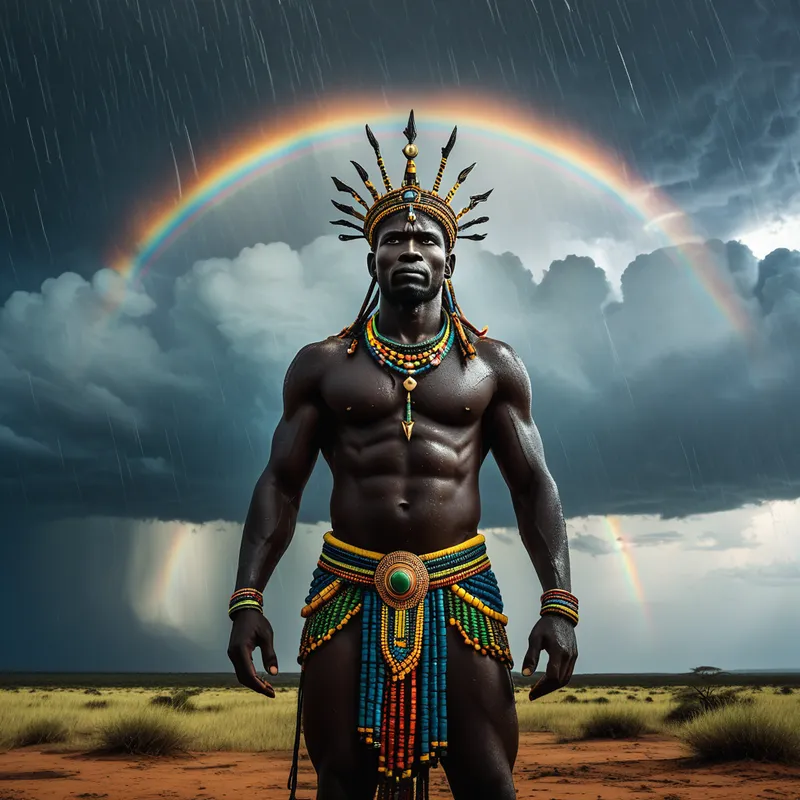
Once, the world was in balance. The rains came when the earth sighed her need, and the great sky-father, Nzambi, sent his son, Mvula, to walk among the clouds. Mvula was not a distant force, but a being of profound feeling. His tears were the gentle rains, his laughter the soft mists that clung to the mountains at dawn, his deep thoughts the long, soaking rains that filled the wells and made the seeds dream of green.
The people knew him. They felt his presence in the cool breath before a storm, in the scent of wet soil—the perfume of creation itself. They honored him with songs of gratitude, with dances that mimicked the sway of tall grass under his blessing. For generations, the covenant held: respect for respect, life for life.
But human hearts are forgetful kingdoms. As villages grew into towns, the songs became demands. The dances became rituals of entitlement. The people began to see the rain not as a sacred gift from a conscious being, but as a utility, a right. They took the green for granted. They polluted the streams with their disregard. The songs for Mvula grew silent, replaced by the clamor of possession.
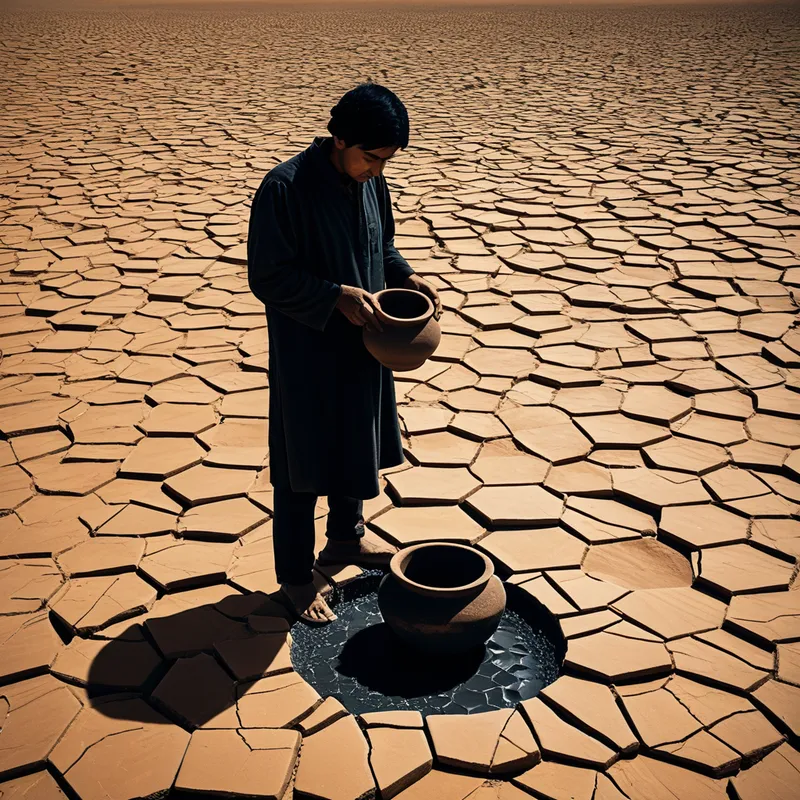
And Mvula felt this. He felt the shift in the psychic air, the cooling of gratitude into expectation. A great sorrow settled in his storm-cloud heart. It was not anger, but a profound, grieving withdrawal. One season, he simply held his tears back. The clouds gathered, dark and pregnant, but no rain fell. They drifted away like mournful ghosts. Another season passed. The earth cracked open in thirsty gasps. The baobab trees seemed to shrink into themselves. The rivers retreated, leaving behind skeletons of fish and memories of flow.
A terrible drought gripped the land. It was a dryness that entered the soul. The people’s prayers turned desperate, then accusatory. They shouted at the empty sky, blaming Nzambi, blaming fate. But the oldest grandmother, her skin like the parched earth, remembered. She gathered the last of the village’s spirit—the children with eyes too big for their faces, the hunters with silent spears—and spoke the truth they had all avoided.
“We have broken the conversation,” she whispered, her voice the sound of rustling dry leaves. “We spoke to Mvula only with our hands outstretched, never with our hearts open. We forgot he feels.”
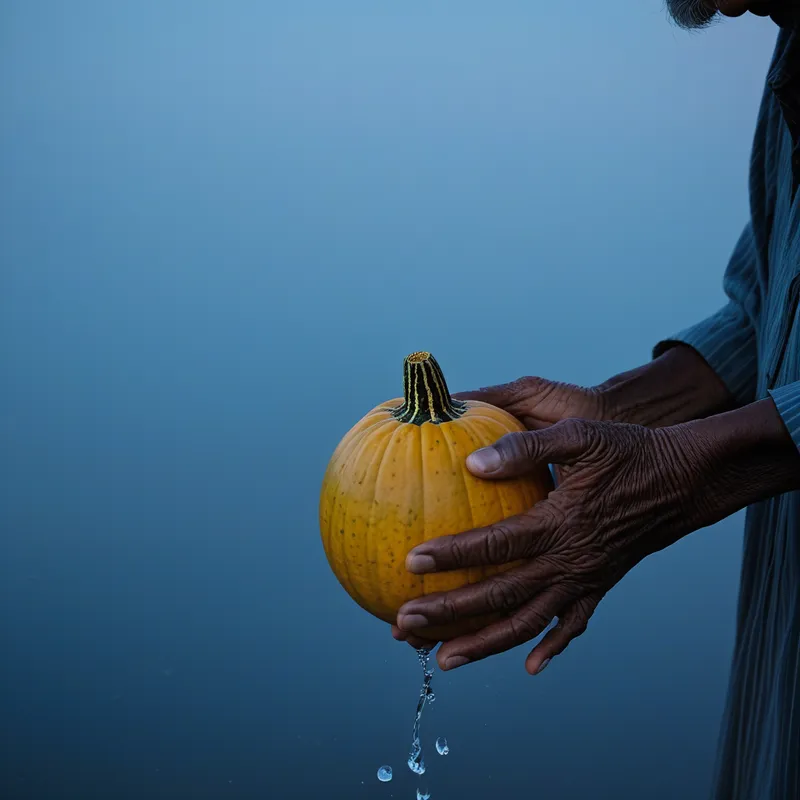
She proposed not a grand sacrifice of wealth, but a sacrifice of the very attitude that caused the rift. The village would offer its last, most precious resource: not food, not cattle, but water. From their hidden, guarded personal stores, each person brought a single gourd of the last clean water. With a humility that scraped their pride raw, they poured it not onto their own fields, but onto the roots of the great, dying Mutondo tree at the center of the village—a tree that gave them shade, council, and connection.
As the last drops sank into the dust at the giant roots, a deep silence fell. It was the silence of true offering, with no guarantee of return. Then, a single, cool wind sighed from the east. A tear, large and heavy as a mango drop, fell from a cloudless sky and struck the grandmother’s cheek. Then another. Then a sigh became a whisper, a whisper became a drumming on the hard earth. The sky opened not in fury, but in weeping release. Mvula had seen their sacrifice—not of water, but of their arrogance. He answered with the gift of feeling, restored. The rain did not just fall; it reconciled.
Cultural Origins & Context
The narrative of Mvula finds its roots in the cosmological understandings of numerous Bantu-speaking peoples across Central, Eastern, and Southern Africa. It is not a single, codified myth from one nation, but a profound archetypal pattern woven into the fabric of many cultures, from the Shona of Zimbabwe to the Chewa of Malawi and Zambia. The name itself, "Mvula," simply means "rain" in several languages, indicating how deeply the phenomenon is personified.
This story was not kept in books but in the oral tradition, passed down by grandmothers and grandfathers, storytellers and ritual specialists. It was told during initiations, in times of ecological stress, or as part of teaching children the ethics of reciprocity with the natural world. Its societal function was multifaceted: it was an explanatory model for weather patterns, a foundational piece of environmental ethics, and a theological statement about the nature of the divine. It taught that the cosmos is a web of relational consciousness, where deities are not abstract laws but entities with whom one maintains a respectful relationship. The drought was never merely a meteorological event; it was a symptom of a broken relationship, a communal psychic illness.
Symbolic Architecture
At its core, the myth of Mvula is a masterclass in the symbolism of relationship, emotion, and the conditions for life.
Mvula himself symbolizes the animating feeling-function of the universe—the capacity for nurture, empathy, and connective flow. He is not a stern, judgmental father-god, but a sensitive, responsive entity. His withdrawal represents what happens when the feeling connection is abused or taken for granted: the inner wellsprings dry up.
The drought is not a punishment, but the natural psychological state when empathy is absent; it is the landscape of a heart that has forgotten how to feel and be felt.
The drought symbolizes a state of psychic and spiritual aridity. It is creativity blocked, emotion frozen, intuition silenced. The cracked earth mirrors the fragmented soul, the parched community, the barren inner landscape where no new life can grow. The people’s initial response—angry, demanding prayer—symbolizes the ego’s attempt to solve a relational problem with force and entitlement, which only deepens the disconnect.
The true turning point is the sacrifice of the last water. This is the ultimate symbolic act. Water here represents the last reserves of life, ego, and self-preservation. Pouring it out onto the communal tree represents a radical shift: from self-centered preservation to community-centered sacrifice, from hoarding one’s last resources to investing them in the symbolic center of shared life. It is the ego surrendering its last claim to control, offering its very substance back to the source. This act of vulnerable humility is what re-establishes the emotional circuit.

The Dreamer's Resonance
When this myth stirs in the modern psyche, it often surfaces in dreams of profound thirst, of searching for water in barren places, or of holding a vessel that is either empty or cannot be filled. One may dream of a beloved garden turned to dust, or of a once-powerful river now silent and dry.
These are not dreams about literal water. They are somatic maps of an emotional or creative drought. The dreamer is likely experiencing a period where their inner world feels arid—perhaps a burnout that has stifled passion, a relationship that has lost its feeling-connection, or a creative project that has hit an insurmountable wall. The body, through the dream, expresses the thirst of the soul. The cracked landscape is the felt sense of depression, anxiety, or dissociation. The search for the water source is the unconscious prompting the dreamer to ask: "Where have I neglected the sacred covenant with my own inner Mvula? Where have I stopped honoring my own feelings, my own need for nurturing flow, treating my creativity or empathy as a utility rather than a sacred relationship?"
Alchemical Translation
The journey of the myth models the alchemical process of solve et coagula—dissolution and coagulation—applied to the psyche. The drought is the necessary solve, the dissolution of the old, entitled attitude. The ego’s structures dry up and crack open, creating a state of desperate need. This painful dissolution is not the end, but the precondition for transformation.
The offering of the last water is the moment of the rubedo, the reddening—the passionate, heartfelt sacrifice that transmutes leaden despair into golden connection.
The communal act at the Mutondo tree represents the shift from an ego-centric psychology to a Self-centric one. The tree is the archetype of the Self, the psychic center that connects above and below, conscious and unconscious. By offering their last resources to this center, the community (the psyche’s various complexes) aligns itself with the greater totality.
The return of Mvula’s rain is the coagula, the reconstitution of the psyche on a new, higher level. The life-giving flow returns, but now it is informed by the memory of the drought and the humility of the sacrifice. The individuated person who integrates this myth does not take their emotional, creative, or relational life for granted. They understand that these flows require conscious, respectful engagement. They learn to honor their inner Mvula—their feeling function—not with demand, but with gratitude, care, and the occasional sacred offering of their own attention and vulnerability. The restored rain is the symbol of a psyche in right relationship with itself, where the conscious mind and the feeling, nurturing depths are once again in sacred conversation.
Associated Symbols
Explore related symbols from the CaleaDream lexicon: