Music Box from The Nutcracker Myth Meaning & Symbolism
A clockmaker's enchanted music box holds the key to breaking a curse, guiding a hero through a dream-battle to reclaim his true, noble form.
The Tale of the Music Box from The Nutcracker
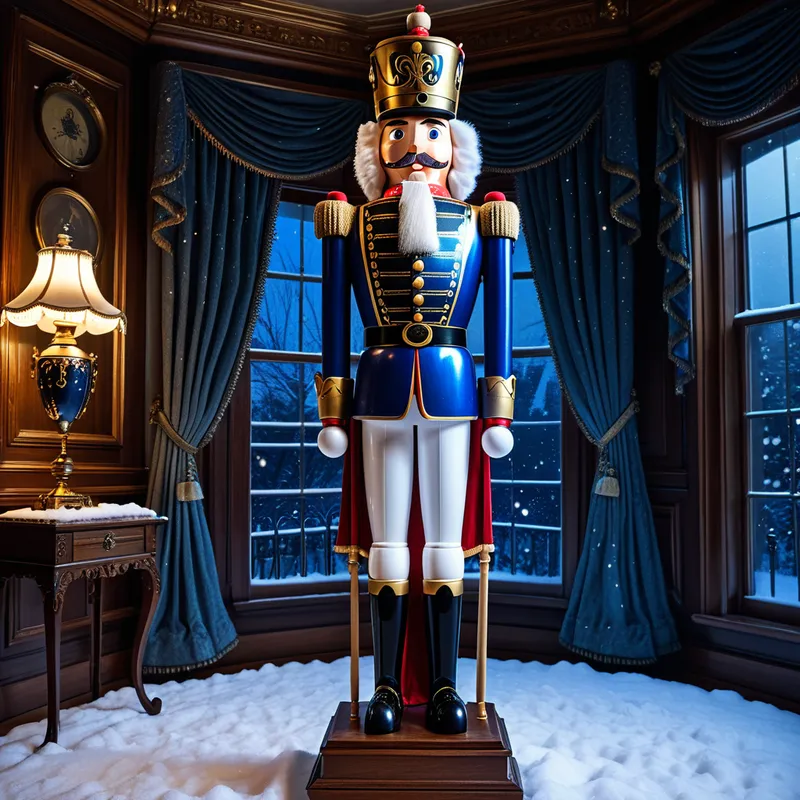
Listen, and you will hear the whisper of pine needles and the scent of marzipan on the cold night air. In the heart of a winter’s eve, in a house where the fire crackled like laughter and the shadows grew long, there lived a girl named Clara. She was given a gift: a soldier of wood and paint, a Nutcracker with a stern, noble face. But this was no ordinary toy.
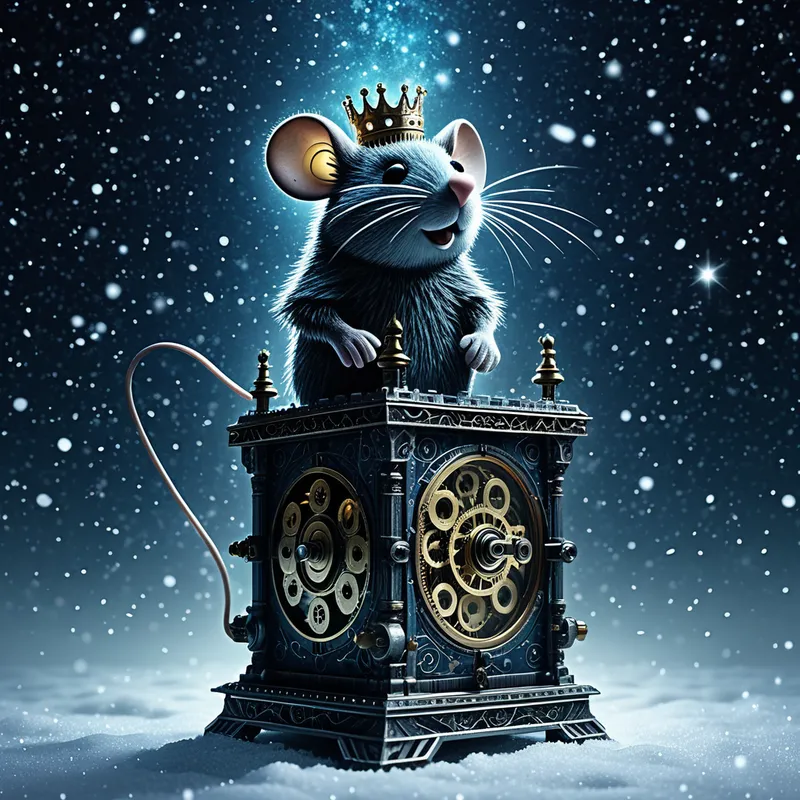
That night, when the great clock struck a ghostly hour, the room shivered. The shadows congealed into a scurrying, squeaking horde led by the Mouse King, a creature of nightmare with seven crowns upon his seven heads. The Christmas tree seemed to grow to the ceiling, and the toys awoke. The Nutcracker, Clara’s wooden soldier, drew his tiny sword. A battle raged across a floor that became a snowy plain, beneath a tree that became a forest. But the Nutcracker was outnumbered, his form too stiff, his curse too heavy.
Just as the Mouse King’s teeth gleamed in victory, Clara, in a surge of courage born of love, threw her slipper. It struck the monstrous king, and in that moment of distraction, the Nutcracker struck true. The mouse army vanished like smoke.
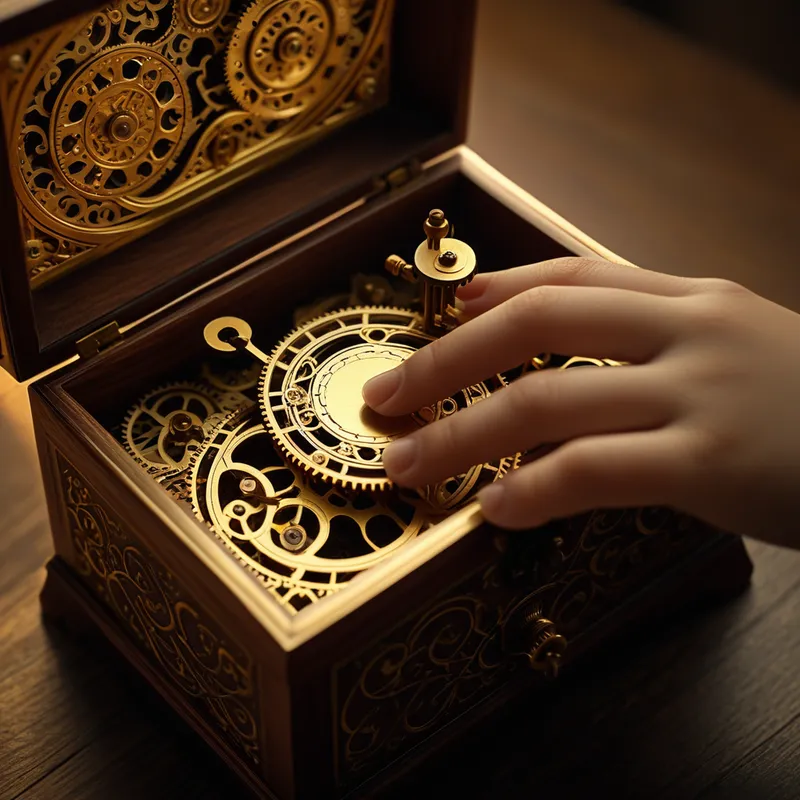
But the tale does not end with a battle. The wounded Nutcracker lay still. Then, from a place of memory and magic, a sound began. It was the sound of a Music Box, a melody spun from silver and starlight, a tune Clara knew in her bones. As its notes wound through the air, the wooden shell of the Nutcracker shimmered. The paint softened into flesh, the rigid joints became supple, and the stern face blossomed into the gentle smile of a young prince. The music box had played the key to his soul. The curse was broken not by the sword, but by the song it unlocked.
The prince led Clara through a land of dancing snowflakes to the Kingdom of Sweets, a realm where confections were architecture and joy was the only law. There, in gratitude, he revealed the truth: he was Prince Drosselmeyer's Nephew, enchanted by the very Mouse King she had helped defeat. The music box’s song was the memory of his true self, a melody that could only be heard when someone believed in the life within the wood.
Cultural Origins & Context
This myth, crystallized in E.T.A. Hoffmann’s 1816 story “The Nutcracker and the Mouse King” and later softened into the famous ballet by Tchaikovsky, is a quintessential Romantic-era fairy tale. It emerged from a culture deeply fascinated with the liminal space between childhood and adulthood, the waking world and dreams. The myth was passed down not around campfires, but in bourgeois parlors during Christmas, a time itself seen as magical. Godfather Drosselmeyer, the mysterious clockmaker, is the myth-teller—the wise, slightly dangerous uncle who brings the strange and wonderful into the safe domestic sphere.
Its societal function was twofold. For children, it validated the inner reality of their imagination, giving epic weight to a beloved toy. For adults, it was a nostalgic invocation, a reminder that the mundane world (a wooden toy, a parlor) could contain portals to the sublime (a prince, a kingdom). It served as an initiatory story for the Christmas season, framing the holiday not just as a celebration, but as a time when miracles of transformation are possible.
Symbolic Architecture
At its core, the myth is a profound map of psychic integration. The Nutcracker represents the complex—a bundle of thoughts, feelings, and memories—of the noble Self, trapped in a hardened, functional, but unlived form. He is potential encased in protection, a prince locked in the rigid armor of duty, trauma, or societal expectation.
The curse is always a story waiting for its key. The rigid form is not the truth, but the protector of a truth too tender for the world.
The Mouse King is the shadow of the petty, gnawing, multiplying anxieties and unresolved fears that seek to keep the Self imprisoned. He is the collective weight of doubt, cynicism, and the “realistic” voices that deny magic. The battle is the necessary inner conflict that must be engaged to claim one’s sovereignty.
Clara represents the conscious ego, the “I,” who possesses the courage to intervene. Her act—throwing the slipper—is an act of feeling (Jung’s Eros) in the face of brute force (Logos). She does not fight the battle for the Nutcracker, but she creates the opening for his victory. She is the human agent of belief.
The Music Box is the ultimate symbol. It is the mandala of the soul—a perfect, contained, mechanical system that, when activated, produces the harmonious pattern (the melody) that restores order. It is the memory of wholeness, the encoded blueprint of the true personality. Its winding is the act of attention and love; its song is the manifestation of the Self.
The Dreamer's Resonance
When this myth appears in modern dreams, the dreamer is at the threshold of a profound inner release. To dream of a music box that won’t play, or plays a distorted tune, speaks to a disconnect from one’s core identity or life’s purpose. The somatic feeling is often one of constriction in the chest or jaw—the body itself feeling “wooden.”
Dreaming of a Nutcracker, especially one that seems alive or in distress, indicates that a part of the dreamer’s noble, capable Self is felt to be trapped, perhaps in a rigid job, a lifeless role, or a pattern of emotional defense. The battle with rodent-like figures points to an active, often exhausting, psychological conflict with nagging insecurities or a swarm of small problems that feel overwhelming.
The resolution in the dream—hearing the clear, beautiful melody from the box—is the psyche’s signal that the key has been found. This often corresponds with a waking-life insight, a recovered memory, or a moment of self-compassion that begins to soften the protective shell, initiating a process of thawing and transformation.
Alchemical Translation
The myth models the alchemical process of individuation—the journey from a leaden, unconscious state to a golden, realized Self. The Nigredo, or blackening, is the Nutcracker’s cursed, wooden state: a life lived mechanically, without fluidity or heart. The battle with the Mouse King is the Mortificatio, the necessary death-struggle with the shadow, the putrefaction of old attitudes.
Clara’s intervention represents the influx of the anima (the inner feminine principle of relatedness) for a masculine-identified psyche, or the animus (the inner masculine principle of action) for a feminine-identified one. It is the complementary energy needed to break the stalemate.
The melody of the Self is always playing, but we must create the silent, attentive space—the wound box—within which it can be heard.
The activation of the Music Box is the Albedo, the whitening. The pure, silver melody is the sound of the transcendent function—the symbol that emerges from the unconscious to bridge the gap between the ego and the Self. It is the remembered truth that dissolves the curse.
Finally, the transformation of wood into flesh and the journey to the Kingdom of Sweets symbolize the Rubedo, the reddening or golden dawn. This is the integration of the unconscious riches into conscious life. The Kingdom of Sweets is not an escape, but a metaphor for the enjoyment of one’s own unique psychic flavors—the talents, joys, and creative energies that were once locked away. The myth teaches that liberation is not a one-time battle, but a continual remembering, a winding of the inner music box to play the timeless song of who we truly are.
Associated Symbols
Explore related symbols from the CaleaDream lexicon: