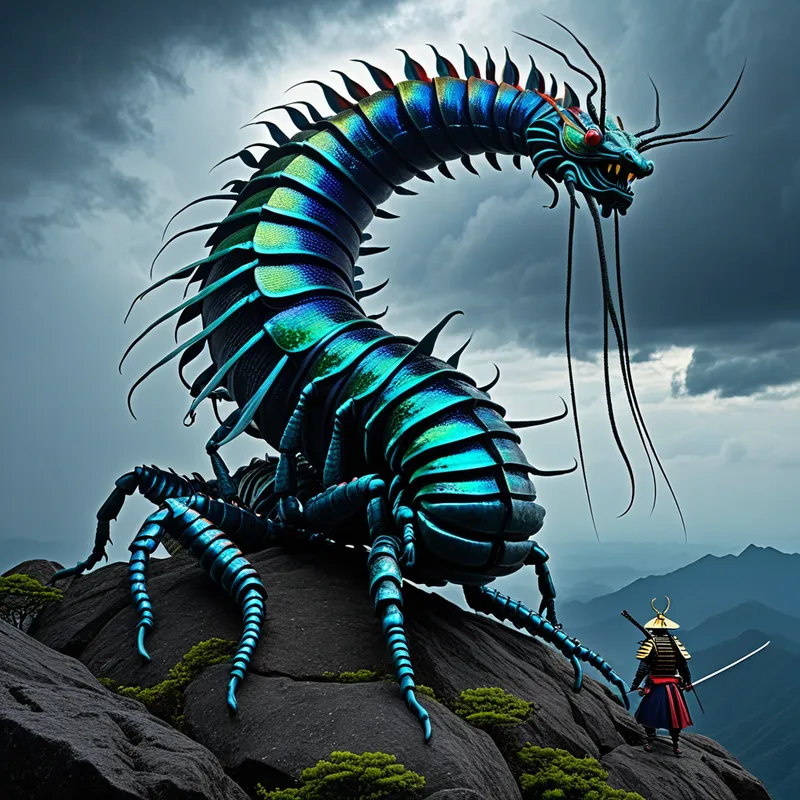
Ōmukade Myth Meaning & Symbolism
A legendary hero confronts Ōmukade, a mountain-sized centipede, in a myth of poison, power, and the alchemy of overcoming primal terror.
The Tale of Ōmukade
Listen, and hear the tale of the mountain that moved.
In the age when gods walked closer to the earth and spirits whispered in the pines, there stood a mountain named Mikami-yama. But it was a mountain under a curse. The lake at its foot, Ōmi-no-umi, churned not with fish, but with dread. For coiled around Mikami’s sacred peak was a creature of primordial nightmare: the Ōmukade. Its body was longer than the tallest pine, segmented like armored plate from a forgotten age, and supported by countless, skittering legs that carved deep furrows into the stone. Its breath was a miasma that wilted the cedars, and its appetite was insatiable, claiming cattle, then villagers, then any soul who dared approach the mountain’s shrine.
The land groaned under its oppression. Prayers to the kami seemed to fall into the creature’s gaping maw. Hope had grown as thin as the mist over the poisoned lake.
Then came the warrior. He was Fujiwara no Hidesato, a man whose name carried the weight of destiny. Drawn by the plight of the land, he stood on the shores of Lake Biwa, gazing up at the darkened mountain. The dragon-king of the lake, Ryūjin, himself tormented by the beast, rose from the depths. In a voice like shifting currents, he offered Hidesato divine aid: a bow of unbreakable yumi, arrows fletched with heron feathers, a sword that could cut mist, and a magnificent bell of protection.
Hidesato accepted only the bow and arrows. A true hero’s strength, he knew, must be his own. He began the ascent. The air grew thick and acrid. The sound was not of wind, but of a million chitinous plates rasping against rock—a dry, endless rustle that crawled into the ears and down the spine. Then he saw it. The Ōmukade reared, its antennae tasting his scent, its body a living, undulating fortress blotting out the sky. Its eyes, cold and multifaceted, fixed upon him.
It charged, a landslide of venom and legs. Hidesato nocked an arrow, drew the bowstring to his ear, and let fly. The shot was true, striking the beast’s armored flank. It shattered. Another arrow. Another shatter. The monster’s hide was impervious to steel. The Ōmukade hissed, a sound of grinding stones and triumph, and surged forward to crush him.
In that moment, suspended between life and a grisly end, memory flashed. An old folk saying: “Human saliva is poison to the centipede.” A desperate, humble alchemy. As the monstrous head descended, jaws wide enough to swallow a horse, Hidesato did not reach for another arrow. Instead, he put the final one to his own lips, bathing its tip in his spittle—the essence of his own humanity.
He drew, aimed not for armor, but for the soft, pulsing spot on the creature’s brow, and released.
The arrow flew, a silent streak. It struck the mark. A terrible, shrieking convulsion seized the Ōmukade. Not a roar of defiance, but a high, piercing whine of shock and finality. The colossal body stiffened, then began to unravel, tumbling down the mountainside in a great, decaying cascade, until at last it sank beneath the dark waters of Lake Biwa, leaving only ripples and a profound, echoing silence.
The mountain breathed again. The curse was lifted.

Cultural Origins & Context
The legend of Hidesato and the Ōmukade is preserved in texts like the Konjaku Monogatarishū and is intertwined with the lore of the real-life Fujiwara no Hidesato, a progenitor of the powerful Ōshū Fujiwara clan. This places the myth within a critical period of Japanese history where the imperial court’s authority was being tested by regional powers and the emerging samurai class. The story functioned as a foundational setsuwa, or moral anecdote, serving multiple purposes.
It was a tale of land-taming, common in many cultures, where a heroic figure subdues a chthonic monster, making the wilderness safe for human order. By linking this feat to a specific, venerated mountain and lake, it sanctified the landscape, embedding the myth into local Shinto practice. Furthermore, as a story told of a clan ancestor, it served as potent propaganda, legitimizing the Fujiwara lineage by attributing to its founder a feat of supernatural heroism that benefited the entire region. It was a narrative passed down not just for entertainment, but to explain the origin of a clan’s prestige and the sacredness of a place.
Symbolic Architecture
The Ōmukade is not merely a monster; it is a perfect symbol of the autonomous, overwhelming complex. It represents the psychic content that has grown too large, too armored, and too poisonous to ignore. It coils around the mountain—the axis mundi of the self or the community—and paralyzes it with fear, draining its vitality.
The monster is always a guardian of treasure. The terror it inspires is the measure of the power it withholds.
Hidesato represents the directed force of consciousness, the ego tasked with the heroic ordeal. His initial failure with the standard arrows signifies that conventional weapons—rationalization, suppression, force of will—are useless against such deeply entrenched, autonomous psychic material. The dragon-king’s offer of magical tools is the unconscious itself providing resources, but Hidesato’s choice to take only the bow and arrows is crucial. He accepts the structure (the bow) and the possibility of action (the arrows), but rejects the talismans that would offer externalized protection. The battle must be entered with vulnerability.
The climax, the application of human saliva, is the myth’s masterstroke of symbolism. It is the ultimate participation mystique. To defeat the inhuman, one must use the most humble, intimate, and biological essence of one’s own humanity. It is not a weapon forged, but a secretion given. This act symbolizes the integration of the shadow not through conquest from a distance, but through a shocking, intimate engagement with one’s own nature. The poison is neutralized by a substance considered base, yet utterly personal.

The Dreamer's Resonance
When the pattern of the Ōmukade myth stirs in the modern psyche, it often manifests in dreams of overwhelming, multi-legged infestations—cockroaches, spiders, or centipedes invading one’s home, or of a single, colossal insectile entity that cannot be escaped. The somatic experience is one of deep visceral revulsion, a crawling on the skin, and a feeling of being consumed by something “beneath” you.
Psychologically, this signals an encounter with an aspect of the shadow that has gained autonomous power. It might relate to a long-ignored resentment (the poison) that has grown to monstrous proportions, a compulsive pattern (the countless, repetitive legs) that has taken over one’s life, or a foundational anxiety that has “coiled around” the dreamer’s core identity (the mountain), stifling growth. The dream is the psyche’s urgent presentation of this complex. The feeling of helplessness mirrors Hidesato’s initial failed shots. The dream asks: What in your life feels like this insurmountable, poisonous, skittering presence? What have you been too disgusted or terrified to face directly?

Alchemical Translation
The myth models the complete arc of psychic transmutation, or individuation. First, there is Acknowledgment: the land (the conscious self) admits it is under siege and cannot continue as it is. Then, Confrontation: the heroic ego, perhaps reluctantly, ascends to meet the complex on its own ground.
The critical alchemical stage is the Transmutation of the Weapon. This is the move from fighting against to engaging with. The ego’s usual arsenals of blame, intellectualization, or avoidance shatter against the complex’s armor. The breakthrough comes from a surrender to a humbler, more embodied wisdom. The hero must “poison” the arrow with his own saliva—he must apply his raw, unadorned humanity to the precise point of vulnerability.
Individuation often requires us to weaponize our vulnerability, to win not by being stronger than the complex, but by being more authentically ourselves in its presence.
This act of intimate engagement neutralizes the poison. The complex, when faced not with rejection but with the full, conscious presence of the self, loses its autonomous, terrifying power. It disintegrates, returning to the unconscious waters from whence it came—not destroyed, but transformed. The “mountain” of the self is freed. The final stage is Sovereignty: Hidesato, having integrated this power, goes on to found a legendary lineage. The conquered energy of the complex becomes a source of strength and fertility for the newly integrated personality. The myth teaches that our greatest monsters guard our deepest strengths, and that the key to unlocking them lies not in a distant magic, but in the courageous, humble application of our own essential nature.
Associated Symbols
Explore related symbols from the CaleaDream lexicon: