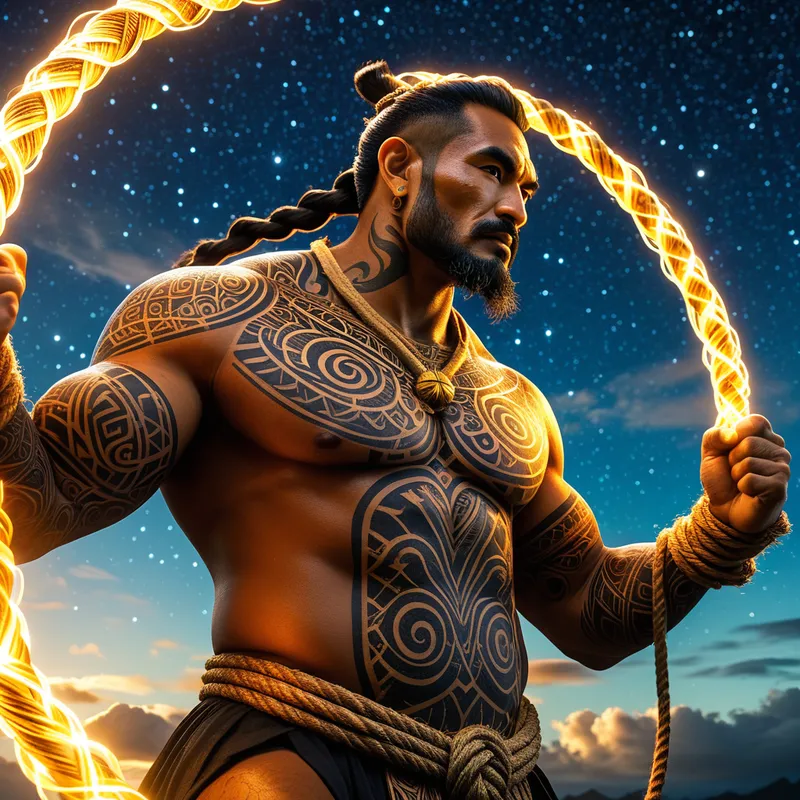
Māui and the Stars Myth Meaning & Symbolism
The trickster demigod Māui captures the sun to slow its journey, winning more daylight for humanity in a cosmic act of rebellion and creation.
The Tale of Māui and the Stars
Listen. In the time before time, when [the world](/myths/the-world “Myth from Tarot culture.”/) was young and raw, the days were cruel and fleeting. The great sun, Tama-nui-te-rā, raced across [the sky](/myths/the-sky “Myth from Persian culture.”/) with a selfish haste. His journey was a furious sprint from horizon to horizon, granting only a pitiful handful of hours for the people of [the earth](/myths/the-earth “Myth from Hindu culture.”/). In that brief, panting light, mothers could not dry their kākahu, fathers could not finish their fishing, and children could not learn the songs of their ancestors. Life was a desperate scramble in the half-light, a race against a tyrant of fire.
But there was one who watched this injustice with a cunning eye. Māui, the last-born, the miracle child fished from [the sea](/myths/the-sea “Myth from Greek culture.”/), whose blood was mixed with mortal and divine. He was a being of impossible strength and impossible cheek, a weaver of schemes that touched the very bones of the world. He heard the sighs of his people, felt the frustration in his own bones as the light vanished before work was done.
He went to his brothers, skilled fishermen all. “We will catch the sun,” he declared. They laughed, a sound like rocks tumbling in a dry creek. “You are mad, little brother. The sun burns. The sun cannot be held.”
But Māui’s will was a force of nature. From the jawbone of his ancestress, Murirangawhenua, he fashioned a mighty, enchanted rope—a cable woven from lineage, magic, and sheer audacity. He convinced his brothers to journey with him to [the pit](/myths/the-pit “Myth from Christian culture.”/) where Tama-nui-te-rā rose each morning, a vast crater at the edge of the world. The air there shimmered with impending fire.
Through the night they toiled, hiding in the shadows of the pit, laying their snares of strong flax. As the first terrible rays began to claw at the eastern sky, the brothers trembled, their courage melting like frost. But Māui stood firm, the jawbone rope coiled in his hands, his [tā moko](/myths/t-moko “Myth from Polynesian culture.”/) glowing in the pre-dawn gloom.
Tama-nui-te-rā heaved himself from his resting place, a colossal being of pure, roaring light. The flax ropes snapped like spiderwebs. The brothers cried out and hid their faces. But as the sun surged upward, Māui sprang. He cast the enchanted jawbone rope, and it flew true, a arc of ancestral power, looping around the sun’s mighty limbs of light.
The world held its breath. The sun roared, a sound that shook the mountains. It strained and flared, a captive star. Māui planted his feet against the primal earth, every muscle corded, his teeth gritted in a supreme effort. He pulled not against flesh, but against the orbit of the heavens themselves.
“Slow!” commanded Māui, his voice cutting through the cosmic din. “You will travel slowly across the sky, that my people may have time to live, to work, to be!”
A great negotiation of force ensued—the relentless push of celestial fire against the anchored pull of mortal will, empowered by lineage. Finally, wounded and weakened, Tama-nui-te-rā relented. “I will go more slowly,” he gasped. “But you must release me.”
Māui, in his wisdom, did not destroy the sun, for the world needs its fire. He loosened the bonds, and Tama-nui-te-rā began his new, measured journey across the vast dome of the sky. The days stretched long and generous. Light poured over the land like a blessing. And from that day forth, humanity had time.
Cultural Origins & Context
This myth is part of the vast oceanic corpus of stories surrounding Māui, found across the Polynesian triangle from Hawaiʻi to Aotearoa (New Zealand) to Tahiti. It was not written, but carried in the waiata (songs), the whai kōrero (speeches), and the communal memory of the whānau and hapū. Told by elders and tohunga around fires and in meeting houses, its function was multifaceted.
It was a cosmological explanation for the rhythm of day and night. It was a pedagogical tool, teaching values of ingenuity (mātauranga), communal benefit, and the respectful challenging of oppressive forces. Most profoundly, it reinforced the Polynesian worldview where the natural world (te ao tūroa) and the realm of the gods (te ao wairua) were in constant, negotiable relationship. Humans, especially those of mixed descent like Māui, were not passive subjects but active participants who could, with the right knowledge, courage, and ancestral backing, alter the very conditions of existence.
Symbolic Architecture
At its [heart](/symbols/heart “Symbol: The heart symbolizes love, emotion, and the core of one’s existence, representing deep connections with others and self.”/), this is a myth of cultural and psychological rebellion against a tyrannical natural order. The sun represents an implacable, consuming force—time itself, in its raw, indifferent [passage](/symbols/passage “Symbol: A passage symbolizes transition, movement from one phase of life to another, or a journey towards personal growth.”/). It is the pressure of [fate](/symbols/fate “Symbol: Fate represents the belief in predetermined outcomes, suggesting that some aspects of life are beyond human control.”/), the [deadline](/symbols/deadline “Symbol: A deadline symbolizes pressure, urgency, and the constraints of time in achieving goals or fulfilling obligations.”/), the inevitable cycle that rushes [life](/symbols/life “Symbol: The symbol of ‘Life’ represents a journey of growth, interconnectedness, and existential meaning, encompassing both the joys and challenges that define human experience.”/) toward its end without regard for [human](/symbols/human “Symbol: The symbol of a human represents individuality, complexity of emotions, and social relationships.”/) need.
The hero does not seek to destroy time, but to re-negotiate his relationship with it, to win space for consciousness within its flow.
Māui embodies the archetypal [trickster](/symbols/trickster “Symbol: A boundary-crossing archetype representing chaos, transformation, and the subversion of norms through cunning and humor.”/)-[hero](/symbols/hero “Symbol: A hero embodies strength, courage, and the ability to overcome significant challenges.”/), who uses wit and craft (the jawbone rope) rather than brute force alone. The jawbone is a profound [symbol](/symbols/symbol “Symbol: A symbol can represent an idea, concept, or belief, serving as a powerful tool for communication and understanding.”/): it is a tool fashioned from an [ancestor](/symbols/ancestor “Symbol: Represents lineage, heritage, and the collective wisdom or unresolved issues passed down through generations.”/), representing the power of [lineage](/symbols/lineage “Symbol: Represents ancestral heritage, family connections, and the transmission of traits, values, and responsibilities across generations.”/), tradition, and inherited [knowledge](/symbols/knowledge “Symbol: Knowledge symbolizes learning, understanding, and wisdom, embodying the acquisition of information and enlightenment.”/). It is not a [weapon](/symbols/weapon “Symbol: A weapon in dreams often symbolizes power, aggression, and the need for protection or defense.”/) of destruction, but a tool of binding and negotiation. Māui’s act is one of sacred defiance. He does not kill the sun; he wounds it into a new [covenant](/symbols/covenant “Symbol: A binding agreement or sacred promise between parties, often carrying deep moral, spiritual, or social obligations and consequences.”/). This reflects a deep ecological and psychological wisdom: transformation, not annihilation, is the goal.
The lengthened day symbolizes the hard-won [space](/symbols/space “Symbol: Dreaming of ‘Space’ often symbolizes the vastness of potential, personal freedom, or feelings of isolation and exploration in one’s life.”/) for culture—for work, art, [family](/symbols/family “Symbol: The symbol of ‘family’ represents foundational relationships and emotional connections that shape an individual’s identity and personal development.”/), and [reflection](/symbols/reflection “Symbol: Reflection signifies self-examination, awareness, and the search for truth within oneself.”/). It is the victory of human time (wā for purposeful living) over chronological time.
The Dreamer’s Resonance
When this myth stirs in the modern [psyche](/myths/psyche “Myth from Greek culture.”/), it often manifests in dreams of frantic chasing, of deadlines that morph into monsters, or of a sun that sets too quickly, plunging the dreamer into darkness before a task is complete. Somaticly, one may feel a constant, low-grade tension, a feeling of being “burned by time,” or of breathlessness.
To dream of being Māui, attempting to lasso a speeding star or a runaway train, signals an active, heroic confrontation within the psyche. The dreamer is in the process of grappling with a force that feels larger than them—often the demands of work, societal expectations, or a personal sense of life rushing away unused. The dream is a somatic rehearsal for asserting one’s will, for saying, “This pace is not sustainable. I must make time for what matters.”
Conversely, to dream of being the sun, being captured and slowed, may indicate a part of [the self](/myths/the-self “Myth from Jungian culture.”/) that is overactive, burning too brightly and too fast, needing to be restrained and integrated into a more sustainable rhythm.
Alchemical Translation
The individuation process, the journey toward psychic wholeness, requires exactly the kind of rebellion Māui models. Each of us lives under a “personal sun”—a complex of internalized drives, parental voices, societal clocks, and unconscious compulsions that dictate our pace and consume our energy. This complex races across our inner sky, leaving our authentic selves in shadow, without time to develop.
The first act of soul-making is to journey to the eastern pit of one’s own life, to where this compulsive energy rises, and to confront it with the rope of one’s own hard-won consciousness.
The “enchanted jawbone” we must fashion is our unique tool of consciousness. It is woven from our ancestry (understood psychologically, not just genetically), our wounds, our learned skills, and our deepest values. It is our analysis, our creative practice, our spiritual discipline, our therapy—the specific means by which we can grasp and hold a problematic energy.
The alchemical work is not to eliminate our drive, our ambition, or our vitality (the sun), but to wound it—to humble its tyrannical aspect—and force a new negotiation. We bind our rampant productivity to make space for rest. We slow our anxious thoughts to make space for feeling. We challenge the inner voice that says “hurry” to create room for being. The resolution is a new covenant within the self, where energy serves life, rather than life being sacrificed to energy. We win, from the cosmos of our own psyche, a longer, more generous day in which our humanity can fully ripen.
Associated Symbols
Explore related symbols from the CaleaDream lexicon: