Muhammad's Night Journey Myth Meaning & Symbolism
The Prophet Muhammad is transported from Mecca to Jerusalem and ascends through the heavens, meeting past prophets and receiving divine revelation before returning.
The Tale of Muhammad's Night Journey
In the deep well of the Arabian night, when the world forgets itself in sleep, a crack appeared in the fabric of the mundane. It was in the Haram of Mecca, a place where the scent of old stone and devotion hung heavy in the air. The man, weary from the weight of a message too vast for any one heart, had laid his body down to rest. But his soul was summoned.
They came to him then, the Mala'ika. With a touch that was both an ending and a beginning, they opened his chest. Not with violence, but with the precision of a divine surgeon. They washed his heart in water from the well of Zamzam, a liquid more pure than snow, filling the cavity with faith and wisdom. The seal of prophecy was set upon him, cool and irrevocable.
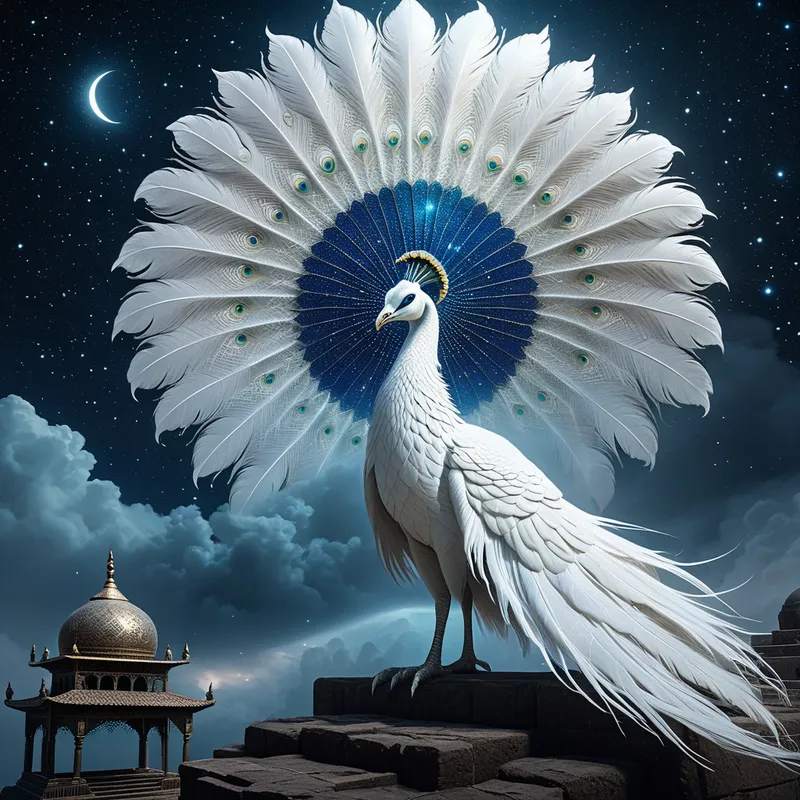
Then it was brought: the Buraq. A creature of light and paradox, its coat the white of a full moon, its face intelligent and mild, its tail a fan of shimmering jewels. It shied at first, unused to any burden but the pure in spirit. "Be still," whispered Jibril, whose presence was a towering column of light. "For none has ridden you more honored than Muhammad." And the Buraq knelt.
The journey was not through space, but across the map of the soul. In a single heartbeat, the deserts of Hijaz blurred beneath them. They arrived at the Al-Masjid al-Aqsa. There, in that hallowed ground, all the Anbiya were gathered—Ibrahim, Musa, Isa—a congress of light from across time. He led them in prayer, this final prophet, uniting the lineage of revelation in one prostrate form.
But the ascent had only begun. From the sacred rock, a ladder of light pierced the vault of heaven. Jibril guided him upward, through seven spheres, each a world and a test. In the first heaven, he met Adam, who turned to greet his descendants with a smile of sorrow and hope. Higher still, in the second, the prophets Yahya and Isa shone like twin stars. In the third, Yusuf, whose beauty was such that the moon had split in envy. In the fourth, Idris welcomed him; in the fifth, Harun; in the sixth, Musa, who wept for the mercy granted to Muhammad's people.
At the threshold of the seventh heaven sat Ibrahim, his back against the Bait al-Ma'mur. Beyond lay the Sidrat al-Muntaha. Its leaves were like the ears of elephants, its fruits like clay jars. A river of light flowed at its roots. Here, Jibril halted. "I cannot go further. If I take one more step, I will be consumed."
Alone now, propelled by a pull at the very core of his being, Muhammad traversed the veil. He entered the presence of the Divine. No eye has seen, no ear has heard, nor has it occurred to the heart of man. Words were exchanged—a dialogue of eternity and time. The command for fifty daily prayers was given. On his return, Musa, the wise intercessor, urged him to seek reduction for his people. Again and again, Muhammad returned to that presence, until the obligation was tempered to five. Mercy was woven into the fabric of law.
Then, descent. The return to the still-warm bed in Mecca, the night not yet old. A cup had been overturned, its contents still dripping. The journey of a lifetime had happened in less than a blink of the world's eye. He was the same man, and he was utterly, irrevocably changed.
Cultural Origins & Context
The account of the Isra and Mi'raj is rooted in the earliest Islamic sources, primarily the Hadith literature and alluded to in the Qur'an. Its transmission was oral, a sacred secret initially shared only with trusted companions before becoming a cornerstone of communal belief. The story emerged during a period of profound crisis for the Prophet and the early Muslim community in Mecca—a time of intense persecution, loss, and isolation known as the "Year of Sorrow."
Societally, the myth functioned on multiple levels. For the beleaguered faithful, it was a divine validation of their Prophet and a miraculous reassurance of God's support. It established Jerusalem as the first Qibla, spiritually linking the new faith with the older Abrahamic traditions. The institution of the five daily prayers (Salat), presented as the "gift" of the journey, provided the rhythmic, structural backbone of Islamic devotional life. The tale was not merely a biography of an event but a map of the cosmos and the soul's potential, told and retold to inspire awe, reinforce theological principles, and offer a template for the believer's own spiritual ascent.
Symbolic Architecture
At its heart, the Night Journey is the archetypal map of the soul's voyage from the particular to the universal, from the earthly mosque to the divine presence.
The journey outward is always a journey inward. The heavens traversed are not places, but states of consciousness.
The Buraq represents the purified vehicle of intuition and imagination—that faculty which can traverse impossible distances when tamed by sincerity. The opening and cleansing of the chest is the quintessential initiatory ordeal: the old self must be surgically prepared to contain a revelation that would shatter an unprepared vessel. The ascent through the seven heavens mirrors the shedding of planetary influences or the seven layers of the ego, each meeting with a prophet representing the integration of a specific spiritual virtue or legacy.
The Sidrat al-Muntaha is the ultimate symbol of the boundary of human comprehension, the point where form dissolves into pure essence, and guidance (Jibril) must fall away so direct experience can occur. The negotiation for the prayers is profoundly psychological: it depicts the necessary dialogue between the boundless aspiration of the spirit and the compassionate understanding of human limitation. The return to Mecca, with time itself bent, signifies the reintegration of the transcendent experience into the fabric of daily life—the mystic must come back to the marketplace, changed.
The Dreamer's Resonance
When this mythic pattern stirs in the modern unconscious, it often manifests in dreams of sudden, miraculous travel—finding secret doors in familiar walls, flying over cityscapes, or arriving instantly at a destined, sacred place. The dreamer may experience a somatic sensation of being "opened" or cleansed, a profound emotional release often accompanied by tears or awe upon waking.
Psychologically, this signals a critical phase of psychic reorganization. The ego is being forcibly expanded to accommodate a new level of awareness or a calling that feels both immense and terrifying. The dreamer is undergoing their own Mi'raj: an ascent through the layered complexes of their personal history (the seven heavens), meeting internalized authority figures and past selves (the prophets), to confront the ultimate boundary of their own identity. The journey promises a direct encounter with the Self (the divine presence), but it demands everything. The return is just as crucial—the dream often ends with the dreamer back in their room, tasked with the difficult alchemy of bringing the unutterable vision back into ordinary life.
Alchemical Translation
The Night Journey is a master narrative of psychic transmutation, a roadmap for the individuation process. It begins with the nigredo: the "dark night" of crisis in Mecca, the feeling of being stuck, persecuted by one's own psyche or circumstances. The cleansing of the heart is the albedo—the purification, the washing away of psychic dross to achieve the necessary clarity and receptivity.
The celestial ascent is the citrinitas, the dawning of the golden light of understanding, where one consciously encounters and integrates the archetypal forces within (the prophets as internal guides and completed aspects of the personality).
The encounter at the Sidrat al-Muntaha represents the ultimate confrontation with the unconscious—the Self in its raw, numinous form. This is the rubedo, the reddening, the fiery marriage of the individual consciousness with the transpersonal. But the alchemy is not complete with ecstasy. The true work is in the return and the negotiation. The reduction of the fifty prayers to five is the critical step of coagulatio: the condensation of the infinite revelation into a sustainable, repeatable, embodied practice. It is the translation of the oceanic experience into the daily ritual, the divine law into human rhythm.
For the modern individual, the myth instructs: your deepest crisis may be the call to journey. Purify your intention (the Buraq). Be willing to have your old self reconfigured. Ascend through your own layered psyche, acknowledging the wisdom of the "prophets" within—your inner child, your critic, your guide. Approach your own boundary. But then, you must return. Your triumph is not in staying in the heavens, but in grounding the vision. Translate the overwhelming revelation into a simple, daily practice—five moments of mindfulness, five expressions of gratitude, five breaths of return. The miracle is not in the flight, but in the fact that you can come back to your same life, and find it, and yourself, utterly transformed.
Associated Symbols
Explore related symbols from the CaleaDream lexicon: