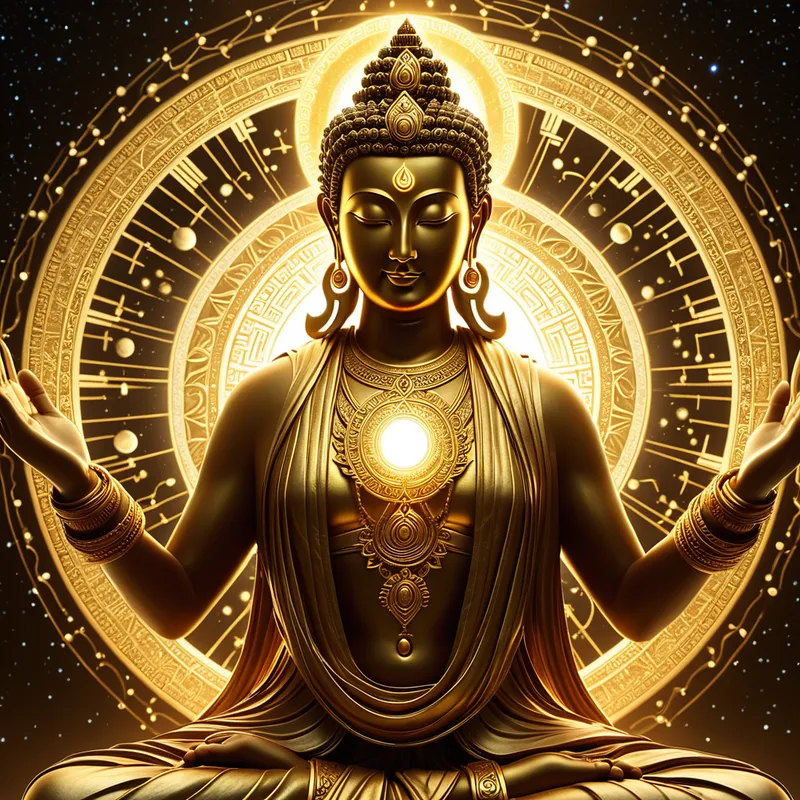
Mudra of Giving/Receiving Myth Meaning & Symbolism
A mythic tale of a bodhisattva's vow, manifesting as a sacred hand gesture that dissolves the illusion of separation between self and other.
The Tale of Mudra of Giving/Receiving
Listen. Before time was counted in breaths, in a realm where thought crystallizes into form, there existed a being of boundless resolve, a bodhisattva named Avalokiteshvara. This was not a realm of earth or sky, but of pure potential, a vast, silent plain of luminous mist. Avalokiteshvara sat in meditation, their consciousness a vast net cast across the suffering of all worlds. They heard it all—the sharp cry of birth, the weary sigh of age, the silent scream of fear, the hollow ache of loss. Each sound was a hook in their heart.
The weight of this hearing became a mountain upon their spirit. They vowed to empty the oceans of sorrow, but for every tear they wiped away, a thousand more sprang forth. The sheer magnitude of suffering began to fracture their luminous form. In a moment of supreme tension, feeling the very core of their vow strain against the impossible reality of pain, Avalokiteshvara raised their hands.
The right hand lifted, palm outward, fingers soft yet poised. This was not a push, but an offering, an opening. From this palm flowed not gold or jewels, but the very substance of their own cultivated merit—peace, courage, understanding—a river of luminous, cooling nectar. Simultaneously, the left hand turned, palm upward, cupped like a vessel at the heart. This was not a grab, but an acceptance, a profound humility. Into this vessel, Avalokiteshvara drew the thick, dark smoke of the world’s anguish—the poisons of hatred, greed, delusion, the cold knots of fear.
The cosmos held its breath. Here was the divine paradox made gesture: to give everything, one must first receive everything. The nectar flowing out and the poison flowing in met at the bodhisattva’s heart. There was no barrier. The dark smoke, upon touching the boundless compassion at their core, did not defile it. Instead, it was transformed. In the alchemical furnace of Avalokiteshvara’s vow, the poison itself became the fuel for more nectar, the suffering became the substance of liberation. The gesture became eternal, a dynamic, silent teaching written in the air itself—the Mudra of Giving and Receiving, forever turning the wheel of compassion.
Cultural Origins & Context
This mythic narrative is not found in a single sutra but is woven from the tapestry of Mahayana Buddhist thought and tantric practice. It is central to the mind-training teachings known as Tonglen, which means "giving and taking." While Avalokiteshvara is the archetypal figure, the story is transmitted as an internal, psychodramatic instruction from teacher to student.
Its primary function is not entertainment but radical re-education of the heart-mind. It was passed down in the whispered instructions of meditation masters in the Himalayas, in the silent monasteries of Tibet, and in the visualized journeys of tantric practitioners. Societally, it served as an antidote to the primal human instinct of self-preservation at all costs. It taught that the community’s suffering is one's own, and that personal peace is inextricably linked to the peace of all. The myth provided the symbolic architecture for a practice that turns the ego’s logic inside out, making the compassionate impulse not just a moral ideal, but a breath-by-breath technology of transformation.
Symbolic Architecture
The myth’s power lies in its dismantling of duality. The two hands are not two separate actions, but two poles of a single, continuous circuit.
The right hand, giving, symbolizes the active expression of our highest nature—our love, our resources, our forgiveness. It is the sun, shining without asking for anything in return.
The left hand, receiving, symbolizes the passive, crucible-like capacity to hold the unbearable. It is the earth, accepting all rain and decay without complaint. It is the shadow’s integration.
Psychologically, the "poison" represents everything the conscious ego seeks to reject: our own hidden shame, rage, vulnerability, and the projected darkness we see in others. The "nectar" represents our latent wholeness, our buddha-nature. The myth insists that these are not enemies, but locked in a necessary dance. The heroic figure of Avalokiteshvara represents the Self (in the Jungian sense)—the organizing principle of the total psyche that can hold this profound contradiction. The fracturing of their form is the ego’s crisis when faced with the totality of life’s pain; the mudra is the resolution born from a deeper center.
The Dreamer's Resonance
When this mythic pattern stirs in the modern dreamer, it often manifests as dreams of impossible exchanges. You may dream of breathing in thick, black smoke from a dying fire and breathing out clear light. You may dream of holding a crying child who morphs into your own face. You may dream your hands are stuck—one forever pushing something away, the other forever clutching something tight.
Somatically, this signals a process at the threshold of the heart chakra, a literal feeling of tightness in the chest giving way to a painful but liberating expansion. Psychologically, you are navigating a profound renegotiation of boundaries. The ego’s defensive walls, which once felt like safety, now feel like a prison. The dream is modeling the psyche’s innate intelligence attempting to heal the split between "what is mine" (to be kept) and "what is yours" (to be rejected). It is the unconscious initiating a practice of Tonglen on your behalf, teaching you to metabolize projected pain and reclaim disowned power.
Alchemical Translation
For the individual on the path of individuation, this myth is a masterclass in psychic transmutation. The core struggle is the ego’s terror of being contaminated by the shadow, by the world’s pain, by one’s own hidden depths. The triumph is the realization that the Self is not a fragile vase to be kept pure, but a philosopher’s stone that turns base metal into gold.
The alchemical operation here is solve et coagula: dissolve and coagulate. You must dissolve the rigid boundary of the ego (the illusion that you can give without receiving, or receive without being changed). You must then coagulate a new, more expansive identity from the dissolved elements.
The modern translation is this: Your capacity for joy is exactly equal to your capacity to hold grief. Your ability to offer love is forged in the willingness to feel heartbreak. The practice is to consciously, in small moments, reverse the ego’s flow. When you feel aversion—to a person, a memory, an emotion—breathe it in. Acknowledge it as a part of the universal human experience you share. When you feel a spark of joy or peace, breathe it out, offering it mentally to all. This is not martyrdom, but the ultimate self-interest, for it heals the fracture within. You are not Avalokiteshvara vowing to save the world. You are the world, vowing to save itself through the conscious gesture of your own, humble, human heart. The mudra is completed not in a celestial realm, but in the space between your next in-breath and your next out-breath.
Associated Symbols
Explore related symbols from the CaleaDream lexicon: